Clear Sky Science · en
Cortical-limbic circuit dynamics of approach-avoidance conflict in humans
Why everyday choices can feel so tense
Deciding whether to step forward or pull back is a constant part of daily life: Do you introduce yourself to a stranger, ask for a raise, or walk down a dark street? These moments mix the promise of reward with the risk of loss, and they can feel especially painful for people with anxiety, who often end up avoiding opportunities altogether. This study asks a deceptively simple question: what exactly is going on inside the human brain, in real time, when we weigh these approach‑and‑avoid choices?
A video‑game window into anxious decisions
To explore this, researchers turned a classic arcade idea into a laboratory tool. Twenty epilepsy patients undergoing presurgical evaluation played a Pac‑Man–style game while electrodes placed directly on their brains recorded electrical activity. On each trial, a Pac‑Man figure could move toward valuable dots while a ghost paced at the far end of a corridor. The closer players moved toward the ghost, the more reward they could earn—but the higher the chance of a ghost “attack” that would wipe out their points and cost a life. At any time, they could turn around and retreat to safety. An online sample of 191 volunteers played the same game, confirming that it reliably provoked feelings like anxiety, stress, and suspense, and that people traded off risk and reward in sensible ways.
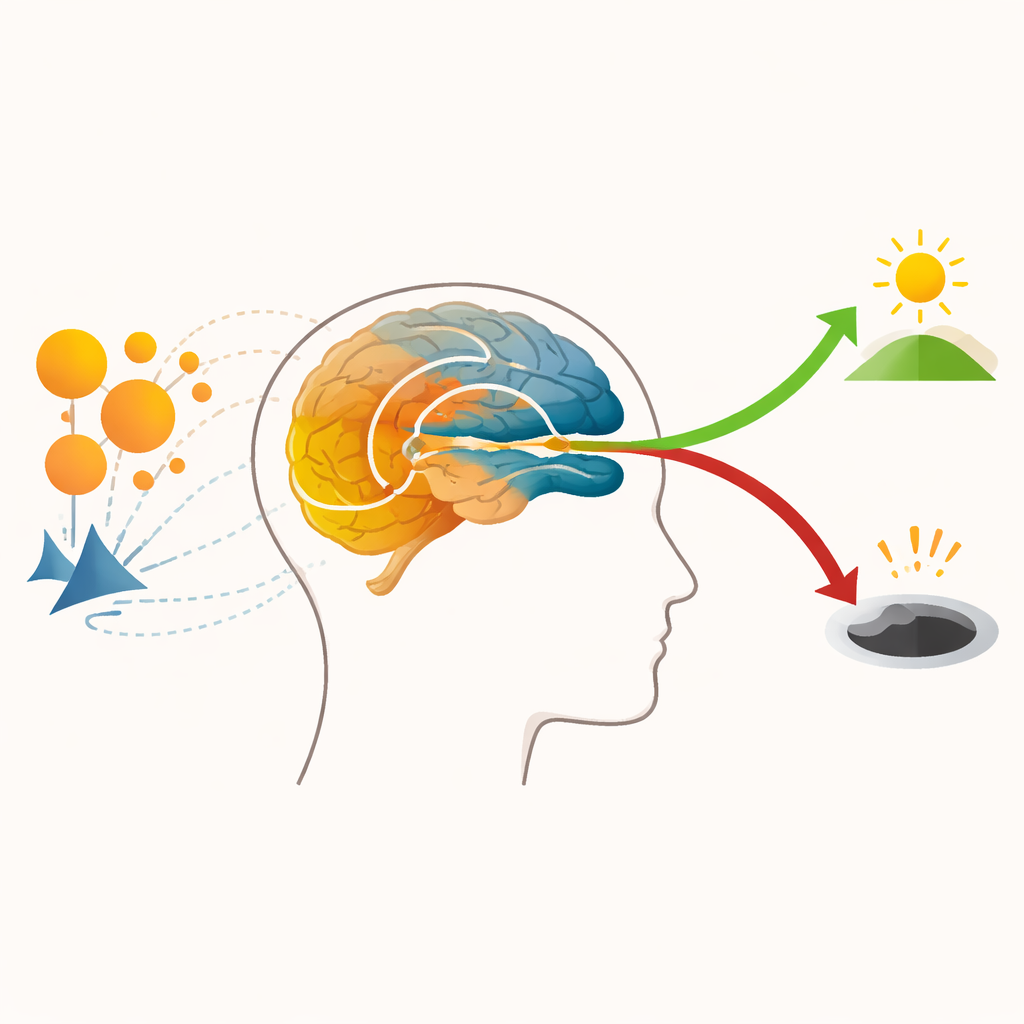
A rhythm in deep brain regions that signals moving toward danger and reward
The team focused on a set of deep and frontal brain regions long linked to emotion and control: the hippocampus and amygdala, which help register context and threat; the orbitofrontal cortex and anterior cingulate cortex, which track value and conflict; and a lateral frontal area called the middle frontal gyrus, associated with planning and regulation. They examined brain waves in the theta range—slow, 3–8‑cycle‑per‑second rhythms thought to help distant brain areas communicate. During the part of each trial when players moved toward the ghost, theta activity rose in the hippocampus, amygdala, orbitofrontal cortex, and anterior cingulate. As soon as players chose to turn back and avoid further risk, theta power in these areas dropped. This pattern appeared only when real threat was present; in trials without a ghost, approaching and then turning back did not produce the same theta shifts, suggesting the signal was tied to conflict between reward and danger rather than simple movement or reward alone.
Brain regions syncing up as conflict builds
Beyond local rhythms, the researchers asked how strongly these areas worked together. They measured how synchronized the theta waves were between pairs of regions, a bit like checking whether distant orchestras are keeping the same beat. As players advanced toward the ghost, theta synchrony across the network steadily climbed, peaking just before they chose to turn around. Once they began retreating, synchrony fell. Importantly, trials where this network was more tightly synchronized were also trials in which players spent longer approaching, willing to tolerate more risk to gain more reward. Detailed analyses showed that deep structures such as the amygdala often led the timing of theta waves in orbitofrontal and cingulate regions, while the lateral frontal cortex also drove theta activity in these same hubs. Together, this suggests that information about threat and control converges in orbitofrontal and cingulate cortex, which may then help resolve the conflict between advancing and escaping.
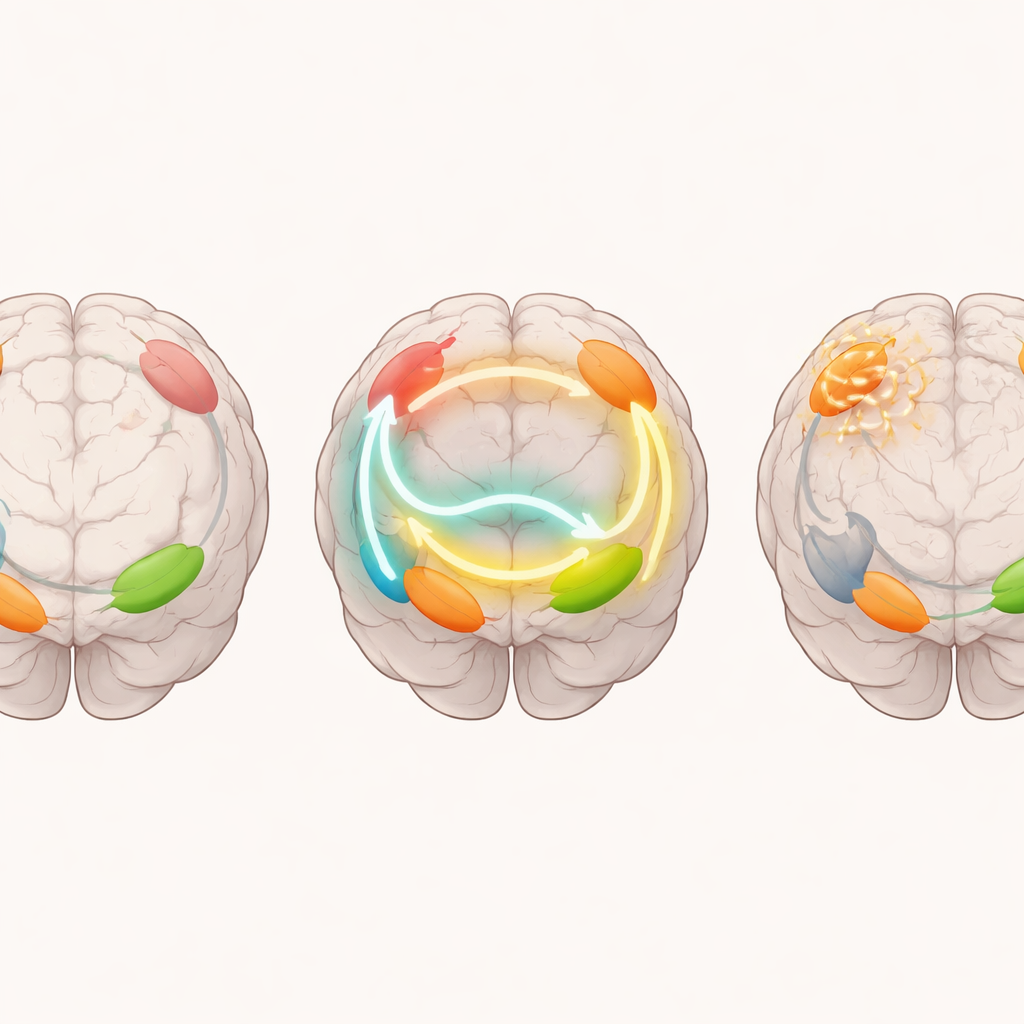
A different frontal signal when danger becomes immediate
The game also allowed the team to zoom in on moments when threat shifted from distant and uncertain to immediate and inescapable. When a ghost suddenly lunged toward Pac‑Man, theta power in the deep emotional regions again dropped after players turned away. But a different signal surged in a patch of right lateral frontal cortex: high‑frequency activity, a fast, broadband flicker of electrical power linked to bursts of local neuronal firing. This high‑frequency signal was strongest when the attack was truly dangerous—trials where Pac‑Man was doomed to be caught no matter what—and faded more quickly when escape was possible. That pattern suggests that this right frontal zone tracks how severe and pressing the threat feels, potentially providing a rapid control signal to guide emergency escape behavior.
What these brain signals may mean for anxiety
Taken together, the results reveal a dynamic conversation between deep emotional centers and frontal control regions as people face approach‑avoidance conflict. A slow, shared rhythm coordinates the network while threat and reward are being weighed, ramping up as conflict intensifies and relaxing once a choice to retreat is made. When danger becomes immediate, a fast, localized frontal signal comes online to track and manage acute threat. For people whose lives are dominated by avoidance—such as those with generalized anxiety, social anxiety, or agoraphobia—these findings offer a more detailed circuit‑level picture of what may be misfiring. In the long run, understanding these rhythms and pathways could help guide new treatments that gently adjust network coordination, supporting healthier decisions about when to step forward and when to step back.
Citation: Staveland, B.R., Oberschulte, J., Berger, B. et al. Cortical-limbic circuit dynamics of approach-avoidance conflict in humans. Nat Commun 17, 3867 (2026). https://doi.org/10.1038/s41467-026-70287-5
Keywords: anxiety, approach-avoidance conflict, theta oscillations, prefrontal-limbic circuit, intracranial EEG