Clear Sky Science · en
Dual-metal-doped perovskite adsorbents for efficient removal of humic acid
Why cleaner water matters
Tap water may look clear, but it often carries invisible natural organic matter formed from decaying plants and animals. One key component, humic acid, is not dangerous by itself—but during disinfection it can react with chlorine to form cancer‑linked byproducts. This study introduces a new, magnetically separable material that can quickly pull humic acid out of water and then be refreshed for reuse, offering a practical way to make drinking water safer while cutting waste and energy use. 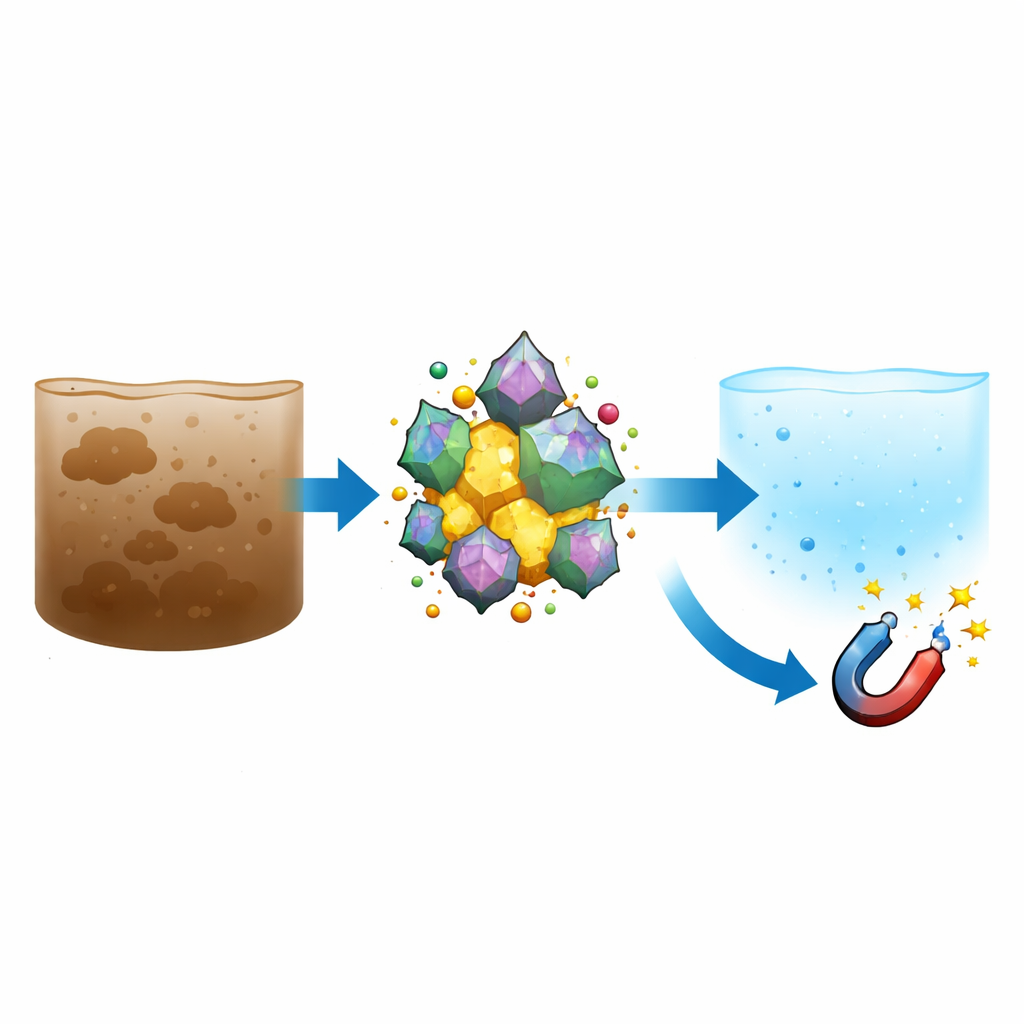
A smart sponge built from crystal blocks
The researchers focused on a family of crystalline materials called perovskite oxides, choosing a compound known as LaFeO3 as the starting point. By swapping some of the iron atoms inside the crystal with two other metals—titanium and cobalt—they created a dual‑doped version dubbed LFCTO. This tuning changed how the atoms are arranged, increasing tiny pores, surface area, and the number of defects where incoming molecules can stick. Electron microscopy and X‑ray techniques confirmed that the crystal structure stayed intact while these modifications produced a porous, block‑like network ideal for trapping humic acid from water.
How the new material grabs pollution
To test performance, the team compared the original LaFeO3 with single‑metal‑doped and dual‑metal‑doped versions in humic‑acid‑contaminated water. All the modified materials worked better than the original, but LFCTO with a particular composition (called LFCTO‑0.3) stood out. It removed up to 97% of humic acid at typical concentrations and reached a very high maximum capacity of 381 milligrams of humic acid per gram of adsorbent. The material works best at neutral to mildly acidic pH, similar to natural waters, where its surface is positively charged and strongly attracts the negatively charged humic acid. Computer models of the molecule’s charge distribution at different pH values backed up these results, showing stronger electrostatic attraction under these conditions. 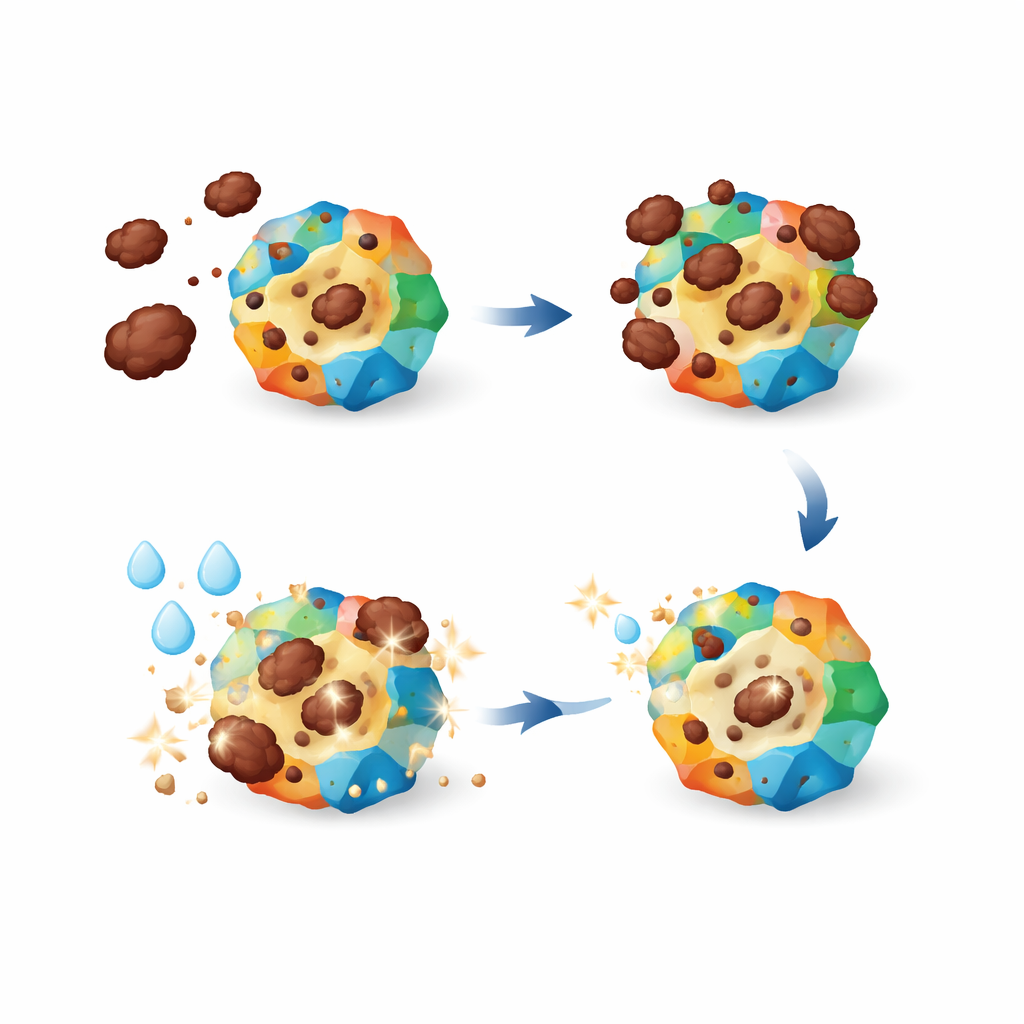
Inside the capture process
Detailed measurements revealed that humic acid attaches to LFCTO mainly through chemical bonding rather than weak physical sticking. Adsorption happened faster and more completely at higher temperatures, indicating a spontaneous, heat‑absorbing process that becomes more favorable as water warms. Gas‑sorption tests showed that the optimal LFCTO sample had the largest surface area and well‑connected mesopores, improving contact between the water and active sites. Low‑field nuclear magnetic resonance measurements indicated that water molecules bind more tightly to LFCTO than to the undoped material, signaling a more water‑friendly surface. Quantum‑chemical calculations further suggested that the dual metal combination increases the number and strength of interaction spots between the humic acid molecules and the crystal surface.
A reusable magnet for dirty water
Beyond simply trapping pollution, this material is designed to be reused. Cobalt and iron in the crystal can activate hydrogen peroxide to generate highly reactive radicals in a Fenton‑like reaction. After the adsorbent is saturated with humic acid, it can be pulled out of water with a magnet, contacted with dilute hydrogen peroxide, and the attached humic acid is chemically broken down right on the surface. Experiments showed that after five adsorption‑regeneration cycles, the material still removed nearly 90% of humic acid, while its crystal structure remained stable and metal leaching stayed well below discharge limits. In continuous fixed‑bed column tests, the material maintained strong performance over more than 280 hours, regenerating in minutes instead of the high‑temperature or solvent‑heavy steps that many existing adsorbents require.
What this means for safer, greener water
To a non‑specialist, the main message is that the authors have built a kind of smart, magnetic sponge that not only soaks up troublesome natural pollutants from water but also cleans itself with a mild chemical rinse. By combining strong, fast uptake of humic acid with easy magnetic recovery and rapid, low‑energy regeneration, this dual‑metal‑doped perovskite could simplify water treatment and reduce waste. If scaled up, such materials could help utilities remove natural organic matter more effectively, lowering the formation of cancer‑linked byproducts during disinfection and contributing to safer, more sustainable drinking water systems.
Citation: Zhao, L., Li, Q., Han, S. et al. Dual-metal-doped perovskite adsorbents for efficient removal of humic acid. Nat Commun 17, 3831 (2026). https://doi.org/10.1038/s41467-026-70286-6
Keywords: humic acid removal, magnetic adsorbent, perovskite oxide, water treatment, advanced oxidation