Clear Sky Science · en
Climate response to Nature Future scenarios in a regional Earth System Model
Why future land choices matter for Europe’s climate
As Europe races to fight both global warming and the loss of nature, many new plans lean heavily on the land: more protected areas, more trees, more restored habitats, and more sustainable farming. This study asks a deceptively simple question with big consequences for daily life: if we actually reshape Europe’s landscapes to meet new biodiversity and climate goals, how will that land reshape the climate we experience—especially heat and rainfall—by the middle of this century?
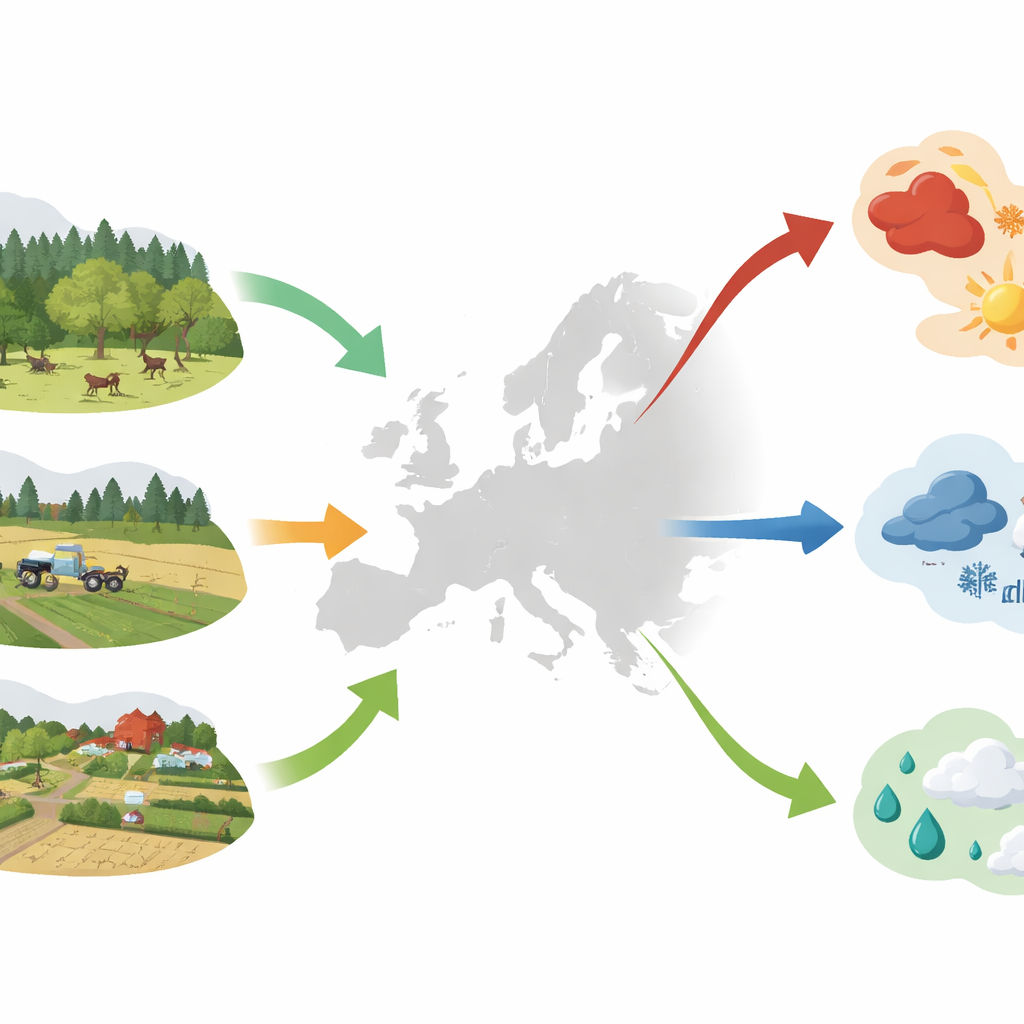
Three different visions of living with nature
The authors explore three contrasting but all “green” futures for Europe in 2050, each based on how people choose to value nature. In a “Nature for Nature” vision, wild species and intact ecosystems come first, with more low‑intensity grasslands and forests and strong protection of high‑biodiversity areas. “Nature for Society” focuses on the services nature provides people, such as storing carbon and producing food, so productive forests and croplands are steered toward high carbon uptake and reliable yields. “Nature as Culture” gives priority to traditional cultural landscapes, with diverse mosaics of fields, pastures, small woods, and villages that reflect long‑standing human–nature relationships. All three visions assume the same low‑emissions global pathway and overall demand for food and wood; what differs is where and how land is managed.
From maps of habitats to how the land feels to the air
To connect these visions to climate, the team first translated detailed European land‑use maps into ecological building blocks known as plant functional types—broad groups such as needle‑leaf trees, broad‑leaf trees, shrubs, grasses, and crops. They used over 800,000 field vegetation plots and high‑resolution habitat models to estimate which mixtures of these plant types would occupy each square kilometer of Europe under each scenario. These plant maps then drove a regional Earth system model that simulates how land and atmosphere exchange energy, water, and carbon. In essence, the model lets the researchers watch how changes in vegetation alter the surface’s brightness, roughness, and evaporation, and how those shifts ripple upward into temperature, clouds, and rain patterns.
How future landscapes reshape summer heat and rain
Although all three futures change land use on a similar fraction of Europe, their climate effects differ sharply. The “Nature as Culture” pathway, with its strong shift from cropland toward grass‑dominated mosaics, produces widespread extra summer warming: on average about 0.17 °C above an already warming low‑emissions baseline, with hot spots approaching 0.7 °C and the hottest days rising by more than 1.5 °C in the most affected areas. Summer rainfall in this scenario tends to decline, especially in western and eastern Europe, even while topsoil moisture does not always drop thanks to lower evaporation. By contrast, the “Nature for Nature” and “Nature for Society” scenarios change plant cover more modestly and in more mixed ways. At the scale of the whole continent they do not add significant extra warming beyond the low‑emissions path and, in some already strongly warming areas, “Nature for Nature” even slightly cools summer temperatures.
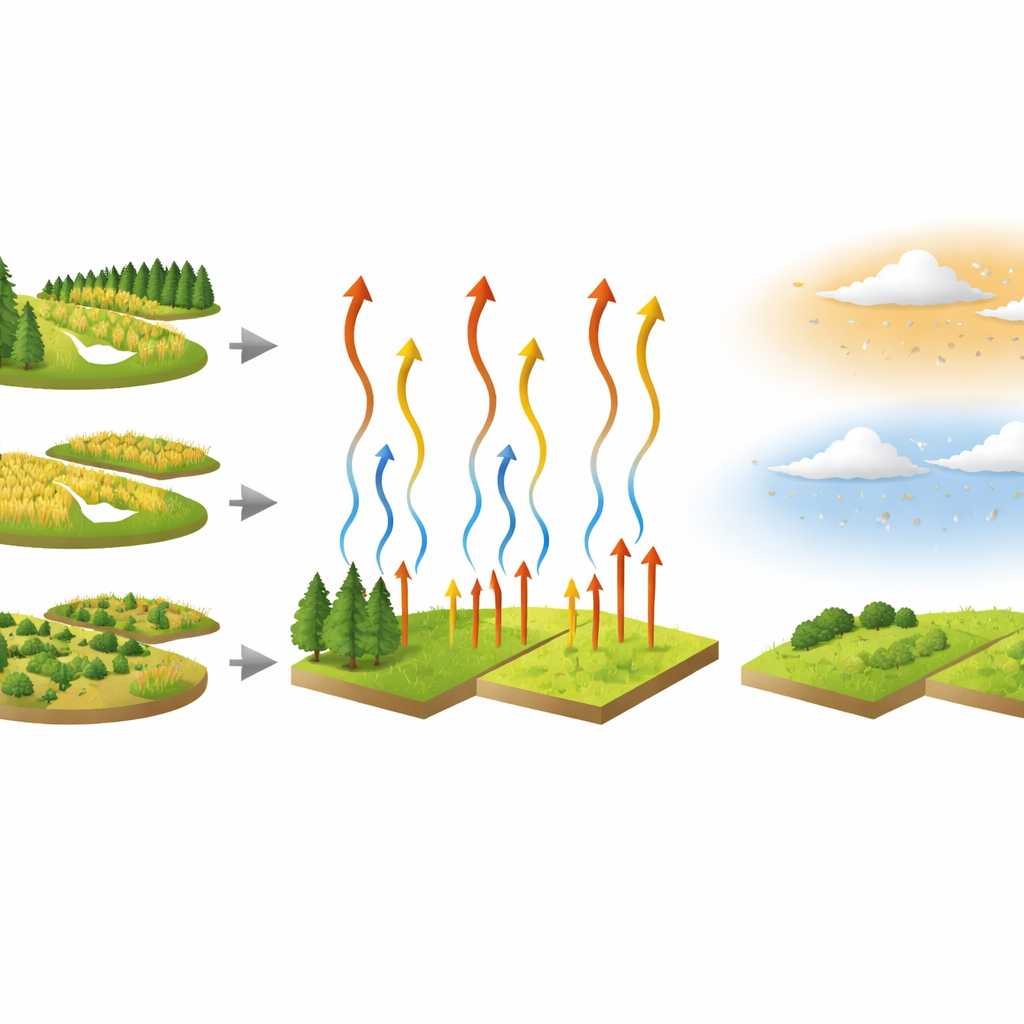
What drives the differences under the hood
The model shows that the key physical levers are how much water plants return to the air, how rough the land surface is, and how much sunlight is reflected. In the “Nature as Culture” case, replacing crops with grasses tends to lower plant height and leaf area and reduce irrigation in the south. That cuts back on evaporative cooling, so more incoming energy heats the air directly. The warmer, drier air then feeds back on the atmosphere above, reducing clouds and letting more sunlight reach the surface, which amplifies the warming. In the other two futures, many land changes—such as some conversions from dark conifer forests to crops—brighten the surface and increase seasonal evaporation enough that atmospheric feedbacks offset much of the local warming, leading to little net change at the regional scale.
Choosing futures that help both climate and nature
For non‑specialists, the bottom line is that not every “nature‑positive” plan is equally climate‑friendly at local and regional scales. A future that strongly favors cultural landscapes risks making European summers hotter and somewhat drier, aggravating heat waves and stressing people and ecosystems already coping with climate change. Futures that prioritize biodiversity protection or carbon‑focused ecosystem services, by contrast, appear compatible with regional climate adaptation: they transform land extensively yet do not add major extra warming or drying overall. The study argues that Europe’s biodiversity and climate policies must be designed together, with explicit attention to how land feeds back on weather. By combining the strengths of all three visions—wild nature, ecosystem services, and cultural values—new scenarios could be crafted that both protect life on land and help steady the climate we depend on.
Citation: Sieber, P., Karger, D.N., Zimmermann, N.E. et al. Climate response to Nature Future scenarios in a regional Earth System Model. Nat Commun 17, 4017 (2026). https://doi.org/10.1038/s41467-026-70284-8
Keywords: land use, biodiversity, European climate, earth system modeling, nature futures