Clear Sky Science · en
Upwind electromigration of sub-10-nm metallic nano-interconnects
Why tiny metal wires behave in surprising ways
Modern phones, data centers and AI chips all rely on metal wires so small that only a powerful microscope can see them. These nanoscale connections carry huge electrical currents in a very tight space, and over time the atoms in the metal can be literally pushed out of place, leading to sudden failure. This study looks inside such ultra-thin metal wires, just a few billionths of a meter wide, and finds that their atoms can move in exactly the opposite direction from what engineers have assumed for decades—an unexpected twist that may reshape how we design future electronics. 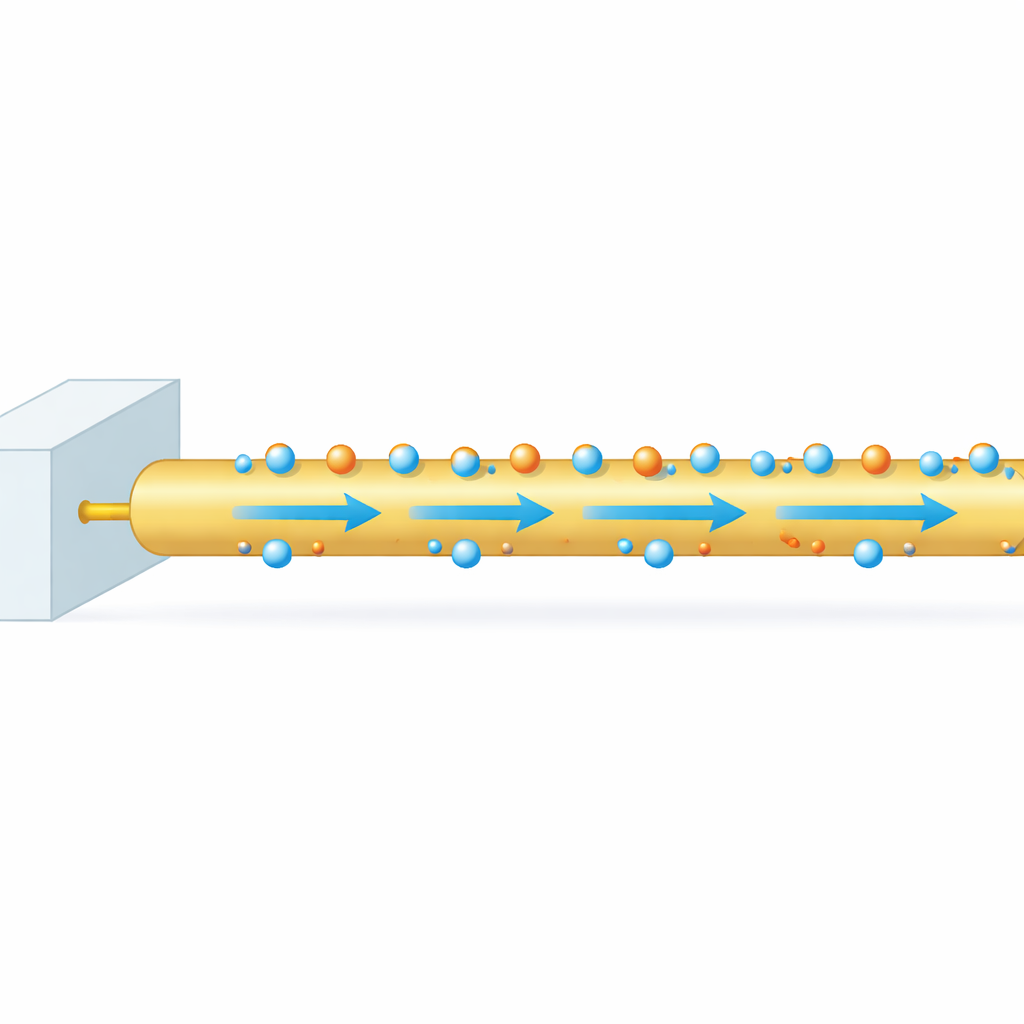
When electric current quietly rearranges metal
In everyday electronics, a failure called electromigration slowly eats away at metal lines as current flows. Electrons rushing through the metal transfer some of their momentum to the atoms, nudging them along the path of electron flow and gradually hollowing out some regions while piling up material in others. This picture, based mainly on studies of common metals like copper and gold, has guided industry rules for how wide a wire must be and how much current it can safely carry. But as interconnects are squeezed below 10 nanometers in diameter, and new metals such as tungsten and molybdenum are adopted, it has been unclear whether the old rules still apply.
Seeing atoms move in real time
To answer this, the researchers developed a method to build and test nanowires directly inside a high-resolution electron microscope. They formed pristine tungsten and molybdenum bridges only a few nanometers thick between larger metal supports, then sent short electrical pulses or steady current through them while recording atomic-scale movies. This setup let them watch individual rows of atoms on the wire’s surface—tiny steps and terraces—shift in response to the current. Instead of drifting with the electrons, the surface atoms consistently crept in the opposite direction, a behavior the authors call upwind electromigration.
How opposite motion reshapes a tiny wire
Over many pulses, this biased motion added up to large, visible shape changes. In one tungsten nanowire, atoms on the surface steadily moved toward the side of the wire facing the incoming current. That end thickened while the opposite end thinned, even though the internal crystal structure stayed orderly. Detailed tracking of surface steps showed that atoms preferred to move along the wire in the current direction and to attach at particular step edges, causing some terraces to grow and others to shrink. These flows were not driven by temperature gradients or internal stress, which the team carefully ruled out, but directly by the electric field acting on atoms at the surface. 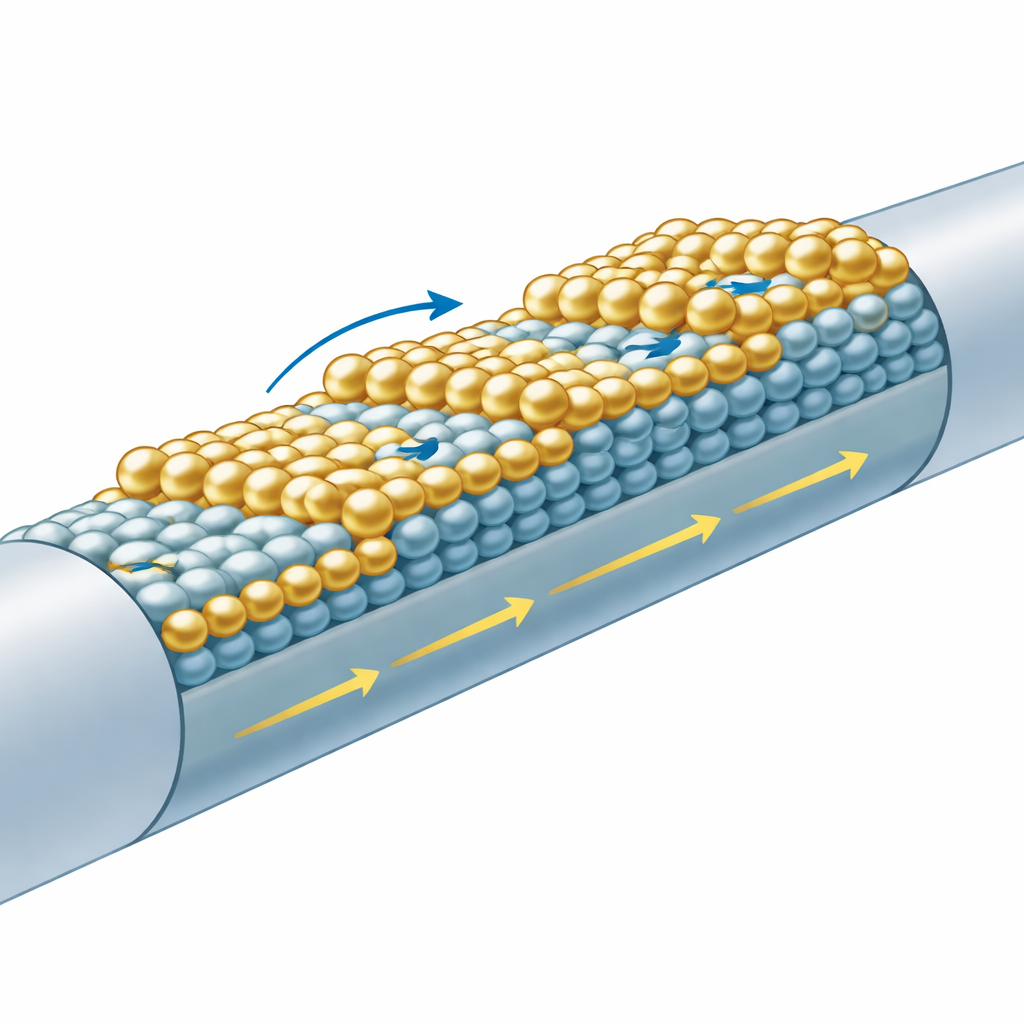
Why some metals go with the flow and others go against it
The team then compared different materials. Gold nanowires behaved as expected: their surface atoms moved with the electrons. Molybdenum, like tungsten, showed the same upwind motion. Using quantum mechanical calculations, the researchers examined two competing forces on each atom. One is a direct pull from the electric field on the ion itself; the other is the so‑called wind force from electrons scattering off the atom. In copper and gold, the wind force is much stronger and drags atoms along the electron flow. In tungsten and molybdenum, the situation flips: their complex electronic structure weakens the wind force, while the direct pull remains strong, so atoms are driven in the opposite direction.
What this means for future electronics
The discovery that surface atoms in next‑generation interconnect metals can march against the electron flow overturns a core assumption in chip reliability. For engineers, it means that lifetime predictions and design rules based on copper and gold no longer hold at the smallest scales. At the same time, upwind electromigration might be turned from a threat into a tool—helping heal damage at one end of a wire or enabling controlled reshaping of surfaces atom by atom. By directly visualizing how atoms respond to current and tying that motion to fundamental electronic properties, this work offers both a warning and a roadmap for building more robust, high‑performance devices in an era of extreme miniaturization.
Citation: Hong, Y., Deng, T., Li, X. et al. Upwind electromigration of sub-10-nm metallic nano-interconnects. Nat Commun 17, 3590 (2026). https://doi.org/10.1038/s41467-026-70283-9
Keywords: electromigration, nanowires, tungsten, molybdenum, interconnect reliability