Clear Sky Science · en
Preventing subsoil enhanced nitrification to safeguard agroecosystem sustainability
Why what happens deep in farm soils matters
Modern farming relies heavily on nitrogen fertilizers to feed a growing population, but much of that nitrogen never makes it into crops. Instead, it seeps into the ground, acidifies soils, and contaminates drinking water. This study reveals that beneath fields around the world there is a hidden “hot spot” layer where fertilizer nitrogen is intensively transformed, with big consequences for soil health and groundwater. Understanding and managing this buried zone could help farmers grow food more sustainably while protecting the environment.
A hidden band beneath our feet
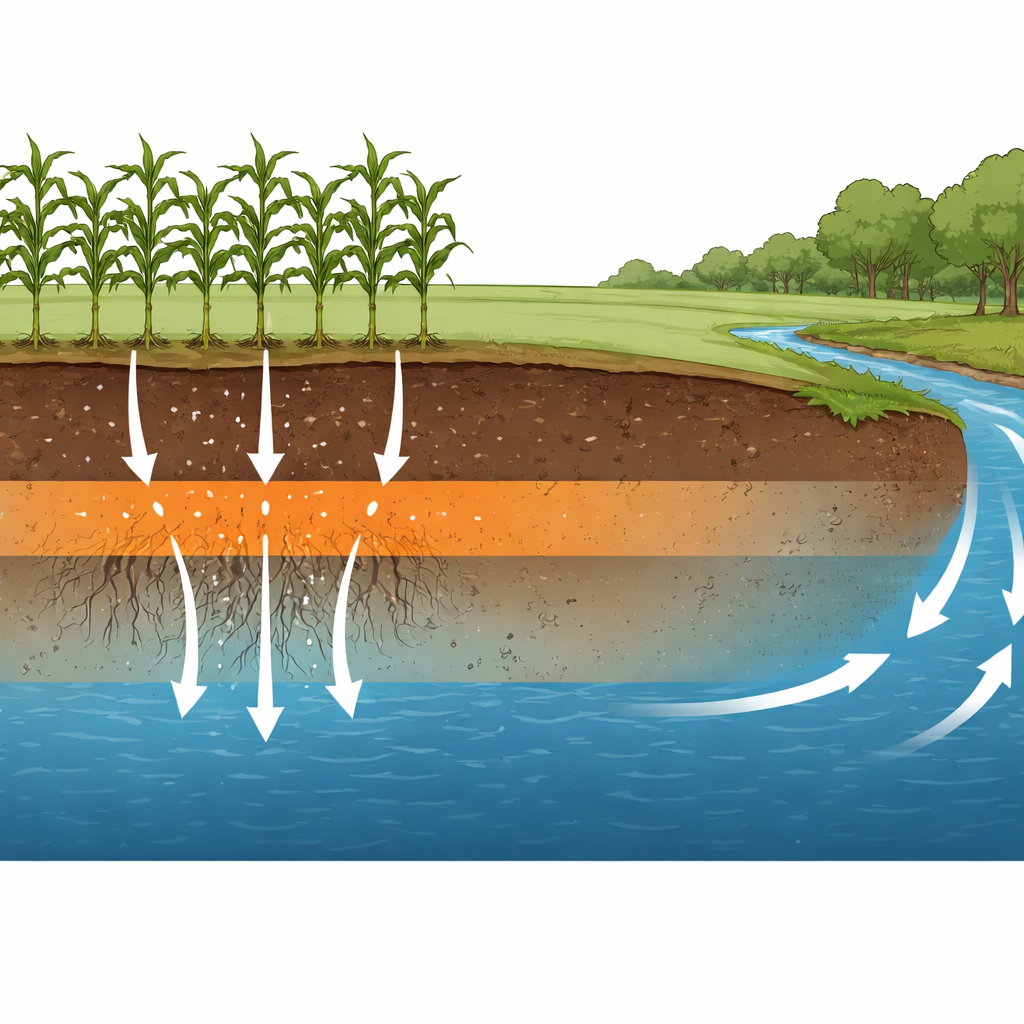
By combining global soil profiles and field observations, the authors discovered a consistent pattern in croplands: at about 0.6 meters below the surface (roughly knee to hip deep), many fields show an unexpected bulge in total nitrogen. In natural ecosystems like forests and grasslands, nitrogen steadily declines with depth. In farmed soils, however, this bulge reveals that extra fertilizer nitrogen is being stored and transformed in the subsoil rather than remaining near the surface. The researchers identify this zone as an “enhanced nitrification layer,” a buried band where ammonium from fertilizers is actively converted into nitrate, a form of nitrogen that easily moves with water.
How roots, soil, air, and water build a hot spot
The study shows that this subsoil layer is not accidental; it forms through the interplay of four key processes. First, crop roots extend down to about 0.6–0.8 meters, acting like conveyor belts that carry fertilizer nitrogen from the surface into deeper layers. As roots die and decompose, they add more nitrogen along these paths. Second, many cropland soils have a sandier, relatively dry band in this depth range. Sandier soil holds less water and more air, creating a well-oxygenated “reaction chamber” ideal for the chemistry that converts ammonium into nitrate. Third, specialized microbes that perform this conversion are not confined to surface soils. Genetic markers show that ammonia-oxidizing microorganisms are enriched around this depth, forming a biological “engine” that runs the nitrification process even in somewhat acidic conditions.
Rainstorms as the on–off switch
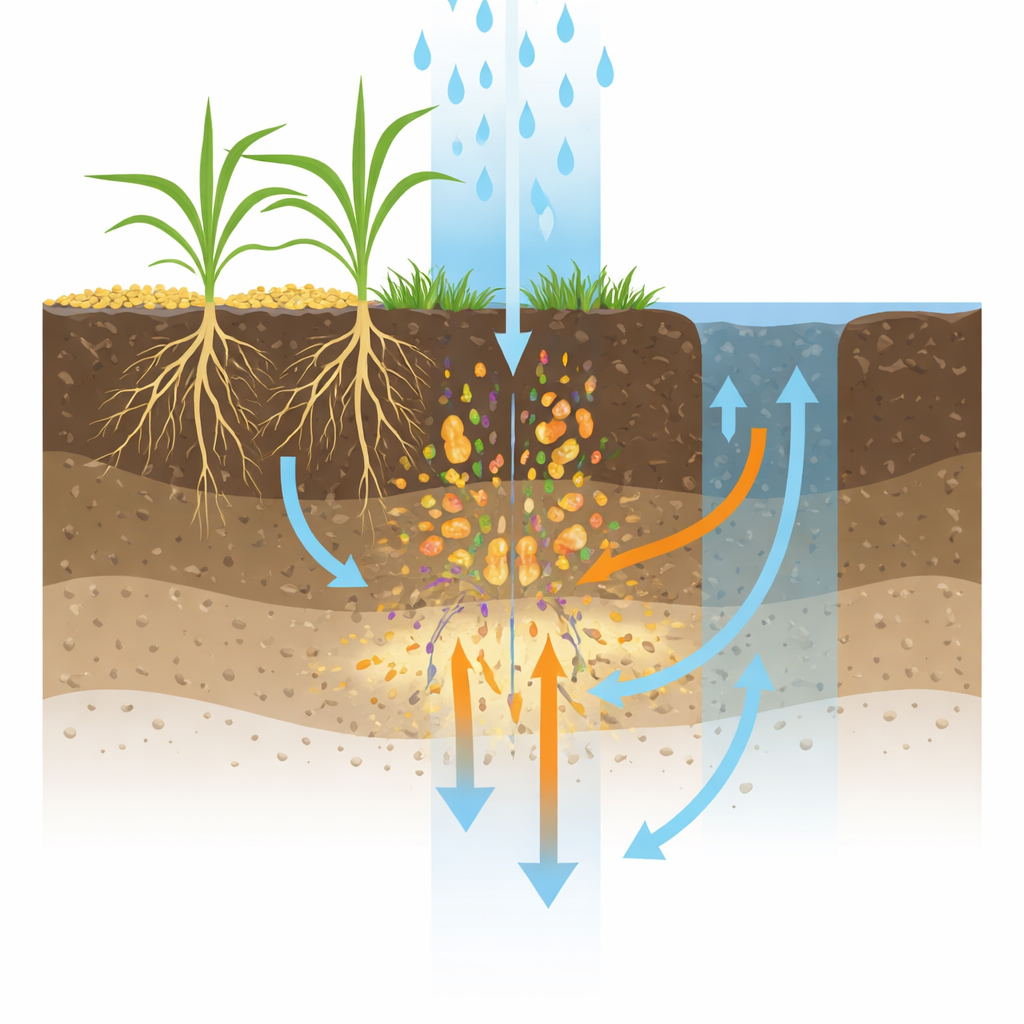
Field measurements in a heavily fertilized citrus watershed in southeastern China reveal how weather turns this hidden engine on and off. During dry periods, nitrogen in the upper soil does not efficiently reach the deeper sandy layer, and both ammonium and nitrate drop with depth. After heavy rains, however, water infiltrates along root channels, carrying fertilizer nitrogen down into the enhanced nitrification layer. There, microbial activity, oxygen-rich pores, and abundant ammonium combine to produce a surge of nitrate, which then seeps further downward into groundwater. Similar patterns in another Chinese agricultural region suggest that this mechanism is not unique, but widespread in humid, intensively managed croplands.
Deep changes in soil health and water quality
The existence of this active subsoil band helps explain two worrying trends. First, long-term global data show that cropland soils are acidifying most strongly right in this depth range, especially near the nitrogen bulge. Nitrification releases acid, and when it is concentrated in a buried layer, it quietly erodes soil quality away from the surface, eventually harming crop yields. Second, the same band acts as a launch point for nitrate to leak into groundwater. Below it, roots and sand content decline and water moves more slowly, allowing nitrate formed in the enhanced nitrification layer to trickle steadily into aquifers and streams long after fertilizer is applied. Groundwater observations confirm that ammonium rarely reaches aquifers, but nitrate levels respond with a clear delay after fertilization, tracing back to this buried source.
Targeting the problem where it actually happens
For decades, efforts to improve nitrogen use efficiency in agriculture have focused almost entirely on the soil surface: adjusting fertilizer rates, timing, and placement. This research shows that a major part of the problem lies deeper down. By identifying the enhanced nitrification layer as a precise subsurface target, the authors argue for a two-pronged approach. Surface practices must still limit how much nitrogen enters the soil, but new strategies should also directly manage this critical depth—using tools like deep-placed nitrification inhibitors or irrigation schedules that avoid repeatedly flushing nitrogen into the reactive band. In simple terms, making farming more sustainable will require not just better handling of fertilizers at the surface, but also smart intervention in the hidden layer where much of the nitrogen damage is actually done.
Citation: Wang, Y., Luo, X., Jobbágy, E.G. et al. Preventing subsoil enhanced nitrification to safeguard agroecosystem sustainability. Nat Commun 17, 3648 (2026). https://doi.org/10.1038/s41467-026-70277-7
Keywords: nitrogen fertilizer, groundwater nitrate, soil health, nitrification, agroecosystem sustainability