Clear Sky Science · en
Grounding large language models in clinical diagnostics
Smarter Help for Doctors
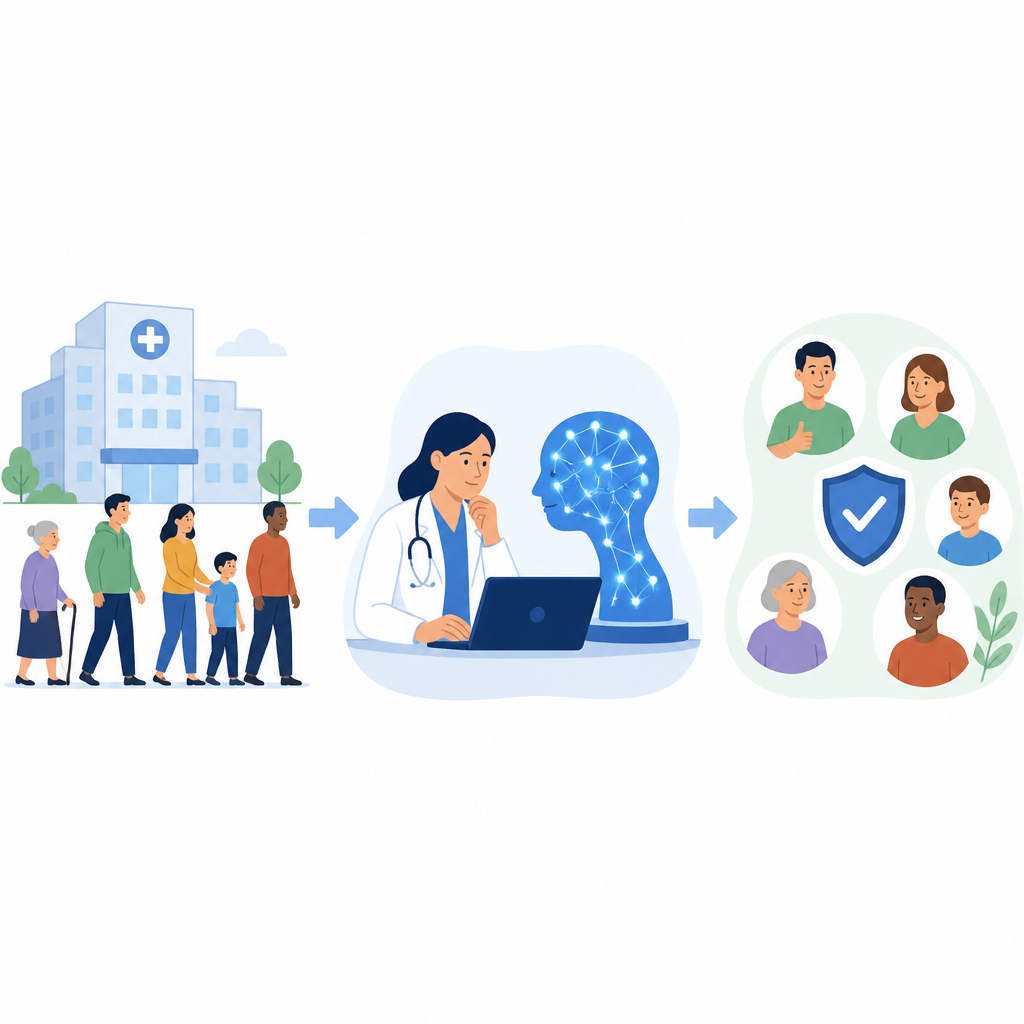
When you visit a doctor, the path to a correct diagnosis is rarely a single question and answer. It is a careful back and forth, with the doctor asking about your story, examining you, ordering tests, and then weighing all the clues. This study looks at whether today’s powerful AI language tools can really help with that full journey, not just with quick quiz-style questions. The researchers build and test a special system that aims to act more like a real clinical partner for doctors, and they explore how teaming doctors with this system can improve both accuracy and speed in finding what is wrong.
Why Clinic Visits Are Hard for Machines
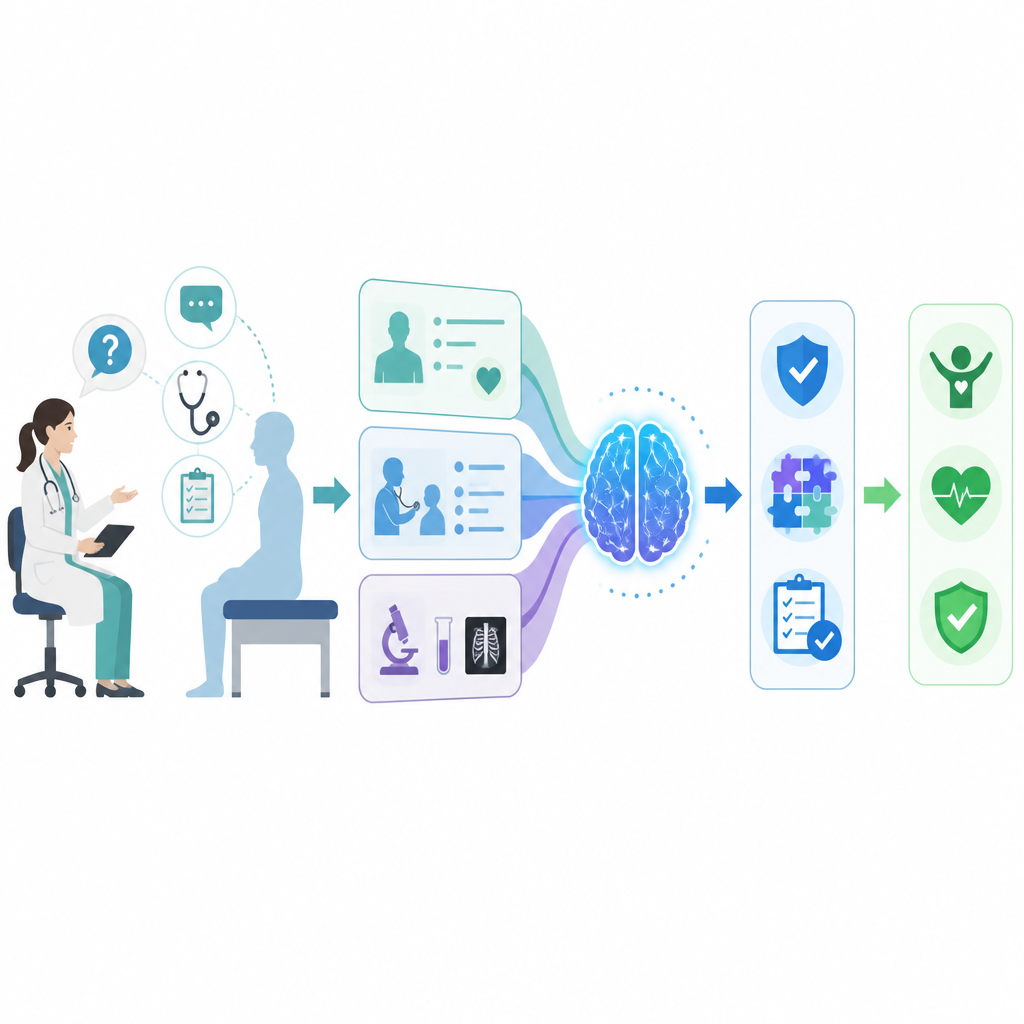
Many news stories highlight how large language models perform well on medical exams or short answers. But real clinic visits are messier. Doctors often start with only a brief description of a problem and must slowly collect details: how long symptoms have lasted, what the body exam shows, and what lab or scan results reveal. At each step they change or refine their ideas. Earlier studies mostly tested AI on neat cases where all the information was already laid out. The authors argue that this is very different from real practice, where missing one key question or test can lead to a wrong diagnosis.
Building a Test Bed from Real Cases
To judge AI in a more realistic way, the team created the ClinDiag-Framework, which sets up a conversation between a “doctor” AI and a “provider” that only releases patient facts when asked. They also assembled ClinDiag-Benchmark, a large collection of 4,421 real clinical cases from 32 specialties, including tough cases, emergency visits, and rare diseases. Each case is broken into stages that mirror clinic notes: initial complaint, history, physical exam, tests, and final diagnosis. This setup lets the researchers see not only whether an AI gets the answer right, but also how well it follows each step that human doctors are trained to perform.
Training an AI to Think More Like a Doctor
The authors then built ClinDiag-GPT, a tailored language model fine-tuned on 7,616 real cases rewritten as multi-step dialogues that imitate doctor–patient encounters. In these training stories, the AI “doctor” has to ask focused questions, decide on exams, request confirmatory tests, and only then settle on a diagnosis. The system learns to follow common clinical habits, such as always asking about past illnesses and family history, and to seek strong evidence rather than stopping at a vague label. When tested against several leading general-purpose models, ClinDiag-GPT achieved the best accuracy in full diagnostic procedures and made fewer mistakes at each stage, including fewer signs of mental shortcuts like jumping too quickly to a favored diagnosis or clinging to an early guess despite new conflicting clues.
How Well Does AI Match Human Doctors?
Even with this training, all models did noticeably worse in realistic step-by-step diagnosis than in simple question-and-answer tests, highlighting how demanding real clinical work remains. Still, ClinDiag-GPT stood out: it gathered more complete information, reasoned more clearly, and misread fewer tests than the other AI systems. The researchers also explored add-ons such as combining multiple AI “doctor” agents or adding an AI critic, but these did not reliably improve performance. Much larger gains came from the targeted fine-tuning on real diagnostic workflows.
Doctors and AI Working Side by Side
Perhaps the most practical test was a three-way comparison: doctors alone, ClinDiag-GPT alone, and doctors working together with ClinDiag-GPT. On a sample of 60 mixed cases, the partnership group had the highest diagnostic accuracy and finished cases faster than doctors working on their own. The gains were strongest in rare and especially tricky conditions, where the model’s broad medical memory could support the doctor’s real-world sense and judgment. At the same time, the AI still missed or mishandled many cases, and it tended to sound more confident than its results justified, underlining the need for careful human oversight.
What This Means for Patients
The study shows that today’s leading language models are far from replacing doctors in real clinics, but a purpose-built system like ClinDiag-GPT can already act as a helpful assistant. By nudging the diagnostic process to be more thorough and by offering extra ideas in difficult or rare cases, it can support doctors in making better and faster decisions. For patients, this points toward a future where your doctor works with a quiet AI partner in the background, using its wide medical knowledge to reduce missed clues and help ensure that complex diagnoses are reached with greater care.
Citation: Chen, X., Zhou, H., Yi, H. et al. Grounding large language models in clinical diagnostics. Nat Commun 17, 4401 (2026). https://doi.org/10.1038/s41467-026-70274-w
Keywords: clinical diagnostics, medical AI, large language models, doctor AI collaboration, diagnostic accuracy