Clear Sky Science · en
Nitrogen fixation in a non-equilibrium spatially distributed electric field
Turning Air into Plant Food
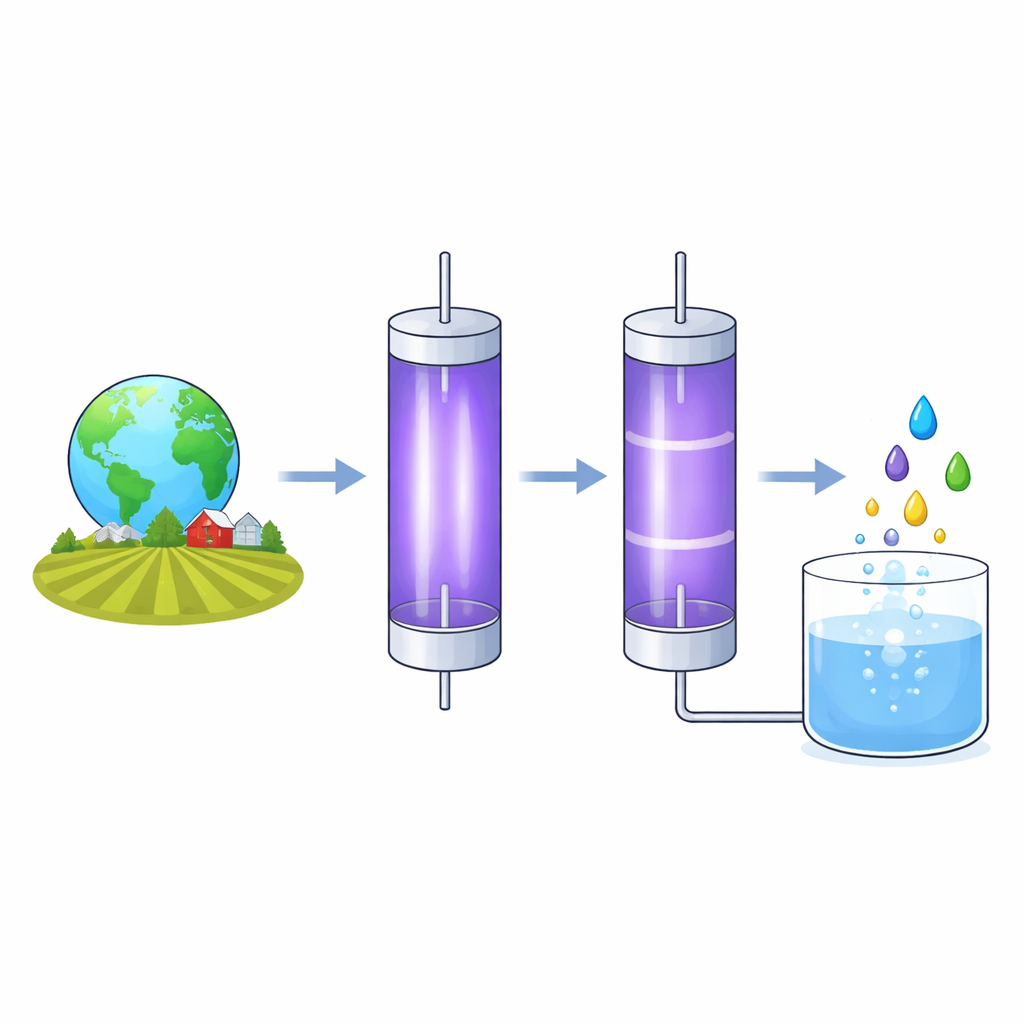
Modern farming depends on fertilizers made from nitrogen, a key ingredient that usually comes from an energy-hungry industrial process. This study explores a cleaner way to “fix” nitrogen directly from the air using electricity instead of fossil fuels. By carefully shaping the electric field inside a small plasma reactor, the researchers show they can boost nitrogen fixation efficiency while cutting energy waste, pointing toward more sustainable fertilizer production powered by renewable electricity.
Why We Need a New Nitrogen Pathway
Today’s fertilizers mostly come from the Haber–Bosch process, which turns nitrogen gas and hydrogen into ammonia at very high temperatures and pressures. This century-old technology underpins global food production but devours about 1–2% of the world’s energy and generates significant carbon emissions, because the hydrogen usually comes from natural gas. Scientists have been hunting for alternatives that work at room temperature and normal pressure and can plug directly into solar and wind power. Among the options, using electricity to drive nitrogen reactions in a plasma—a partially ionized gas full of energetic particles—has attracted attention, but so far it has struggled with low yields and high energy costs.
Plasma Bubbles and a New Way to Watch Reactions
In this work, the team uses a “plasma bubble reactor,” where air is fed through a tube into water, forming bubbles in which plasma discharges occur. Reactive nitrogen and oxygen species formed in the glowing gas quickly dissolve into the surrounding water and are captured as nitrate and nitrite, which can be further processed into fertilizers. A major obstacle has been that the reaction network in such plasmas is extremely complex and hard to probe in real time. To tackle this, the researchers developed a hollow-core optical fiber probe that can sit directly in the harsh plasma and liquid environment. Using a technique called photothermal spectroscopy, they can continuously measure tiny changes in light caused by key molecules and ions such as nitric oxide, nitrogen dioxide, nitrous oxide, ozone, nitrate, and nitrite, both in the gas and in the water, with high sensitivity and second-by-second resolution.
Two Helpful Reaction Pathways Hidden in the Glow
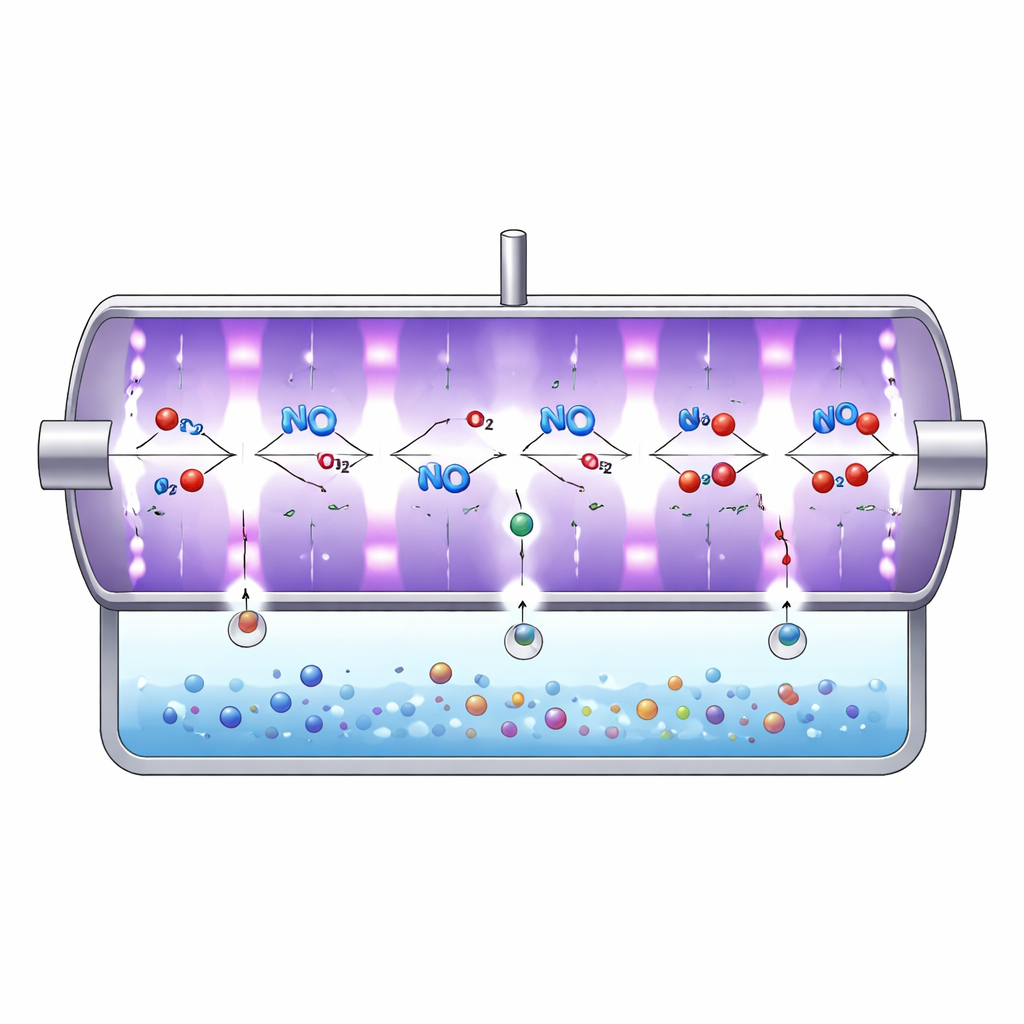
Armed with this in-situ “eye,” the team compared two common plasma modes: a spark discharge with relatively low electric field strength but hotter gas, and a dielectric barrier discharge with a higher electric field and cooler gas. They found that each mode favors a different beneficial reaction pathway. In the lower-field spark, electrons mainly pump energy into vibrationally excited nitrogen molecules, which makes it easier to break the very strong nitrogen–nitrogen bond and form nitric oxide. In the higher-field dielectric discharge, electrons preferentially split oxygen molecules, generating abundant oxygen atoms and ozone. Ozone dissolves well in water and acts as a powerful oxidizer, helping convert nitric oxide and nitrite into nitrate, the final fixed-nitrogen product in the solution. Numerical simulations of the coupled plasma and liquid chemistry confirmed that these two pathways—vibrationally excited nitrogen and ozone-driven oxidation—work together to enhance overall nitrogen fixation.
Designing a Reactor with “Just-Right” Fields
These insights led the authors to a simple but powerful idea: instead of choosing between low and high electric fields, design a reactor that has both at the same time in different regions. They implemented this “spatially distributed electric field” strategy by wrapping the central electrode with a dielectric tube whose thickness changes along its length. Thinner sections create a narrower gap and higher local electric field, ideal for producing ozone via oxygen splitting, while thicker sections lower the field and favor vibrational excitation of nitrogen. The plasma naturally fills these alternating regions, so both helpful reaction networks operate simultaneously. Measurements showed that this design increases the production of nitrogen oxides in the gas and boosts the concentration of nitrate in the water compared with conventional uniform-field discharges.
Performance Gains and Broader Potential
After optimizing the voltage and gas flow, the new reactor achieved a nitrogen oxide yield of 9.8 millimoles per hour and an energy use of about 1.6 kilowatt-hours per mole of fixed nitrogen. That yield is roughly three times higher than a standard dielectric barrier discharge operating under similar conditions, while maintaining high selectivity toward nitrate. When benchmarked against other plasma-based and electrochemical nitrogen fixation approaches, the spatially distributed field concept delivers substantially higher nitrogen conversion than most other plasma configurations at comparable or lower energy cost, and far greater conversion than typical electrochemical systems, albeit with higher energy use. Because the reactor runs at ambient temperature and pressure and can be powered directly by electricity, it is especially promising for small, distributed fertilizer production units connected to renewable grids.
What This Means for Cleaner Fertilizers
In essence, the study shows that carefully sculpting the electric field inside a plasma reactor lets engineers “tune” the invisible reaction network to get more useful nitrogen products out for less energy. By combining regions that activate nitrogen efficiently with regions that strongly oxidize and capture it in water, the spatially distributed electric field design overcomes some of the long-standing bottlenecks of plasma-based nitrogen fixation. Beyond fertilizers, the same principle—using non-uniform electric fields to steer complex plasma chemistry—could help improve other green processes, such as carbon dioxide conversion, hydrogen production from methane, and chemical recycling of plastics.
Citation: Guo, S., Wang, Y., Guo, Y. et al. Nitrogen fixation in a non-equilibrium spatially distributed electric field. Nat Commun 17, 3680 (2026). https://doi.org/10.1038/s41467-026-70272-y
Keywords: plasma nitrogen fixation, green fertilizer, spatially distributed electric field, ozone-assisted oxidation, renewable ammonia alternatives