Clear Sky Science · en
Reconstitution of woody biomass framework via dual-functional lignin engineering toward efficient and salt-resistant solar desalination
Turning Sunlight and Wood into Fresh Water
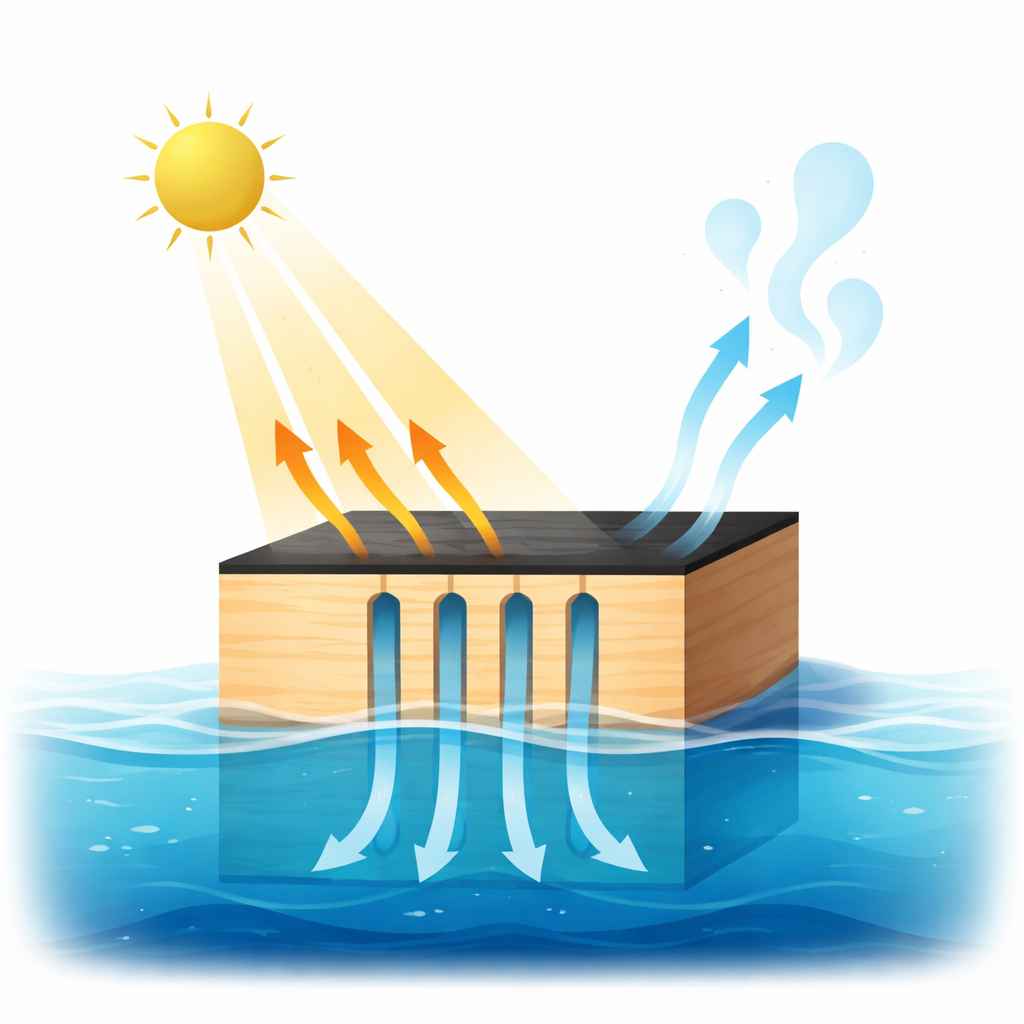
Billions of people live in regions where clean drinking water is scarce, while vast oceans sit just out of reach because removing salt is costly and energy-hungry. This study shows how a common natural material—wood—can be smartly redesigned to turn sunlight directly into fresh water. By rethinking the role of one of wood’s key ingredients, lignin, the researchers build a simple, low-cost device that floats on seawater, soaks up sunshine, and produces clean water efficiently while resisting salt buildup.
Why Wood Is a Clever Starting Point
Wood is abundant, renewable, and already has a built-in network of tiny channels that can pull water upward, much like a tree drawing sap from its roots. These features make it a tempting candidate for solar desalination devices that heat only a thin layer of water at the surface, rather than large volumes, saving energy. But natural wood has two big limitations: it does not absorb sunlight strongly enough, and its internal chemistry is not ideal for fast evaporation. Many earlier designs tried to fix this by stripping out almost all the lignin—the glue-like, water‑repelling component that holds wood fibers together—and then adding separate light‑absorbing coatings. That approach improves water flow but wastes lignin, weakens the structure, and often relies on expensive or less‑eco‑friendly additives.
Redesigning Water Inside Wood
This work takes the opposite tack: instead of removing lignin completely, the authors carefully tune how much remains in the wood and how it is arranged. Water inside porous materials can exist in several “states,” ranging from tightly bound to loosely held. The team focuses on creating more so‑called intermediate water—water that is loosely bound and therefore needs less energy to evaporate. Through a combination of thermal treatment and chemical adjustment, they partially remove lignin and subtly change its structure. Measurements using calorimetry and nuclear magnetic resonance show that at an optimal treatment temperature (producing a material they call W‑150), the wood holds more intermediate water and less tightly bound or fully free water. As a result, the energy required for water to turn into vapor drops, while the wood’s natural pumping ability remains strong.
Recycling Lignin into a Sun-Hungry Surface
Rather than discarding the lignin taken out of the wood, the researchers upcycle it into a highly efficient light‑absorbing layer. They coat the treated wood with recovered lignin and then expose it to a finely controlled laser. The intense energy rearranges the lignin’s carbon atoms into a mixture of porous graphitic carbon and thin, graphene‑like sheets. This dark, sponge‑like top layer traps sunlight across a broad range of wavelengths and converts it into heat with high efficiency. Its maze of pores not only boosts light absorption but also provides many tiny contact points where pumped water forms small droplets that evaporate more easily. The resulting device, named E‑150, combines optimized water handling below with powerful light capture above, all using components derived from wood itself.

Fast, Durable, and Resistant to Salt
Under standard sunlight, E‑150 achieves an evaporation rate of 2.24 kilograms of water per square meter per hour and a photothermal conversion efficiency above 91%, outperforming most previously reported wood-based evaporators, including those that rely on metals or complex nanomaterials. Because some lignin is left in the internal framework, the multiscale channels of the wood stay intact and mechanically robust. This architecture allows salt ions to move sideways and back into the surrounding water instead of crystallizing and clogging the surface. In tests with seawater and highly salty brines up to 10% salt, the device maintains nearly the same evaporation rate for many hours with little to no salt crust. It also survives repeated cycles of drying and reuse without cracking or collapsing, unlike fully delignified controls.
What This Means for Future Freshwater
In plain terms, the study shows that simply “cleaning out” wood is not the best way to turn it into a solar still. By keeping some lignin in place and turning the rest into a high‑performance, carbon‑rich skin, the researchers transform a single piece of biomass into both the plumbing and the heater of a desalination unit. The result is a scalable, all‑wood device that turns sunlight and seawater into drinkable water efficiently, shrugs off salt buildup, and uses only low‑cost, recyclable ingredients. This dual use of lignin—inside the wood to manage water and at the surface to harvest light—points to a practical, environmentally friendly route toward large‑scale solar desalination in coastal and arid regions.
Citation: Wang, B., He, Y., Yang, Z. et al. Reconstitution of woody biomass framework via dual-functional lignin engineering toward efficient and salt-resistant solar desalination. Nat Commun 17, 3758 (2026). https://doi.org/10.1038/s41467-026-70270-0
Keywords: solar desalination, wood-based materials, lignin engineering, interfacial evaporation, renewable water treatment