Clear Sky Science · en
Lorentz skew scattering and giant nonreciprocal magneto-transport
Why one-way electricity matters
Most electronic components treat forward and backward currents the same, but useful devices like rectifiers and diodes are built precisely to favor one direction. Engineers would love to create such “one-way” behavior directly inside ultra-clean quantum materials, where electric current flows with very little resistance and power loss. This article explains a newly discovered way that magnetic fields and microscopic scattering of electrons can team up to create especially strong one-way, or nonreciprocal, electrical response. The work not only fills a basic gap in our understanding of how electrons move in crystals under magnetic fields, it also points to concrete material platforms where this effect could power highly efficient rectifiers and detectors.
A hidden twist in electron traffic
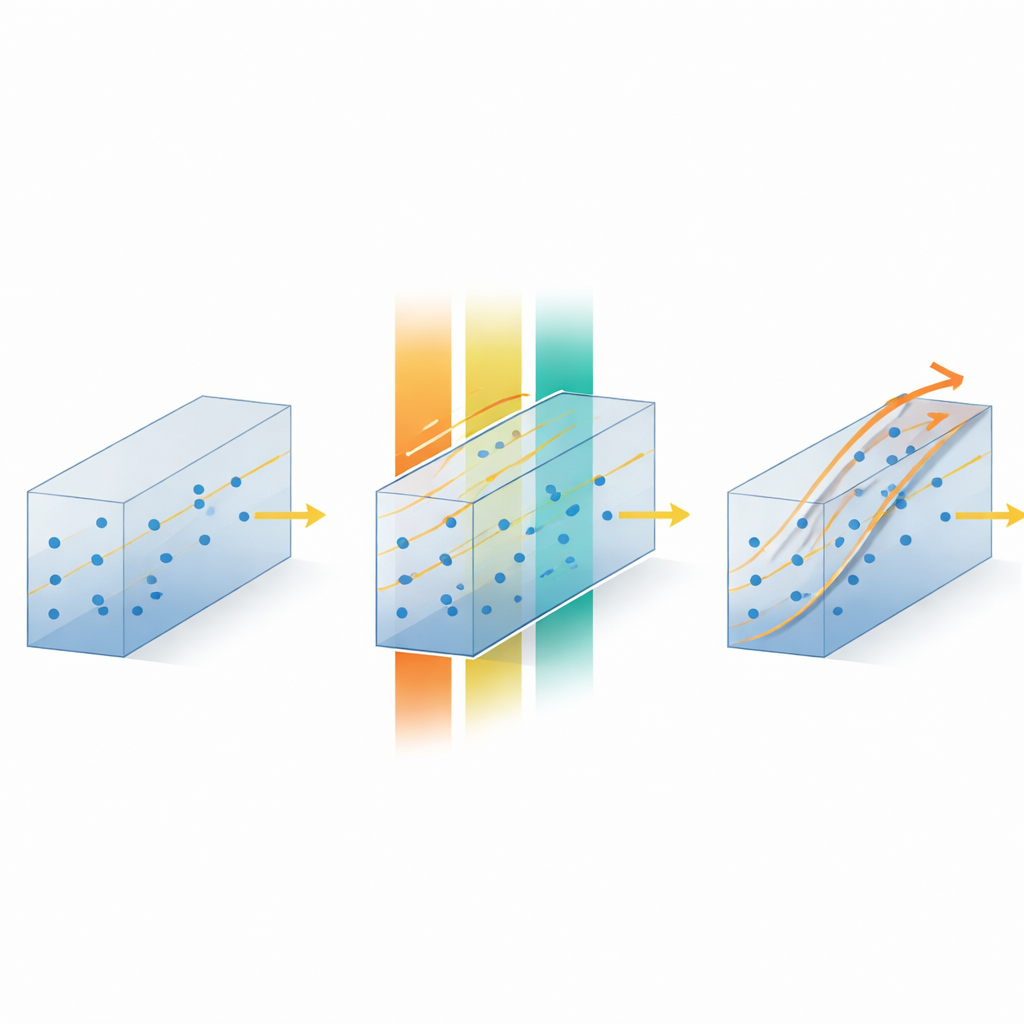
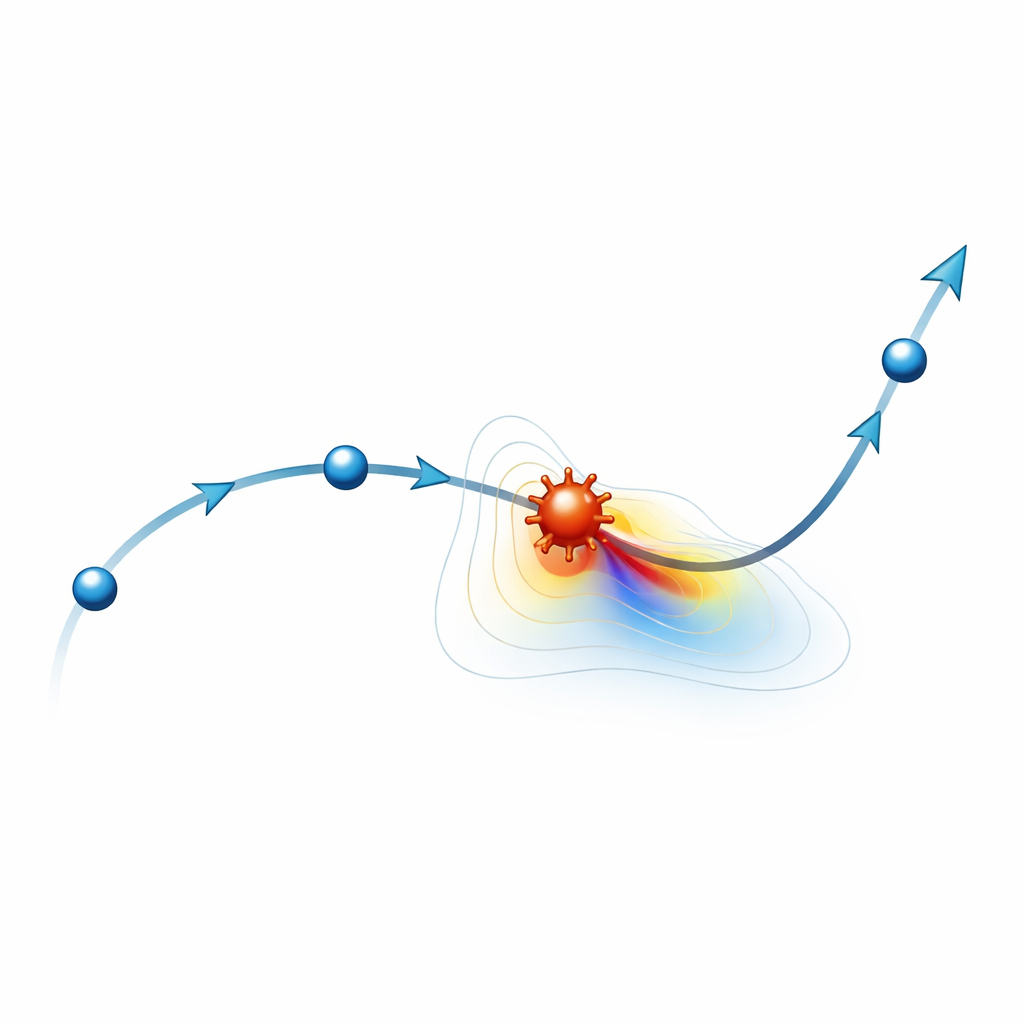
When an electric current passes through a material in a magnetic field, electrons feel the familiar Lorentz force, which bends their paths sideways. Separately, imperfections in the crystal—such as impurities or disorder—scatter electrons. In some cases this scattering is not perfectly symmetric: electrons are more likely to be deflected to one side than the other. This preferred sideways deflection is called skew scattering and is tied to the quantum “shape” of electron waves in momentum space. The authors show that when Lorentz bending and skew scattering act together, they generate a new kind of one-way current response, dubbed Lorentz skew scattering (LSK), that had been overlooked in previous theories of nonlinear magneto-transport.
From gentle bends to strong one-way flow
The key idea is that the current response of a clean metal is controlled by how long electrons travel before they scatter, a time that also sets the usual Drude conductivity. Most known mechanisms for nonreciprocal magneto-transport scale only with the square of this conductivity, so they remain modest in very clean samples. By contrast, LSK behaves much more strongly: at low temperatures, where static impurities dominate, the authors show that the LSK contribution to the one-way response grows with the cube of the conductivity, and at higher temperatures, when vibrations of the lattice join in, it can grow with the fourth power. In simple terms, the cleaner and more conductive the material, the more dramatically this particular combination of bending and skew deflection amplifies the one-way effect.
Quantum geometry behind the scenes
Skew scattering is not just a classical imbalance; it reflects the quantum geometry of the electron states. The authors trace its origin to a geometric phase picked up when an electron is scattered successively between three nearby momentum states, an effect that is directly related to a quantity known as Berry curvature. Where this curvature is large near the energies actually occupied by electrons, skew scattering is enhanced. Since the Lorentz force also pushes electrons sideways, the cooperation between Lorentz bending and curvature-driven skewness produces a particularly efficient route to redirect current in a way that depends on the current’s direction, the electric field, and the magnetic field, even though the material itself has no built-in magnetism.
Topological materials as one-way highways
To move from general theory to concrete predictions, the authors analyze two classes of materials that naturally host strong Berry curvature and very mobile electrons: the surface states of topological crystalline insulators such as SnTe, and bulk Weyl semimetals. Using realistic parameters, they find that LSK can simultaneously affect current along and across the applied electric field and can exceed previously proposed mechanisms by orders of magnitude. In model calculations for SnTe surfaces, reversing the drive current under modest magnetic and electric fields can change the effective conductivity by around 20 percent, a huge effect compared with earlier observations. In Weyl semimetals, the intrinsic measure of nonreciprocal strength also comes out far larger than known alternatives, indicating that LSK can dominate the nonlinear response under realistic conditions.
Toward practical low-loss rectifiers
Because LSK thrives in exceptionally clean, high-mobility systems, it naturally lends itself to low-power device concepts. The authors estimate that, in a suitably designed Weyl semimetal device, the ratio of direct current output to power dissipation—an important figure of merit for rectifiers and detectors—could surpass competing mechanisms by several orders of magnitude. Early experiments in candidate materials already report signals consistent with this prediction. For non-specialists, the bottom line is that a subtle quantum interplay between magnetic bending and asymmetric scattering of electrons can turn certain topological materials into powerful one-way conduits for electric and even heat currents, pointing toward a new generation of efficient, miniature rectifiers built directly from quantum matter.
Citation: Xiao, C., Huang, YX. & Yang, S.A. Lorentz skew scattering and giant nonreciprocal magneto-transport. Nat Commun 17, 3632 (2026). https://doi.org/10.1038/s41467-026-70269-7
Keywords: nonreciprocal transport, magnetoresistance, topological materials, Weyl semimetal, skew scattering