Clear Sky Science · en
Nonequilibrium ordering dynamics of confined soft alginate hydrogel colloids driven by time-evolving electrostatic interactions
How Soft Beads Learn to Line Up
When tiny particles jostle in a liquid, they usually behave like a crowded crowd at a concert—messy and disordered. This study shows how soft, gel-like beads can slowly “learn” to line up into neat, crystal-like patterns as invisible electrical forces between them grow stronger over time. Understanding this self-organization helps scientists design smart materials that can heal, reconfigure, or change stiffness on demand.
Building a Tiny World Inside a Droplet
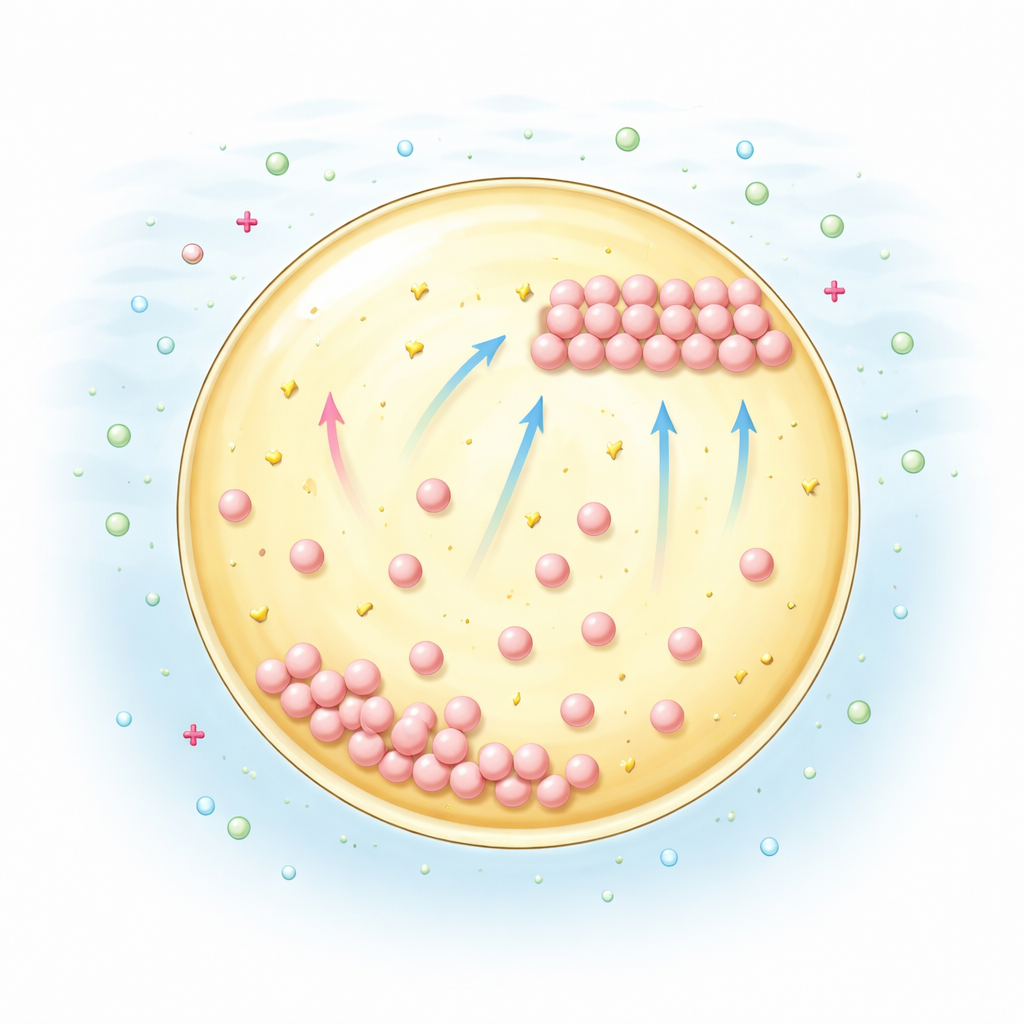
The researchers created a miniature laboratory inside droplets of an oil-like liquid called cyclohexyl bromide. Inside each oil droplet, they trapped many much smaller water-rich beads made from alginate, a jelly-like material derived from seaweed. These nested droplets float in a surrounding water solution. Using a microfluidic device—essentially a precisely shaped glass channel—they produced thousands of nearly identical oil droplets, each packed with alginate beads. This controlled, repeatable geometry allowed them to track how the beads moved and rearranged over many hours using optical microscopes.
Charging Up Soft Beads with Ions
The key ingredient driving organization is the flow of charged atoms, or ions, from the outer water phase into the oil droplet. The team added barium ions to the surrounding water. These ions slowly crossed the oil–water boundary and diffused through the oil until they reached the alginate beads. There, they bound to charged chemical groups on the alginate, locking neighboring chains together into soft hydrogels and at the same time increasing the beads’ surface charge. Because the oil has a low ability to screen electric fields, this growing charge produced unusually long-ranged electrical repulsion between beads.
From Random Crowd to Hexagonal Crystal
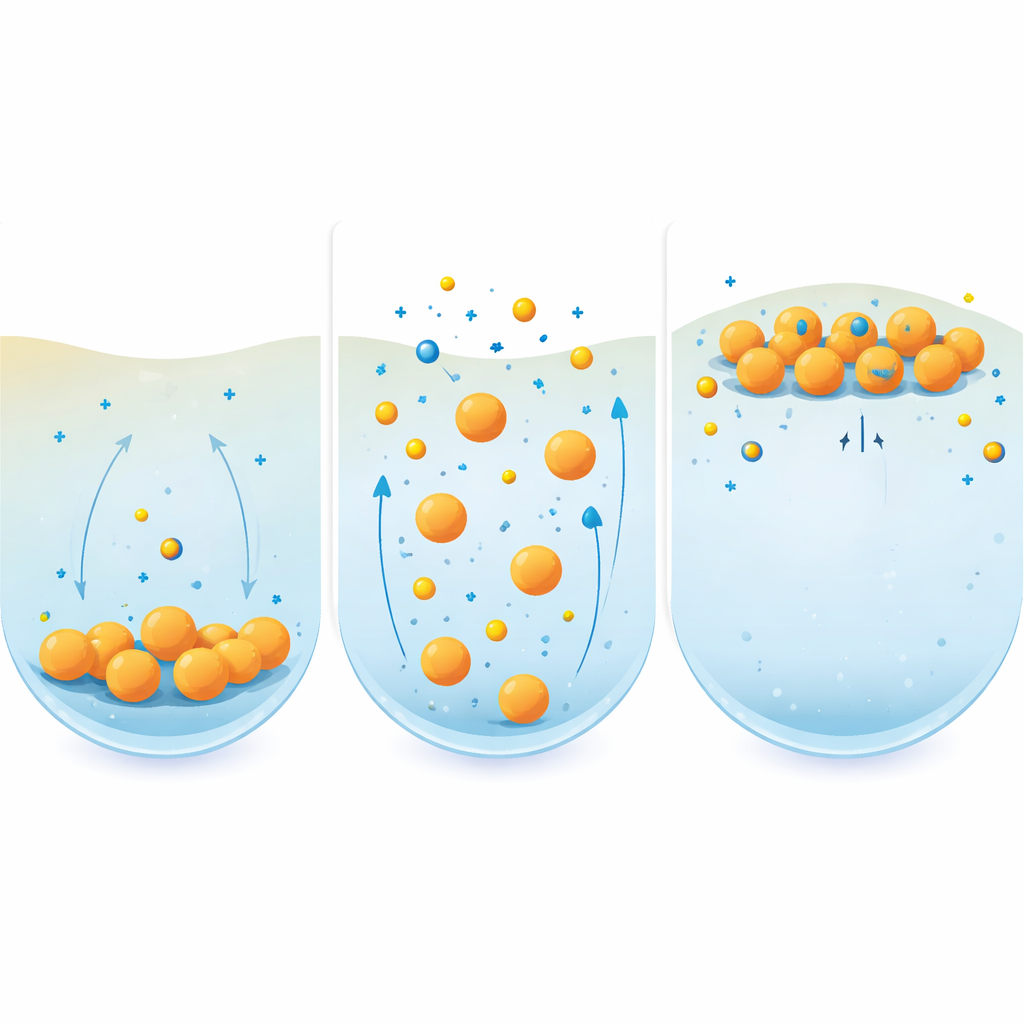
Gravity and buoyancy added another twist. The soft beads and the surrounding oil have slightly different densities, so the beads drifted upward inside each oil droplet and collected into a stack of thin layers near the top. At first these layers were loose and irregular. As more barium ions arrived and surface charge increased, the electrical push between neighboring beads strengthened. Over several hours, the upper layers gradually shifted from a disordered arrangement to a nearly perfect hexagonal pattern, much like oranges stacked in a grocery display. Detailed image analysis—tracking bead positions, the shapes of their surrounding “cells,” and patterns in the images’ Fourier transforms—showed this order emerging first in the topmost layer and weakening with depth, where beads remained smaller and less strongly repelling.
Measuring Invisible Forces with Simulations
To put numbers to these invisible forces, the authors treated each bead as if it were held in a gentle spring cage created by its neighbors. By watching how much beads wiggled around their average positions, they extracted an effective “spring constant,” a measure of how stiff the crystal-like structure was. They then ran Brownian dynamics computer simulations, varying both the strength and range of the electric repulsion, until the simulated springiness matched the experiments. This comparison pinned down the distance over which charges are screened in the oil—about 2.5 to 3 micrometers, many times larger than in salty water—confirming that the beads feel one another over relatively long distances. The team also defined a dimensionless interaction parameter that compares electrical energy to random thermal motion, finding that clear ordering appears once this ratio passes roughly 120 and becomes very robust at higher values.
Tuning Order with Ions and Gentle Disturbances
Because the system’s behavior depends so strongly on ions, the authors explored how different ion types and concentrations changed the outcome. Low barium levels left beads coalescing or poorly organized, while higher levels produced clean, stable hexagonal lattices. Multivalent ions like barium and calcium worked far better than simple salts such as sodium or potassium, with barium giving the most durable structures. Remarkably, when the team disturbed the ordered arrays with a magnet (by first adding tiny iron oxide particles to the beads) or by gently shaking the sample, the crystals temporarily melted into a disordered state. Once the disturbance stopped, the beads reassembled into ordered layers, demonstrating a kind of self-healing solid that can be repeatedly disrupted and rebuilt.
Why This Matters for Future Soft Materials
In everyday terms, this work shows how a collection of soft, wet beads inside an oil droplet can evolve from chaotic motion to a precise, crystal-like packing simply by slowly turning up invisible electrical forces over time. The authors provide both a physical picture and concrete numerical markers for when this transition occurs. Their platform is relatively easy to build and image, making it a powerful testbed for exploring how soft particles organize under gentle confinement. Such insights can guide the design of responsive gels, reconfigurable coatings, and model systems that mimic how more complex matter—ranging from electronic crystals to biological tissues—organizes itself far from equilibrium.
Citation: Jung, I.H., Revadekar, C.C., Lee, H.S. et al. Nonequilibrium ordering dynamics of confined soft alginate hydrogel colloids driven by time-evolving electrostatic interactions. Nat Commun 17, 3662 (2026). https://doi.org/10.1038/s41467-026-70266-w
Keywords: colloidal self-assembly, hydrogel particles, electrostatic interactions, soft matter, non-equilibrium ordering