Clear Sky Science · en
Rab14 restricts pathogens by promoting V-ATPase lysosomal delivery to drive lysosomal acidification
Why our cells’ “stomachs” matter for fighting germs
Drug-resistant infections are rising around the world, making it harder to treat once-curable diseases. This study explores how our own cells naturally destroy invading bacteria and viruses, and uncovers a built-in defense switch that could be turned into a new kind of treatment. Instead of attacking germs directly, the work shows how boosting a small cellular controller called Rab14 helps the cell’s internal “stomachs,” the lysosomes, become more acidic and lethal to many different pathogens at once.
Cell recycling centers that double as germ killers
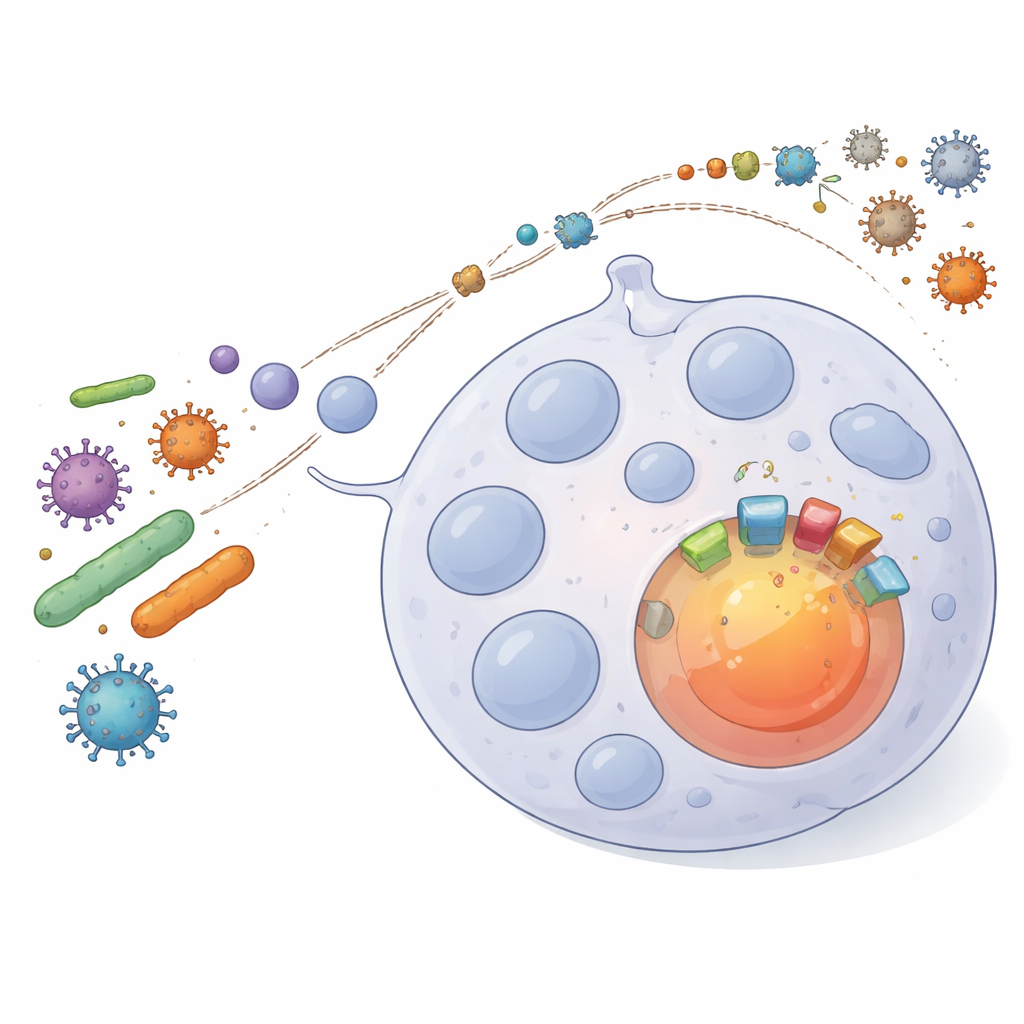
Every cell contains lysosomes—tiny sacs filled with powerful digestive enzymes. They normally break down waste, but they also act as execution chambers for invading microbes. For these enzymes to work well, the inside of lysosomes must be strongly acidic, like a concentrated lemon juice. That acidity is created by V-ATPase, a molecular pump that moves protons into the lysosome. While scientists knew a lot about how this pump is built, they knew far less about how it gets delivered to lysosomes at the right time and place, especially during infections. Understanding this delivery system is key to harnessing lysosomes as weapons against disease.
A traffic cop for the cell’s germ-killing machinery
The researchers focused on Rab proteins, a big family of small molecular switches that guide traffic inside cells. By testing many Rab proteins in immune cells called macrophages, they discovered that losing Rab14 made lysosomes less acidic, even though the number of lysosomes stayed the same. Macrophages without Rab14 were worse at activating a major digestive enzyme, cathepsin D, and allowed bacteria and viruses to survive better inside them. This pattern held across several very different pathogens, including two bacteria and two viruses, suggesting that Rab14 is a broad-spectrum “restriction factor” that naturally limits many infections.
How Rab14 helps load the acid pump
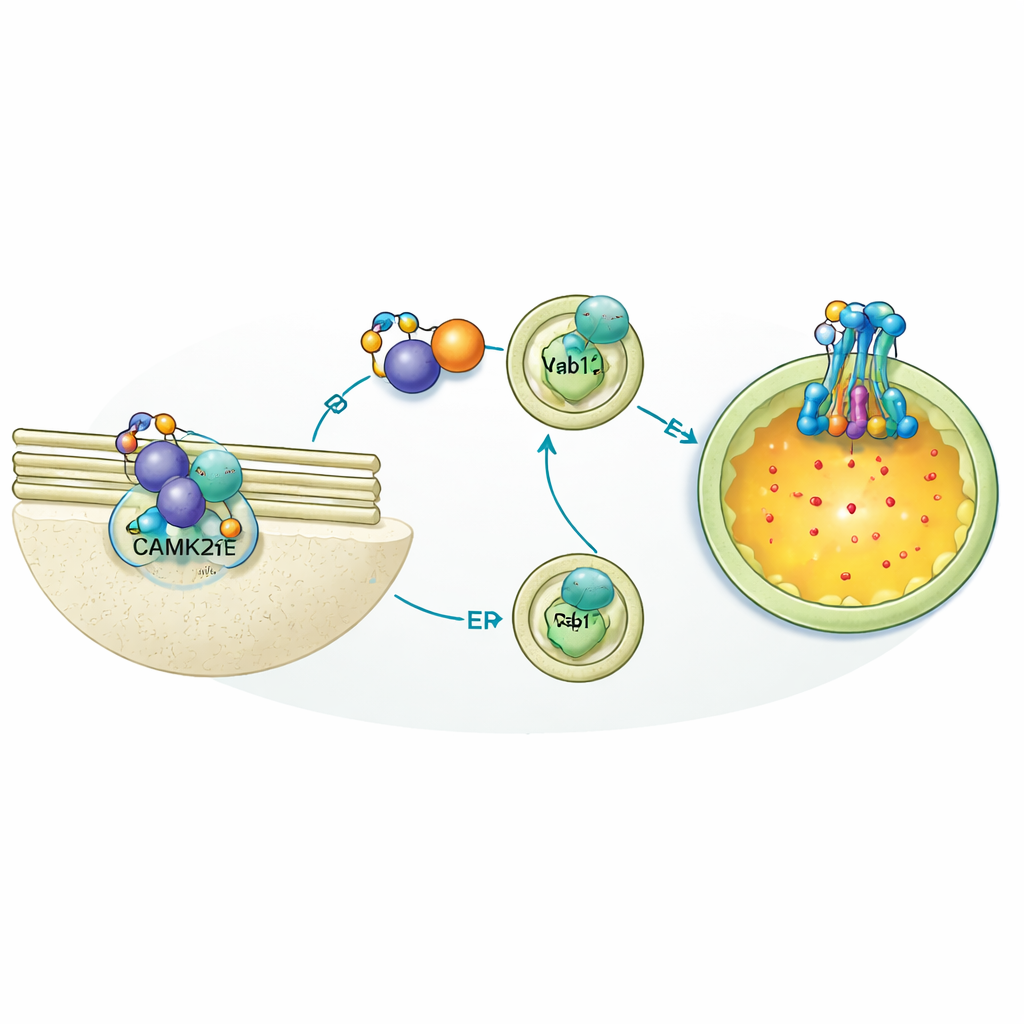
To see how Rab14 sharpens lysosomal acidity, the team traced the journey of V-ATPase’s key targeting subunit, called V0a1. In normal cells, V0a1 travels from the endoplasmic reticulum, through a transport hub called the Golgi, and ends up on lysosomes, where it helps anchor the proton pump. In cells lacking Rab14, however, V0a1 got stuck early in this route and piled up in the endoplasmic reticulum instead of reaching lysosomes. This blockage raised lysosomal pH, weakened enzyme activation, and hampered pathogen clearance, showing that Rab14 is needed specifically to deliver V-ATPase to lysosomes.
A molecular tug-of-war that controls acidity
Diving deeper, the scientists found that Rab14 does not escort V0a1 directly. Instead, it controls another protein, a kinase called CAMK2D, which can add a phosphate “tag” to V0a1 and change its behavior. When Rab14 was missing, V0a1 carried more of this phosphate mark on a single amino acid near its start, and its trip to lysosomes failed. Rab14 binds to CAMK2D and competes with V0a1 for access, preventing this tagging. When CAMK2D’s activity was removed genetically or blocked with a drug, V0a1 could once again attach to the COPII transport machinery, leave the endoplasmic reticulum, and reach lysosomes even in Rab14-deficient cells. This revealed a simple logic: when pathogens are present, more Rab14 switches into its active form, grabs CAMK2D, and lifts the “brake” on V0a1 so the acid pump can be shipped to lysosomes.
From cell cultures to infected animals
The team then asked whether this pathway matters in living animals. Mice engineered to lack Rab14 in key immune cells carried higher levels of bacteria and viruses in their organs and showed stronger tissue damage during infection. Remarkably, treating these mice with a drug that inhibits CAMK2D’s kinase activity reduced the pathogen load and tissue inflammation, bringing them close to normal animals. This confirmed that Rab14 defends the body in large part by reining in CAMK2D and allowing efficient delivery of V-ATPase to lysosomes.
Turning a natural defense into new therapies
Together, these findings uncover a previously hidden immune mechanism in which Rab14 fine-tunes lysosomal acidity through a simple on–off control of V-ATPase trafficking. By blocking a single phosphate tag on V0a1, Rab14 ensures that more acid pumps reach lysosomes, allowing cells to digest a wide range of invading microbes more effectively. For non-specialists, the key message is that instead of inventing yet another antibiotic or antiviral, future treatments might boost this Rab14–CAMK2D–V-ATPase axis, strengthening the cell’s own “acid bath” defenses. Such host-directed strategies could help tackle drug-resistant infections and might also be relevant to brain diseases where faulty lysosomal acidification has been linked to chronic inflammation and degeneration.
Citation: Lei, Z., Qiang, L., Ge, P. et al. Rab14 restricts pathogens by promoting V-ATPase lysosomal delivery to drive lysosomal acidification. Nat Commun 17, 3348 (2026). https://doi.org/10.1038/s41467-026-70258-w
Keywords: lysosomal acidification, host-directed therapy, Rab14, V-ATPase trafficking, intrinsic immunity