Clear Sky Science · en
Re-entrant unconventional superconductivity induced by rare-earth substitution in Nd1-xEuxNiO2 thin films
Why Mixing Metals Can Make Better Superconductors
Superconductors are materials that can carry electricity with zero loss, promising ultra-efficient power lines, powerful magnets, and next‑generation electronics. Most high‑temperature superconductors discovered so far are based on copper. This study explores a newer family made from nickel and shows that carefully swapping in a magnetic rare‑earth element, europium, can not only strengthen superconductivity but even allow it to flourish under intense magnetic fields that would normally destroy it.
Nickel Superconductors Enter the Spotlight
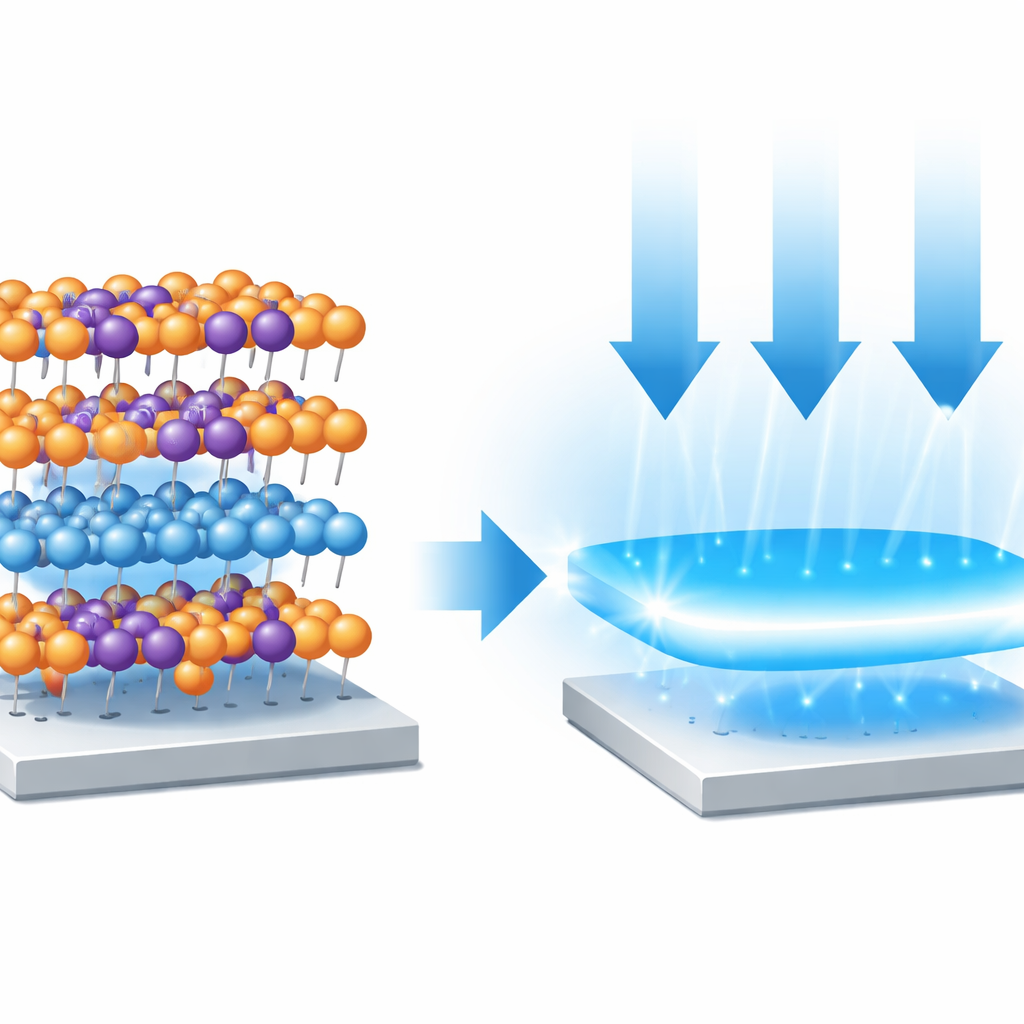
In the last few years, thin films of so‑called “infinite‑layer” nickelates have emerged as copper’s cousins in the search for high‑temperature superconductivity. These materials are built from stacked sheets of nickel and oxygen, with a layer of rare‑earth atoms such as neodymium (Nd) sandwiched in between. Earlier work suggested that, unlike in copper‑based superconductors, nickelates showed only weakly bound electron pairs, a sign of relatively modest superconducting strength. Intriguingly, changing the rare‑earth element was already known to alter the superconducting behavior, hinting that the supposedly innocent spacer layer actually plays an important role.
Adding Europium Changes the Game
The authors focus on thin films of Nd1-xEuxNiO2, in which some of the neodymium atoms are replaced by europium (Eu). Europium carries strong magnetic moments, making it a powerful local magnet inside the crystal. The team grew ultrathin, carefully controlled films with different Eu concentrations and then measured how their electrical resistance responded to temperature and to very large magnetic fields—up to 60 tesla, far beyond what standard laboratory magnets can provide. Instead of magnetic fields simply quenching superconductivity, the researchers observed something striking: over a wide range of fields, the superconducting state was actually stabilized and became more robust.
When Magnetism Protects Superconductivity
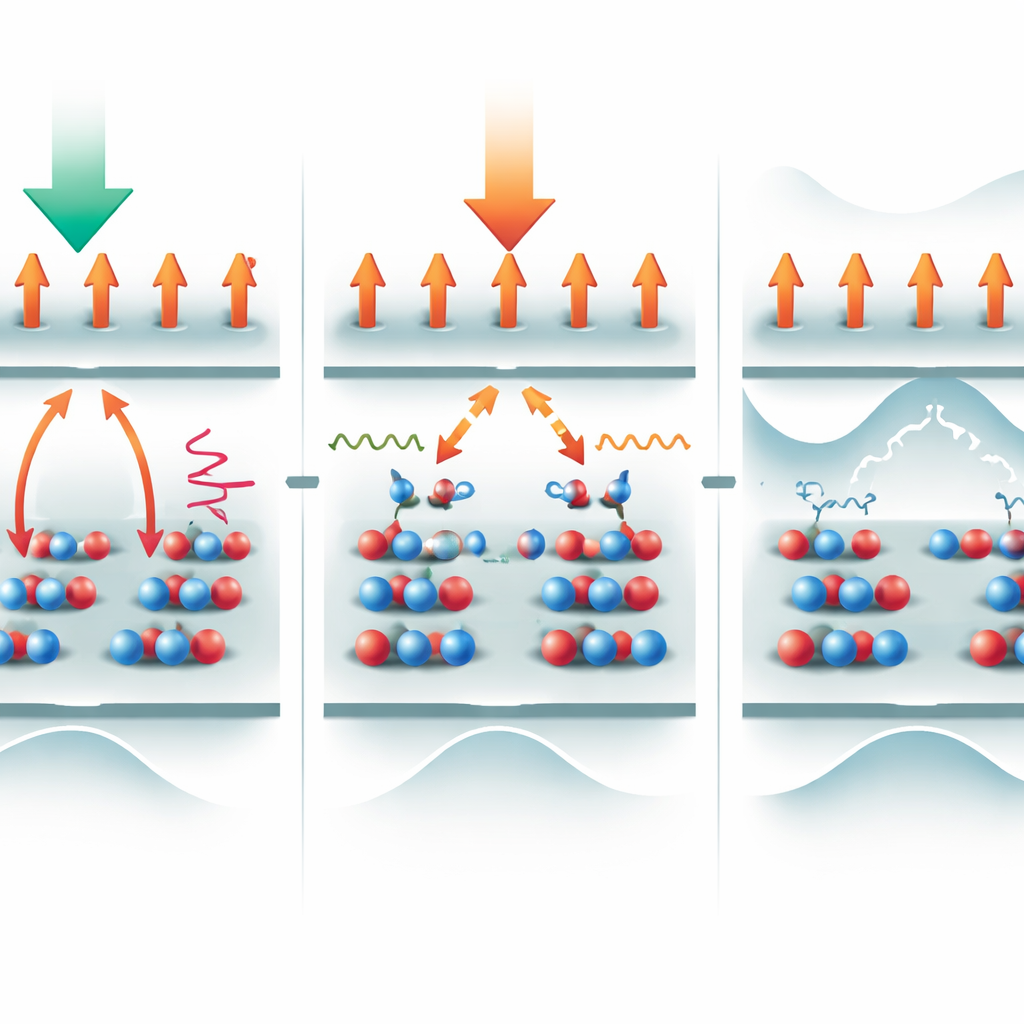
Under ordinary circumstances, a magnetic field eventually tears apart the paired electrons that enable superconductivity, setting an upper limit to how strong the field can be before the material reverts to normal resistance. In these Eu‑doped nickelates, that limit is dramatically exceeded. Detailed measurements of resistance as a function of temperature and field revealed a non‑monotonic behavior: superconductivity weakens at low fields, then re‑emerges or strengthens at higher fields, a phenomenon known as re‑entrant superconductivity. The authors explain this with a subtle magnetic compensation effect, long theorized but rarely seen in thin films. The europium moments couple antiferromagnetically to the electrons in the nickel‑oxygen sheets, creating an internal magnetic field that opposes the applied one. As the external field polarizes the Eu moments, their internal field partially cancels the field felt by the superconducting electrons, allowing superconductivity to survive—and even improve—at fields where it should have vanished.
Probing the Strength of Electron Pairing
To find out how strongly electrons are paired in these materials, the team turned to infrared spectroscopy, which can detect the energy needed to break pairs apart. By comparing the reflected light from the film above and below the superconducting transition temperature, they extracted the size of the superconducting gap. The gap they measured in Eu‑doped films is significantly larger than in related nickelates doped with strontium instead of europium. Expressed relative to the transition temperature, this gap falls in the same range as strongly coupled copper‑oxide superconductors, indicating that the pairing interaction here is also unusually strong. The data are consistent with a nodal d‑wave–like state, in which the gap vanishes along certain directions, again echoing the behavior of well‑studied cuprate materials.
Shaping Superconductivity with Atomic Substitutions
The researchers combined their experiments with advanced quantum mechanical calculations to show that europium’s magnetic moments exert a sizable exchange field specifically on electrons in the nickel orbitals most responsible for superconductivity. This targeted interaction appears to boost the pairing strength and is essential for the magnetic‑field compensation effect. At the same time, Eu’s smaller ionic size subtly alters the spacing between the nickel‑oxygen layers, which may further enhance pairing. Together, these effects transform Nd1-xEuxNiO2 into a strongly coupled, unconventional superconductor whose behavior contrasts sharply with its strontium‑doped cousin.
What This Means for Future Superconductors
In plain terms, this work shows that by choosing the right magnetic rare‑earth ingredient, scientists can not only dial up the strength of superconductivity in nickelates but also make it unusually resilient to strong magnetic fields. The europium atoms act as internal, adjustable magnets that protect the fragile paired electrons rather than destroy them. This rare example of magnetic‑field‑enhanced superconductivity in a thin film points to a powerful design principle: using magnetic dopants in the spacer layers to tune both the pairing strength and the way superconductivity responds to extreme conditions. Such control could be crucial for engineering future high‑temperature superconductors for real‑world technologies.
Citation: Vu, D., Lee, H., Nicoletti, D. et al. Re-entrant unconventional superconductivity induced by rare-earth substitution in Nd1-xEuxNiO2 thin films. Nat Commun 17, 3480 (2026). https://doi.org/10.1038/s41467-026-70254-0
Keywords: nickelate superconductors, europium doping, magnetic-field-enhanced superconductivity, Jaccarino-Peter effect, strong-coupling pairing