Clear Sky Science · en
Additive manufacturing of cellulose-based photopolymerizable resin with high strength and shape-memory
Why smart 3D‑printed plastics matter
Additive manufacturing, better known as 3D printing, is transforming how we make everything from aircraft parts to medical devices. Yet most of today’s photo‑curable printing resins are based on fossil fuels and behave like brittle glass: once bent or crushed, they crack and stay damaged. This study introduces a new kind of 3D‑printing resin made largely from cellulose—the main building block of plants—that is not only strong and stiff, but can also “remember” its original shape and snap back after heavy deformation. Such materials could make future products tougher, lighter, and more sustainable.
Borrowing a trick from plant cell walls
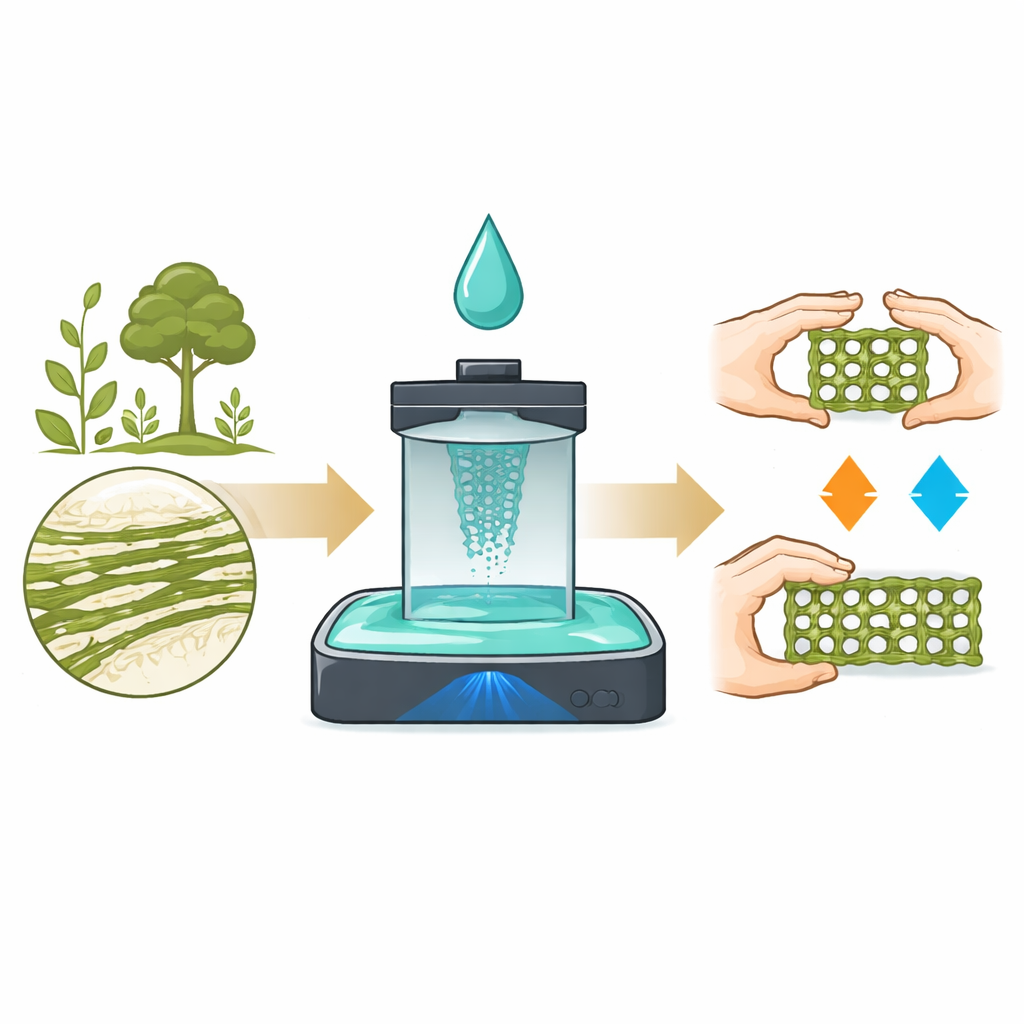
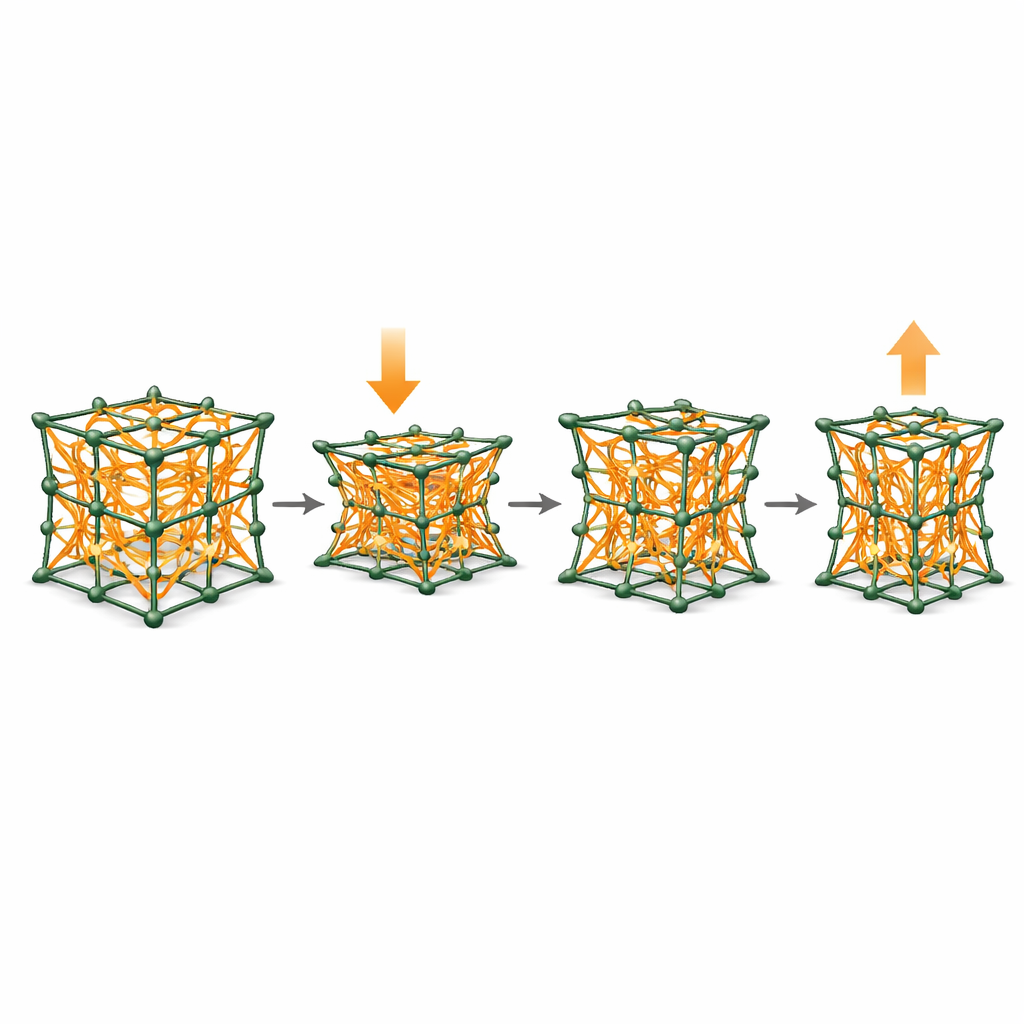
Plants survive wind, impacts and their own weight thanks to a subtle architecture in their cell walls. Bundles of cellulose fibers are packed in semi‑ordered layers that can slide a little when stressed, dissipating energy without breaking. The authors mimic this natural strategy in a printable resin. They start with microcrystalline cellulose, a refined plant material, and chemically attach small reactive units that allow it to harden under light. Mixed with a supporting network of more conventional plastic chains, the result is a dense tangle of rigid backbones intertwined with cellulose strands that can move slightly under load, much like the fibers in wood.
From liquid resin to shape‑shifting structures
The team formulates this cellulose‑based resin so it can be used in digital light processing (DLP), a common 3D‑printing method where patterns of ultraviolet light solidify thin layers of liquid in seconds. Using this approach, they print intricate lattice structures without extra supports, demonstrating good flow, curing speed, and dimensional accuracy. When these printed pieces are compressed in a testing machine to 75% of their height, or even run over by a bus to generate complex, uneven forces, they do not crack or crumble. Instead, after the load is removed they recover their original shape within a few minutes, showing a strong “spatiotemporal memory” of both form and function.
Strength that rivals industrial plastics
Mechanical tests reveal that the new material, called CPPR‑P, combines properties that rarely coexist. Under compression, it reaches strengths around 115 megapascals and remains elastic over strains of about 80%, recovering fully after unloading. In tension it is markedly stronger and stiffer than versions of the resin missing key cellulose‑based steps, and it withstands many loading cycles with little fatigue. Shear tests show high resistance to sliding failure between layers, crucial for printed architectures. Compared with widely used materials such as UV‑cured epoxy, nylon and flexible polyurethane, CPPR‑P offers higher compressive strength than all three, stiffness comparable to epoxy, and far superior ability to spring back repeatedly instead of suffering permanent damage.
Built to work in real‑world conditions
The researchers also probe how the resin behaves under heat, water exposure and repeated motion. Dynamic mechanical analyses indicate that below about 90 °C the solid stores mechanical energy efficiently, while around this temperature it can dissipate energy and switch between shapes—ideal for controlled shape‑memory behavior. Thermal measurements show decomposition only above roughly 250 °C, indicating good stability during typical use. When immersed in water for months, printed samples swell modestly but keep their integrity and stiffness; in some cases their strength even increases, reflecting subtle rearrangements in the internal network. Microscopy and scattering techniques confirm a uniform, tightly crosslinked microstructure that explains the balance of toughness and resilience.
What this means for future devices
By translating a natural stress‑dissipation mechanism from plant cell walls into a light‑curable, cellulose‑rich resin, this work shows that 3D‑printed parts do not have to choose between strength, flexibility, and sustainability. CPPR‑P offers a rare mix of high stiffness, high strength, and reliable shape memory under realistic, multi‑directional loads. In practical terms, it could enable reusable impact‑absorbing components, protective housings that recover after shocks, and lightweight structures that function in wet or warm environments—all while relying on a renewable biomass feedstock. The study thus outlines a path toward greener, smarter materials for the next generation of additively manufactured products.
Citation: Zhao, X., Li, J. & Xiao, S. Additive manufacturing of cellulose-based photopolymerizable resin with high strength and shape-memory. Nat Commun 17, 3423 (2026). https://doi.org/10.1038/s41467-026-70253-1
Keywords: cellulose, 3D printing, shape memory, photopolymer resin, additive manufacturing