Clear Sky Science · en
Accelerated discovery of highly active enzyme nanohybrids with parallelized Bayesian optimization in hybrid space
Smarter Factories for Nature’s Tiny Workers
Enzymes are nature’s microscopic machines, quietly powering everything from how plants capture sunlight to how our bodies digest food. Industries would love to harness these same biological tools to make fuels, medicines, and materials more cleanly and efficiently. But enzymes are delicate: outside their natural comfort zone, they often unfold and stop working. This study shows how an artificial intelligence (AI)–guided approach can rapidly design protective “nano-suits” that keep enzymes active and reusable under tough industrial conditions, potentially cutting costs and speeding greener manufacturing.
Why Enzymes Need a Protective Home
On their own, enzymes float freely in water and constantly flex in order to catalyze chemical reactions with remarkable speed and precision. In factories, however, high temperatures, harsh solvents, and repeated use can damage their fragile shapes. A common fix is to trap enzymes inside or onto solid particles so they can be recovered and reused more easily. Unfortunately, this often creates a trade-off: the enzyme becomes more stable, but its activity plummets because the surrounding material blocks molecules from reaching its active sites, or the harsh growth conditions harm the enzyme during encapsulation. Designing the right “home” for each enzyme has therefore become a slow, trial-and-error art.
Exploring a Huge Design Space with AI
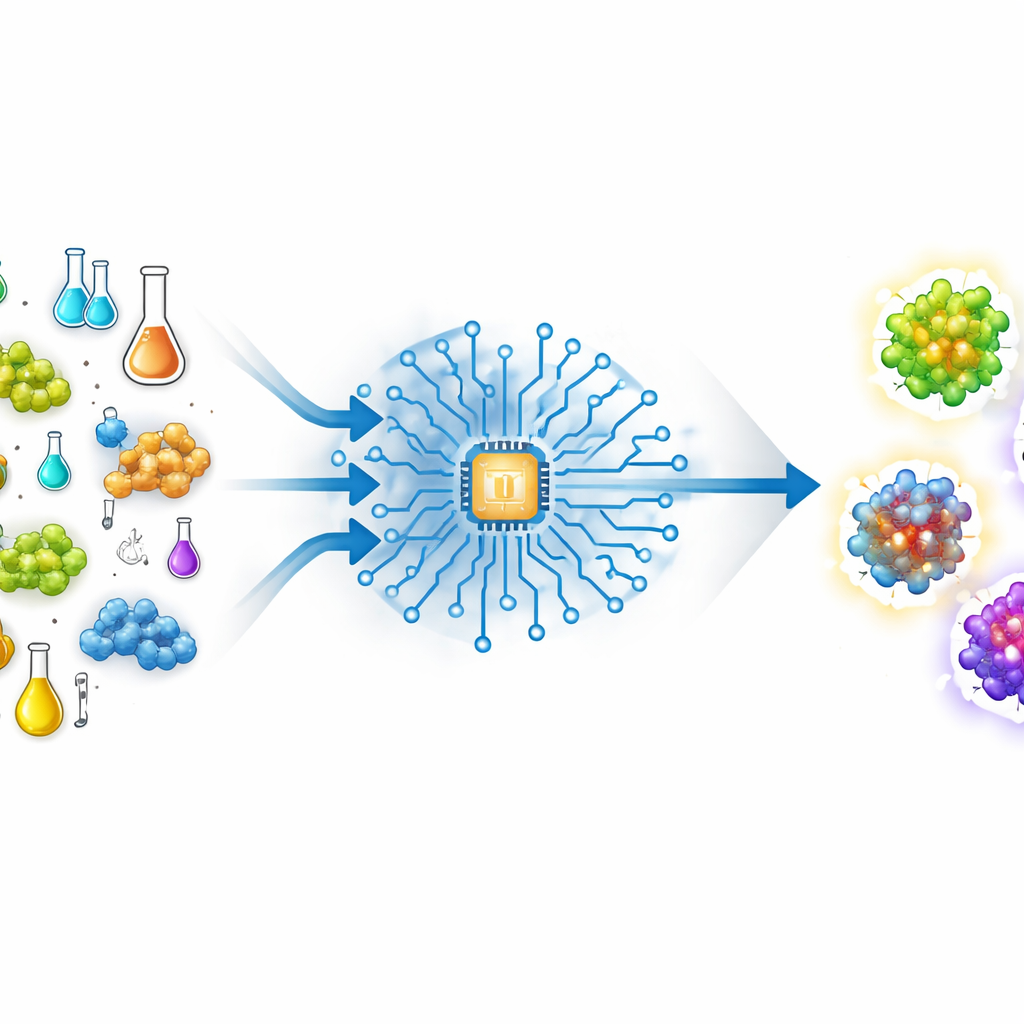
The team tackled this problem using tiny porous or amorphous materials called metal–organic frameworks (MOFs) as enzyme carriers. These are built from metal ions (in this case, zinc salts) and organic “linker” molecules that snap together like modular building blocks. By combining 7 different zinc salts, 17 different linkers, and continuously tunable concentrations and reaction times, the researchers faced a design space of more than ten million possible experiments—far too many to test by hand. Instead of attempting to brute-force this landscape, they created an AI-driven workflow centered on a new algorithm called parallelized hybrid-space Bayesian optimization (PHBO), which can juggle both “either–or” choices (which metal and linker) and continuous knobs (how much, how long) while proposing multiple promising recipes at once.
How the Algorithm Learns and Improves
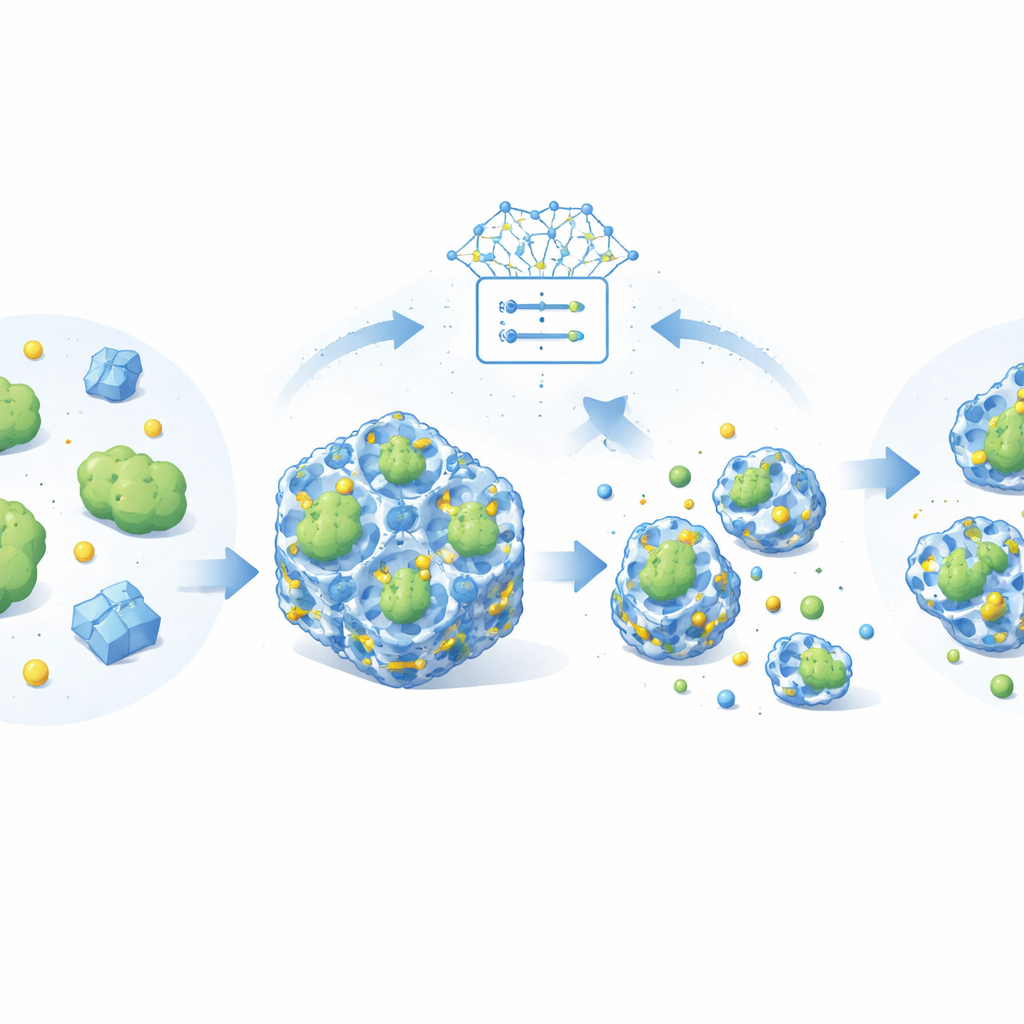
PHBO works by building a statistical model that links recipes to a single performance score called “activity recovery,” which captures both how much enzyme ends up in the carrier and how well it still works afterward. Starting from a modest set of initial experiments, the algorithm predicts where in the design space high-performing materials are likely to be found and suggests small batches of new experiments in parallel. Crucially, it treats the choice of metal and linker as probability distributions rather than fixed picks, allowing it to use gradient-based methods—tools usually reserved for smooth, continuous problems—to climb toward better solutions more efficiently. A “nearby liar” strategy helps it diversify each batch of suggested experiments, preventing the robot chemist from repeatedly testing nearly identical conditions.
Tailored Nano-Suits for Different Enzymes
Using glucose oxidase (GOx), an enzyme important in biosensors and food processing, the researchers showed that PHBO could outperform both human-guided trial-and-error and a previous Bayesian approach. Within just dozens of experiments, it identified zinc–linker combinations that restored and even exceeded the activity of the free enzyme, while still offering the benefits of immobilization. Microscopy and structural measurements revealed that the best carriers were not the traditional, rigid, highly porous crystals, but rather smaller, more amorphous zinc–organic nanohybrids. These formed loose, enzyme-rich solid regions with minimal internal pore structure, helping substrates reach the enzymes more easily while still protecting their three-dimensional shapes.
Learning from One Enzyme to Help Another
The team then went a step further by asking whether what the AI had learned for one enzyme could speed optimization for others. They used the data and model structure from GOx to “warm up” searches for two very different enzymes: catalase, which breaks down hydrogen peroxide, and Candida antarctica lipase B, widely used in making fine chemicals. With this transfer learning, the first set of suggested conditions for each new enzyme already delivered strong performance, and subsequent rounds quickly uncovered carriers achieving near-complete recovery of activity. Interestingly, the ideal carrier recipes differed for each enzyme, highlighting that there is no one-size-fits-all material and underscoring the value of a flexible, data-driven design tool.
What This Means for Greener Chemistry
For a non-specialist, the key takeaway is that the authors have built a kind of “smart explorer” for enzyme materials. Instead of spending months or years testing thousands of recipes, scientists can use this AI-guided approach to home in on a handful of highly active enzyme–nanocarrier combinations, even in a vast sea of possibilities. The study shows that by loosely confining enzymes in carefully tuned nanostructures, it is possible to keep them stable without sacrificing performance, and to adapt the strategy rapidly to new enzymes and applications. In practical terms, this could accelerate the development of cleaner, more efficient industrial processes—from pharmaceuticals to biodegradable plastics—by making it far easier to deploy enzymes as robust, high-performance catalysts.
Citation: Liu, Y., Hu, H., Han, Y. et al. Accelerated discovery of highly active enzyme nanohybrids with parallelized Bayesian optimization in hybrid space. Nat Commun 17, 3634 (2026). https://doi.org/10.1038/s41467-026-70251-3
Keywords: enzyme immobilization, Bayesian optimization, metal-organic frameworks, biocatalysis, machine learning in chemistry