Clear Sky Science · en
A hormetic transcriptional program coregulates invasion, proliferation and dormancy to define metastatic potential
Why some cancers return years later
Many people survive their first diagnosis of breast cancer, only to face the disease again years or even decades later when hidden cells in distant organs suddenly begin to grow. This study asks a deceptively simple question with huge implications: what is different about the cancer cells that quietly spread, sleep, or awaken to form deadly metastases? By tracking how tumor cells change inside breast cancers and in experimental models, the authors uncover a single molecular program that simultaneously controls how cancer cells move, multiply, and fall asleep—thereby shaping a tumor’s true metastatic potential.
The hidden travelers at the tumor’s edge
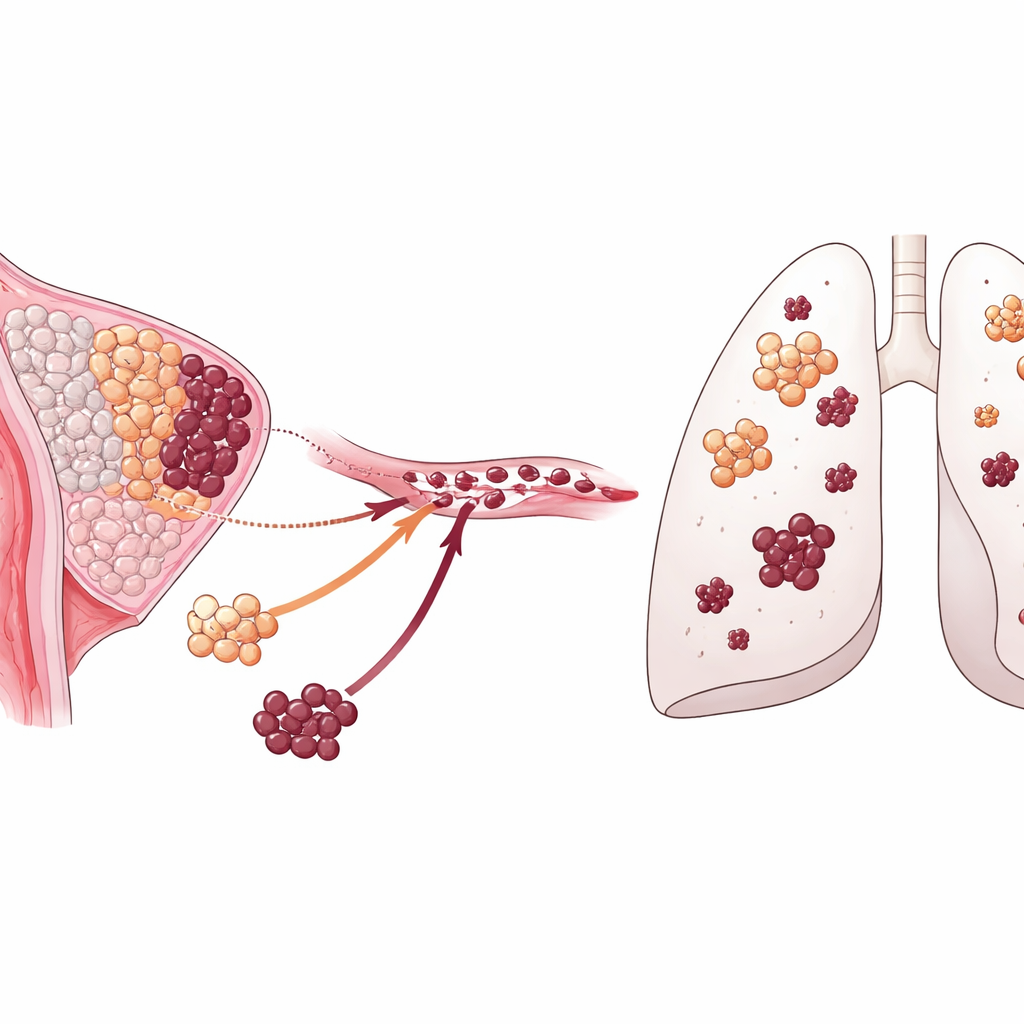
The researchers began with tissue samples from women with aggressive breast tumors. They focused on cells located at the tumor’s outer rim, where cancer first invades surrounding tissue and escapes into the bloodstream. Using staining methods to visualize a protein called Prrx1, they found three patterns: tumors with no detectable Prrx1, tumors with scattered cells showing intermediate levels, and tumors with many cells expressing very high levels. Surprisingly, patients whose tumors had intermediate Prrx1 in a minority of cells were most likely to develop distant metastases, while those with very high Prrx1 fared comparatively better. This non-linear pattern suggested that it is not simply the presence of Prrx1, but how much of it cancer cells carry, that matters most for metastasis.
A sweet spot between motion and rest
To explore this counterintuitive result, the team turned to mouse models of breast cancer engineered to produce different amounts of Prrx1 in tumor cells. In these animals, overall tumor size was similar regardless of Prrx1, but the number and size of metastases changed dramatically. Mice whose tumors expressed an intermediate dose of Prrx1 developed the most numerous and largest metastatic colonies in the lungs. Tumors lacking Prrx1 altogether were less invasive and formed fewer metastases, while tumors with very high Prrx1 sent out cells that traveled but largely failed to grow after arrival. This confirmed that Prrx1 acts like a dial: too little and cells do not invade efficiently; too much and they invade but then stall.
Zooming in on invading cells
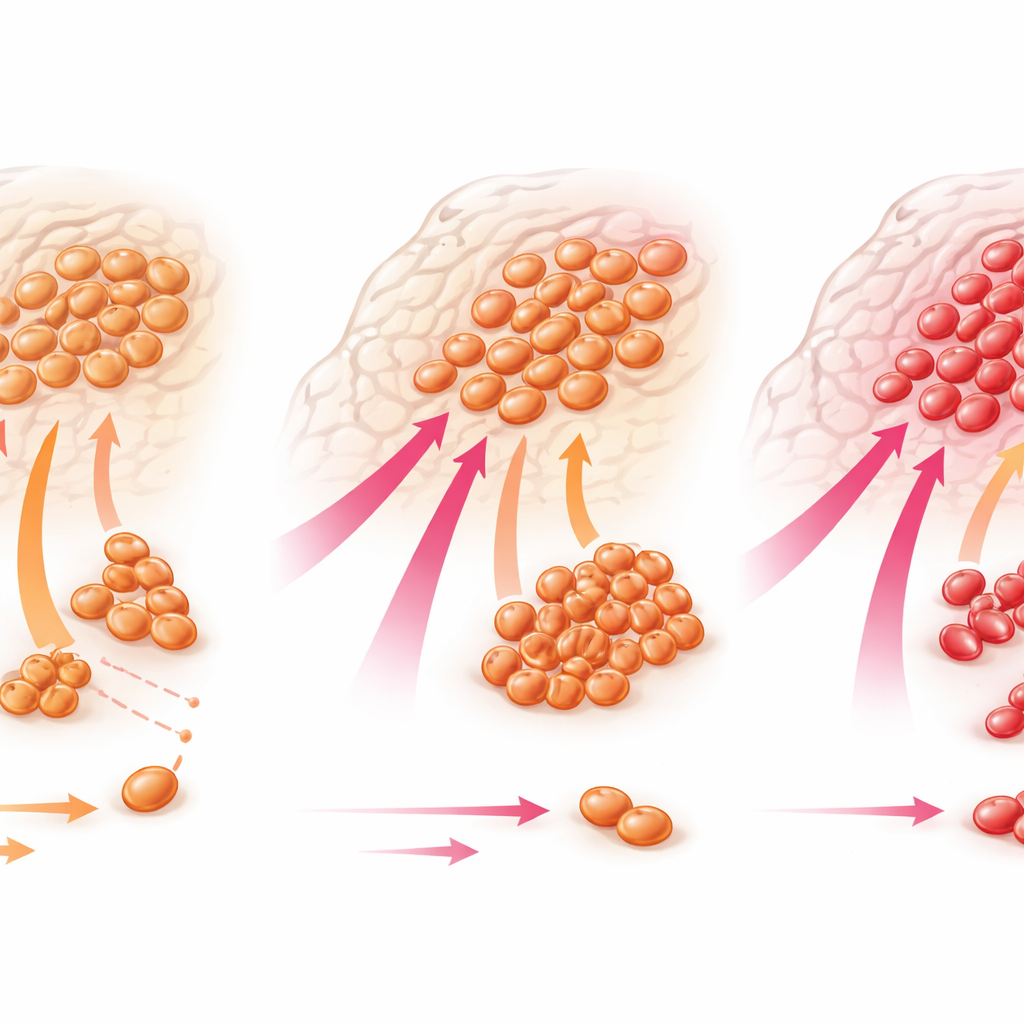
Using powerful single-cell technologies, the researchers mapped which genes were active in thousands of individual tumor cells and where those cells sat in the tissue. Cells at invasive edges formed a distinct population with features of a partial “shape-shifting” state between epithelial and mesenchymal identities. In these border cells, Prrx1 turned on a set of genes that help break down surrounding tissue and promote movement, but also genes that slow the cell cycle and trigger a dormant, non-dividing state. When Prrx1 levels were very high, the dormancy program was strong and invasive cells tended to lie low after reaching distant organs. When Prrx1 was only moderately expressed, the same cells retained their invasive behavior but were less likely to become dormant, allowing them to both travel and divide to seed growing metastases.
How one factor ties together invasion, growth and sleep
To understand how Prrx1 could coordinate such different behaviors, the team analyzed how DNA is packaged and accessible in invasive cells. They found that regions controlling key cell-cycle regulators and dormancy-related genes were open and decorated with Prrx1 binding sites. In cell culture experiments using human breast cancer lines, dialing Prrx1 up or down directly altered the balance between invasion-promoting genes, growth-promoting cyclins, and genes associated with cellular sleep. High Prrx1 reinforced invasion but activated brakes on division and boosted dormancy genes; partial reduction of Prrx1 weakened those brakes while preserving the ability to move. This “hormetic” pattern—where intermediate levels of a factor produce the strongest effect—provides a mechanistic explanation for why hybrid, partially transformed cancer cells can be the most dangerous.
Finding high-risk patients before metastasis strikes
Finally, the researchers linked their mechanistic insights back to patient data. By scoring breast tumors in large clinical datasets for gene patterns tied to invasion, proliferation, and dormancy, they identified a subgroup of patients whose cancers were simultaneously highly invasive and highly proliferative, with relatively weak dormancy signals. These tumors tended to show intermediate PRRX1 expression and were associated with the poorest survival, especially soon after diagnosis. In contrast, tumors that were invasive but less proliferative, with stronger dormancy signatures and higher PRRX1, carried a better outlook. To a lay reader, the key message is that metastatic risk is encoded in the primary tumor long before cells are detected elsewhere: a small fraction of cells at the tumor’s edge, tuned to just the right level of a single regulator, can both escape and grow. Recognizing and targeting this “sweet spot” state—rather than invasion or growth alone—may be essential for therapies that truly prevent metastatic relapse.
Citation: Jiménez-Castaño, R., Narwade, N., Moreno-Bueno, G. et al. A hormetic transcriptional program coregulates invasion, proliferation and dormancy to define metastatic potential. Nat Commun 17, 3425 (2026). https://doi.org/10.1038/s41467-026-70242-4
Keywords: breast cancer metastasis, tumor dormancy, epithelial mesenchymal transition, transcription factors, single-cell genomics