Clear Sky Science · en
Magnon damping as a probe of Kondo coupling in magnetically ordered systems
Listening to the Quiet in a Magnetic Crystal
Modern electronics increasingly rely on the quantum quirks of electrons and spins inside solids. One especially puzzling set of behaviors, known as Kondo physics, shows up when mobile electrons jostle with tiny magnetic moments in a material. This article explains how scientists used delicate neutron experiments to "listen" to ripples of magnetism—called magnons—in a layered metallic magnet, and discovered that the way these ripples fade provides a new window into Kondo physics in everyday 3d-electron materials.
A Tug-of-War in Quantum Metals
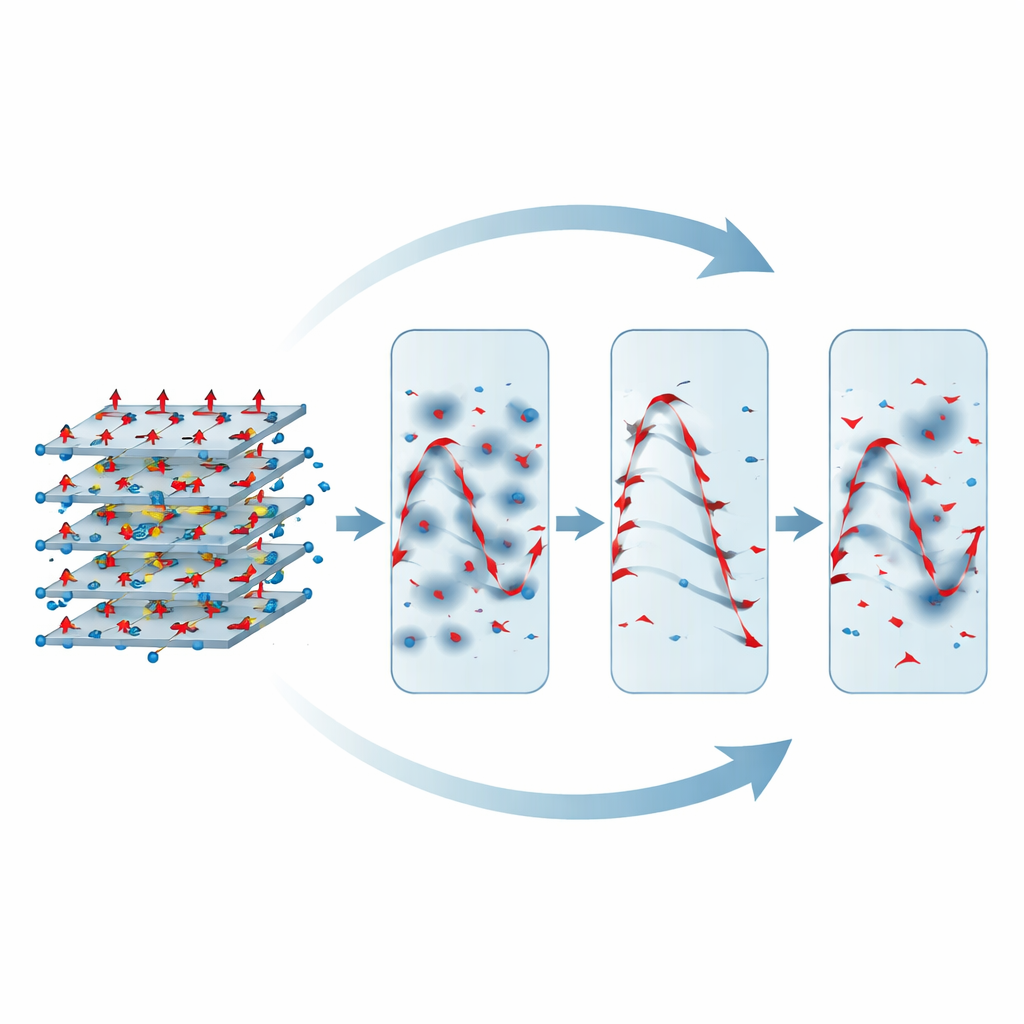
In certain metals, electrons do double duty. Some behave like localized tiny bar magnets, while others roam freely and conduct electricity. Kondo physics describes how these roaming electrons scatter off isolated magnetic impurities, producing strange signatures such as a resistivity minimum as temperature is lowered. When instead of rare impurities there is a dense lattice of local moments, the same basic interaction becomes a many-body tug-of-war between magnetic order and the tendency of the electrons to screen and neutralize those moments. In classic “heavy-fermion” compounds based on rare-earth or actinide elements, this competition reshapes the electronic structure and can even trigger exotic states such as unconventional superconductivity.
A New Playground: A Layered Magnetic Metal
The team focused on Fe3−xGeTe2, a van der Waals ferromagnet made of stacked atomic sheets. This material is metallic and hosts both localized and itinerant 3d electrons, placing it in the intermediate zone between rigid local moments and fully itinerant magnetism. Earlier work had shown that its magnetism has a dual origin—local moments produce sharp spin waves, while itinerant electrons generate a broader background of spin fluctuations. Transport and spectroscopic measurements had already hinted that some form of Kondo coupling is at work, with evidence of heavy electrons and a change in resistivity slope near 90 K. The open question was whether the magnetic excitations themselves carry a clear fingerprint of this coupling.
Watching Spin Ripples Fade with Temperature
To probe the magnetic dynamics, the researchers used inelastic neutron scattering to track low-energy magnons as the temperature was swept from well below to near the Curie temperature of about 160 K. They monitored how sharply defined the magnon peaks were in energy, which reveals how quickly these collective spin ripples decay—a property known as damping. Surprisingly, the damping did not change smoothly. Instead, it was large at very low temperatures, decreased to a clear minimum around 90 K, and then increased again as the system approached the magnetic ordering temperature. This behavior appeared both for ripples traveling within the atomic layers and for those moving between layers, though the in-plane magnons were noticeably more strongly damped.
A Logarithmic Signature and a Hidden Mechanism
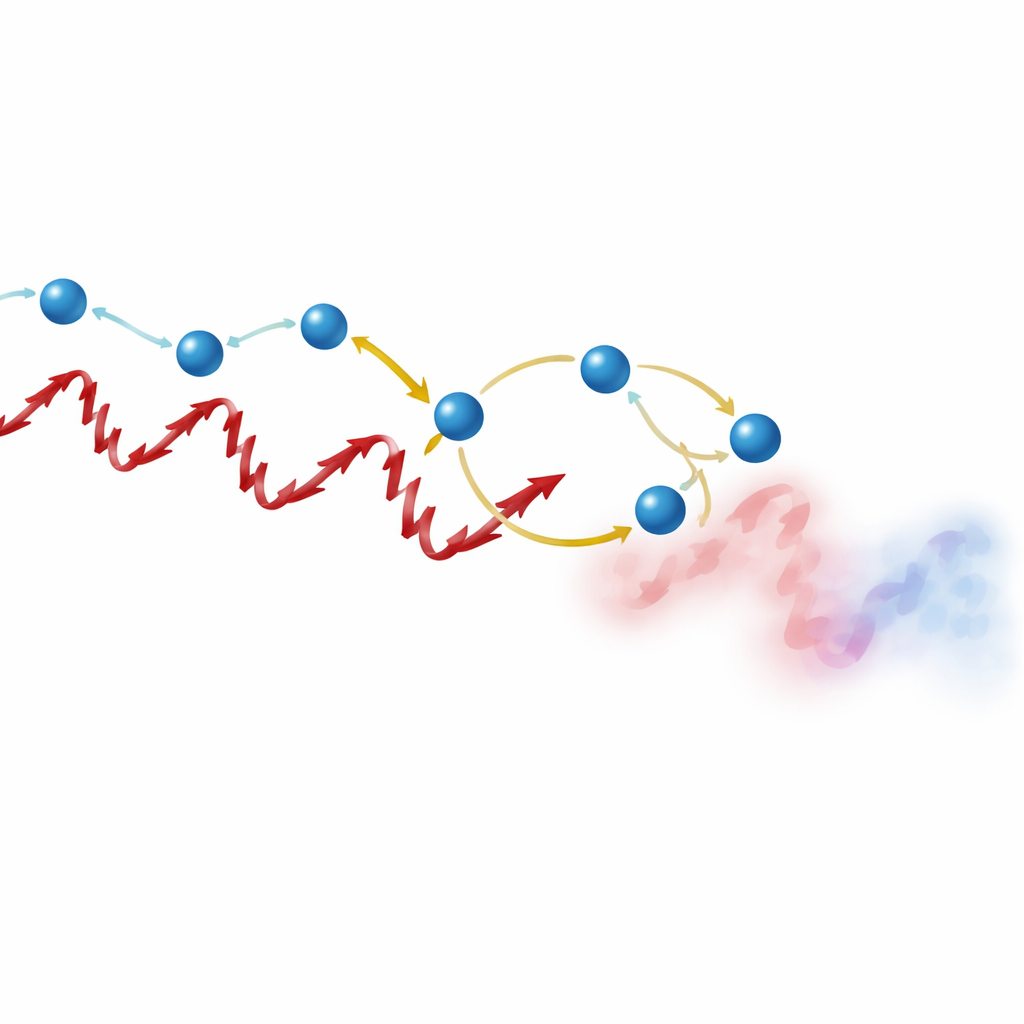
The nonmonotonic damping turned out to be well described by a simple mathematical form that combines a logarithmic term with a power law. The logarithmic part mirrors the hallmark temperature dependence seen in classic Kondo systems, while the power-law part reflects the usual thermal fluctuations that destabilize magnetic order near the Curie point. To go beyond fitting, the authors built a ferromagnetic Kondo–Heisenberg lattice model in which local spins are strongly coupled to each other but only moderately coupled to itinerant electrons. Using advanced tensor-network simulations on a simplified chain version of this model, they reproduced both the damping minimum and the logarithmic scaling, and traced them to spin-flip scattering events where a magnon decays into electronic particle–hole excitations.
Why This Matters for Future Quantum Materials
For a non-specialist, the key message is that the lifetime of magnetic ripples in a solid can reveal how strongly mobile electrons are entangled with local magnetic moments. In Fe3−xGeTe2, magnon damping behaves in a way that unambiguously signals Kondo-like coupling, even though the material is a 3d-electron ferromagnet rather than a traditional heavy-fermion compound. This establishes magnon damping as a sensitive new probe of Kondo physics in magnetically ordered metals, opening the door to exploring similar effects in other quantum magnets and potentially guiding the design of spin-based devices that harness the subtle interplay between magnetism and electron motion.
Citation: Bao, S., Gao, Y., Wang, J. et al. Magnon damping as a probe of Kondo coupling in magnetically ordered systems. Nat Commun 17, 3557 (2026). https://doi.org/10.1038/s41467-026-70241-5
Keywords: Kondo lattice, magnon damping, Fe3GeTe2, heavy fermion, spin waves