Clear Sky Science · en
Topological magneto-optical Kerr effect without spin-orbit coupling in spin-compensated antiferromagnet
Light That Knows Which Way the Spins Twist
In many modern technologies, from hard drives to emerging quantum devices, engineers rely on how light behaves when it bounces off magnetic materials. This study reveals a surprising new way that light can sense magnetism: by detecting a subtle twisting pattern of microscopic magnets, even when the material has almost no overall magnetization and hardly any of the usual relativistic effects. This opens a route to faster, more compact, and more robust devices that control information using hidden patterns in magnetism rather than big magnetic fields.
A New Kind of Magnetic Mirror
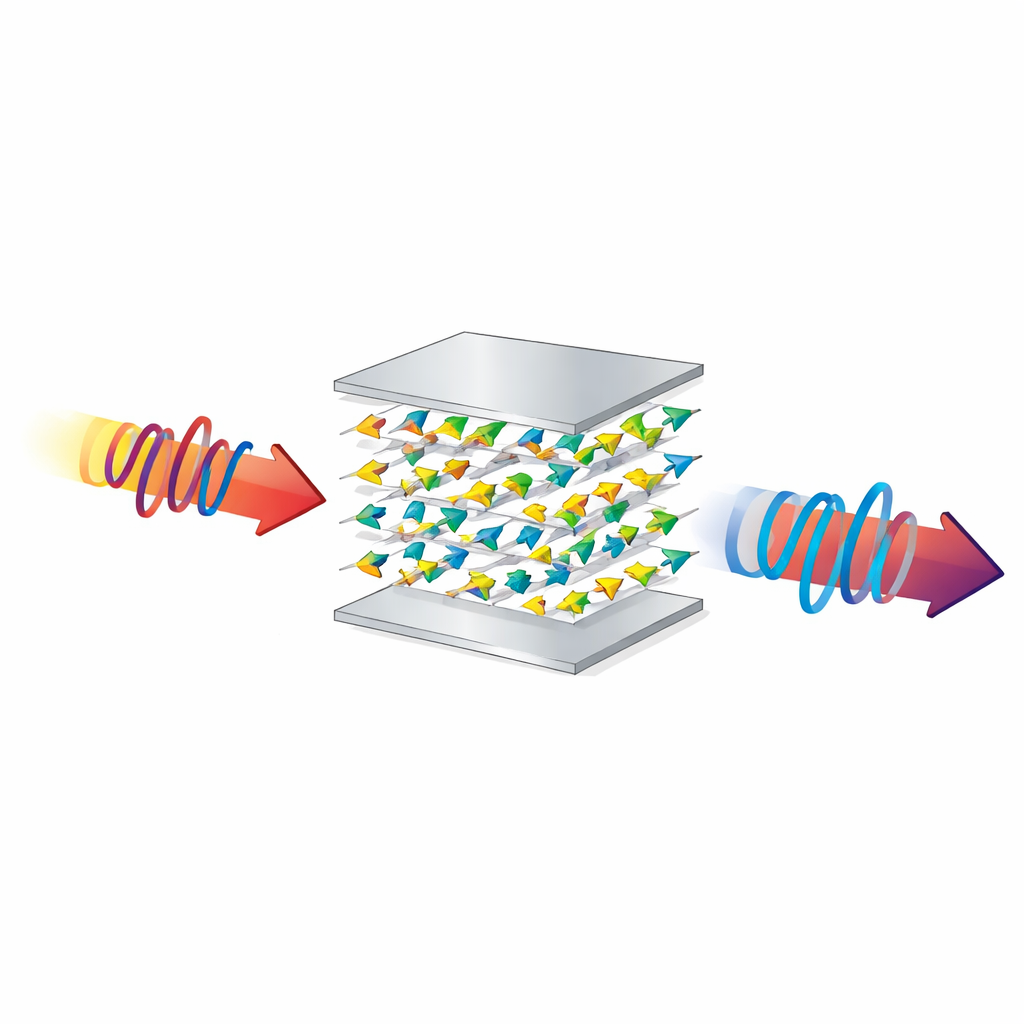
When polarized light reflects from a magnet, its polarization can rotate slightly, an effect known as the magneto-optical Kerr effect. Traditionally, this rotation has been tied to two things: a net magnetic moment (as in a bar magnet) and a relativistic interaction called spin–orbit coupling, which links an electron’s spin to its motion around atoms. The stronger these two ingredients, the larger the Kerr signal. That view has shaped how scientists design materials for optical readout of magnetic data, leading them to seek strong magnetization and heavy elements with strong spin–orbit coupling.
Hidden Twists Instead of Net Magnetism
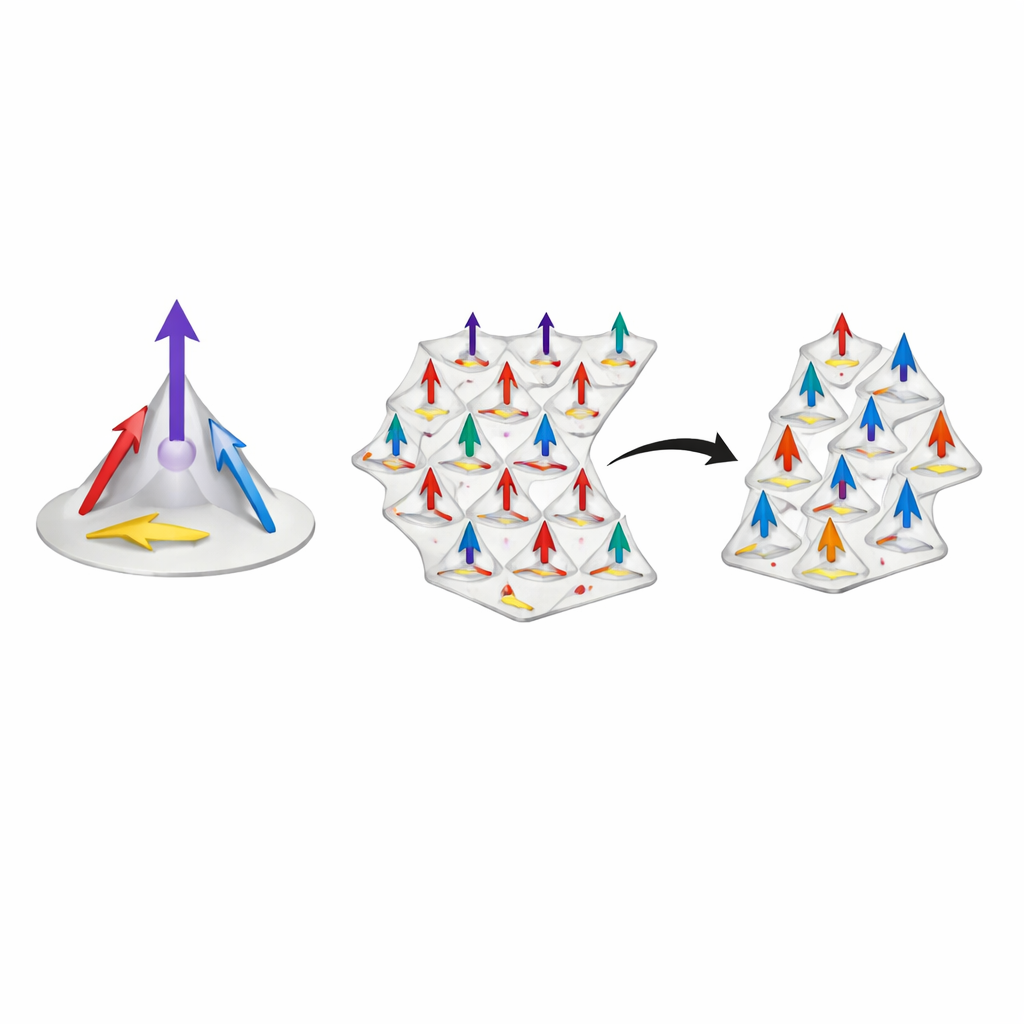
The material studied here, Co1/3TaS2, seems at first glance like a poor candidate for a strong optical response. Its overall magnetization is almost zero, and it does not rely on strong spin–orbit coupling. Instead, its cobalt atoms form a triangular network in which the tiny atomic magnets (spins) tilt in three dimensions to create a noncoplanar “triple-Q” pattern. In this pattern, sets of three neighboring spins do not lie in a flat plane but form a twisted triangle. That twist carries a handedness, or chirality, which can be thought of as a kind of microscopic spin “swirl” that an electron experiences as it moves through the crystal.
Fictitious Fields and a Giant Optical Signal
As electrons hop around these twisted spin triangles, they accumulate a geometric phase that mimics the effect of passing through a magnetic field, even though the overall spin magnetization is nearly canceled. This so‑called fictitious field distinguishes left‑handed from right‑handed circularly polarized light upon reflection, producing a Kerr rotation purely from the real‑space twisting of spins. Using an ultrasensitive Sagnac interferometer microscope operating at the common telecommunications wavelength of 1550 nanometers, the researchers measured a Kerr rotation as large as about 250 microradians—comparable to leading antiferromagnets whose response is powered by conventional spin–orbit effects. Crucially, this large signal appears only in the twisted triple‑Q phase; it vanishes when the spin pattern straightens into a stripe‑like state or becomes disordered at higher temperature, directly tying the effect to the presence of spin chirality rather than to net magnetization.
Imaging Invisible Magnetic Domains
Because the Kerr signal is linked to the local handedness of the spin pattern, it can be used as a non‑contact probe to map where different chiral domains reside in the crystal. By scanning the focused light spot across the sample at low temperatures and sweeping an external magnetic field, the team visualized how regions with opposite chirality grow, shrink, and move as the field is changed. They observed that domain reversal often proceeds via the motion of domain walls—boundaries between regions of opposite twist—rather than a uniform, all‑at‑once flip. The strength of the Kerr signal at zero field correlates with subtle variations in cobalt content, while the fields needed to move domain walls appear to be governed more by local strain and defects than by the intrinsic spin pattern itself.
From Fundamental Insight to Future Devices
By showing that a large Kerr effect can arise from a carefully arranged but nearly magnet‑neutral spin texture, this work expands the design toolbox for optical control and readout of magnetism. It demonstrates that light can be made sensitive to topological patterns—how spins wind in space—without relying on heavy elements or large external magnetic fields. In practical terms, such spin‑compensated, chiral materials could enable ultrafast, stray‑field‑immune components for spintronics and opto‑spintronics, where information is stored and manipulated in hidden spin patterns that are robust yet easily read out by light.
Citation: Farhang, C., Lu, W., Du, K. et al. Topological magneto-optical Kerr effect without spin-orbit coupling in spin-compensated antiferromagnet. Nat Commun 17, 3386 (2026). https://doi.org/10.1038/s41467-026-70238-0
Keywords: magneto-optical Kerr effect, spin chirality, antiferromagnet, topological magnetism, opto-spintronic devices