Clear Sky Science · en
Dominance and natural suppression of bacterial plant pathogens across global soils
Why the Hidden Life of Soil Matters
Every harvest we depend on begins in the thin skin of soil that covers our planet. That soil is home to both friends and foes of plants: helpful microbes that nourish roots, and harmful bacteria that can devastate crops and wild vegetation. This study asks a deceptively simple question with huge consequences for food security and ecosystems: where in the world do dangerous bacterial plant diseases lurk in the soil, and what natural forces keep them in check? By blending global DNA data with greenhouse experiments, the authors reveal how climate, farming, and the unseen diversity of soil life shape the rise—or suppression—of these plant-killing microbes.
Finding the World’s Trouble Spots
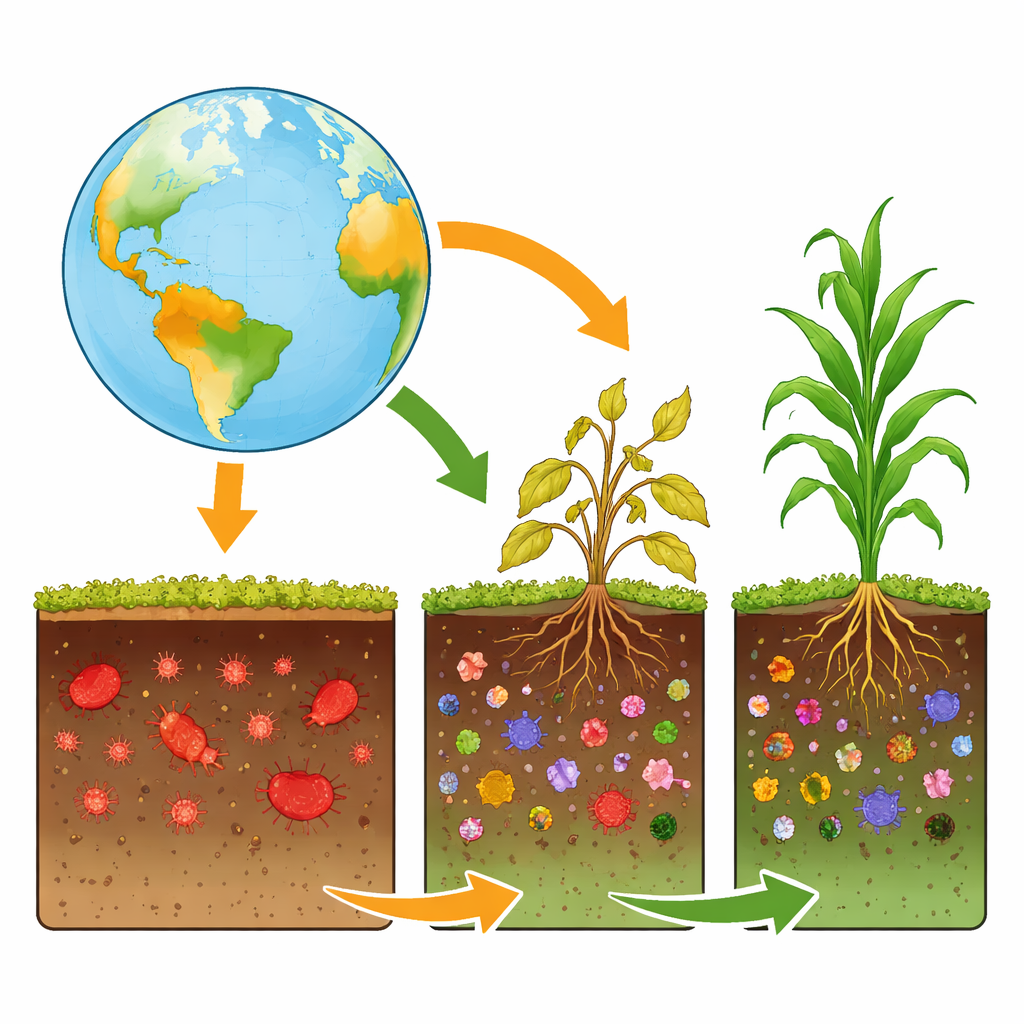
The researchers assembled one of the largest soil DNA collections ever used for plant disease research: 1,602 soil metagenomes from 59 countries and 23 types of ecosystems, ranging from croplands to forests, wetlands, grasslands, and drylands. They built a custom genetic library of 310 genomes representing 113 known bacterial plant pathogens and used it to scan each soil sample for disease-causing species. From this global search, 32 bacterial species emerged as dominant, repeatedly turning up at high abundance across many soils. These include notorious culprits such as Ralstonia solanacearum, which causes bacterial wilt in many crops, and several Streptomyces species responsible for potato scab. When they compared their DNA-based estimates with independent international surveillance databases, they found strong agreement, suggesting that soil metagenomics can reliably flag areas where major plant diseases are likely to occur.
Warm Fields, Busy Pathogens
Mapping these dominant pathogens revealed clear geographic patterns. Hotspots tended to occur in warm regions and especially in agricultural soils. Farmland, shaped by practices such as monoculture and heavy chemical use, generally hosted higher levels of bacterial plant pathogens than natural ecosystems. Statistical models showed that mean annual temperature was the single most important factor driving the abundance of most dominant pathogens, with warmer climates favoring their spread. The role of rainfall depended on the pathogen group: some species thrived in wetter soils, while others preferred drier conditions, implying that different pathogens occupy distinct “climate niches.” Overall, the work suggests that a warming world—particularly in tropical and subtropical zones—will tilt conditions in favor of many soil-borne bacterial diseases.
Nature’s Own Disease Shield
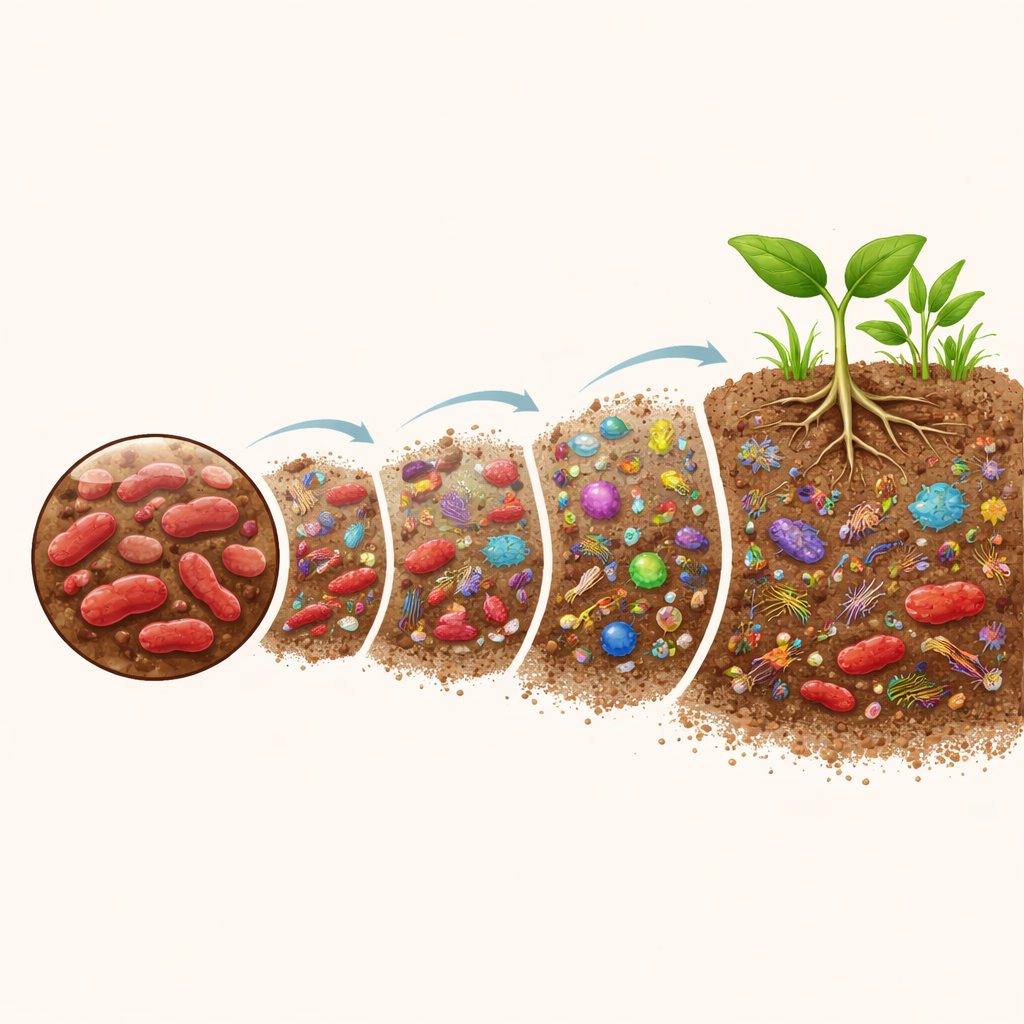
Just as striking as the hotspots were the places where pathogens struggled. Colder climates, soils rich in organic carbon, finer soil textures, and especially high microbial diversity all corresponded to lower pathogen abundance. Using advanced statistical techniques, the authors showed that wetter climates can promote plant cover, which in turn boosts microbial diversity and indirectly suppresses pathogens. To test whether diversity itself truly restrains pathogens, they ran a greenhouse experiment. They created soils with different levels of microbial richness using a dilution approach, then introduced two important pathogens with contrasting lifestyles and moisture preferences. In these controlled pots, both pathogens reached lower levels in the most diverse soils, confirming that a crowded, varied microbial community can act as a living barrier against invaders.
The Helpful Microbes and Their Chemical Weapons
Diving deeper into the soil DNA, the team asked which specific microbes and biochemical traits are linked to pathogen-poor soils. They identified more than 500 bacterial taxa whose presence tended to accompany low pathogen levels, with non-pathogenic Streptomyces species standing out. These cousins of disease-causing Streptomyces are known producers of antibiotics, and here their abundance was negatively associated with plant pathogens worldwide. Certain fungal partners also seemed protective: arbuscular mycorrhizal fungi and lichen-forming fungi both correlated with lower pathogen loads and with richer, more abundant microbial communities. On the chemical side, soils where microbe DNA carried many biosynthetic gene clusters for terpenes and polyketides—two large families of natural antimicrobial compounds—tended to have fewer bacterial plant pathogens. This suggests that diverse soil communities may restrain disease not only through competition for space and nutrients, but also by flooding the soil with microbe-made defensive chemicals.
Looking Ahead in a Changing Climate
Finally, the researchers built predictive models to chart how dominant soil-borne bacterial pathogens might shift under future climate scenarios. Using projections for mid-century warming and land-use change, they forecast rising pathogen prevalence in many warm regions, including parts of South America, Africa, and South and East Asia, and the emergence of new hotspots in northern Asia. Specific pathogens such as Streptomyces europaeiscabiei and the Ralstonia solanacearum species complex are expected to expand into new areas, increasing potential disease risks for crops and natural vegetation. At the same time, the study highlights practical levers for resilience: farming and land-management practices that build soil organic carbon, foster microbial diversity, and encourage beneficial groups like non-pathogenic Streptomyces and mycorrhizal fungi can help soils naturally suppress pathogens. For a layperson, the message is clear: the health of our food systems and ecosystems depends not only on the climate above ground, but also on nurturing the rich, protective web of life hidden in the soil beneath our feet.
Citation: Gao, M., Delgado-Baquerizo, M., Xiong, C. et al. Dominance and natural suppression of bacterial plant pathogens across global soils. Nat Commun 17, 3883 (2026). https://doi.org/10.1038/s41467-026-70233-5
Keywords: soil microbiome, plant disease, bacterial pathogens, climate change, pathogen suppression