Clear Sky Science · en
Diel and eddy driven changes in microbial gene expression and biogeochemistry in the oceanic chlorophyll maximum
Why the hidden green stripe in the ocean matters
Far below the glittering ocean surface lies a dim, thin layer rich in microscopic life called the deep chlorophyll maximum, or DCM. Though invisible from shore, this hidden green stripe helps power global food webs and influences how carbon and nutrients move through the sea. This study followed that layer inside a swirling ocean eddy near Hawaiʻi, revealing how tiny plankton and other microbes adjust their daily routines and long‑term lifestyles as light and nutrients shift around them.
A swirling ocean experiment
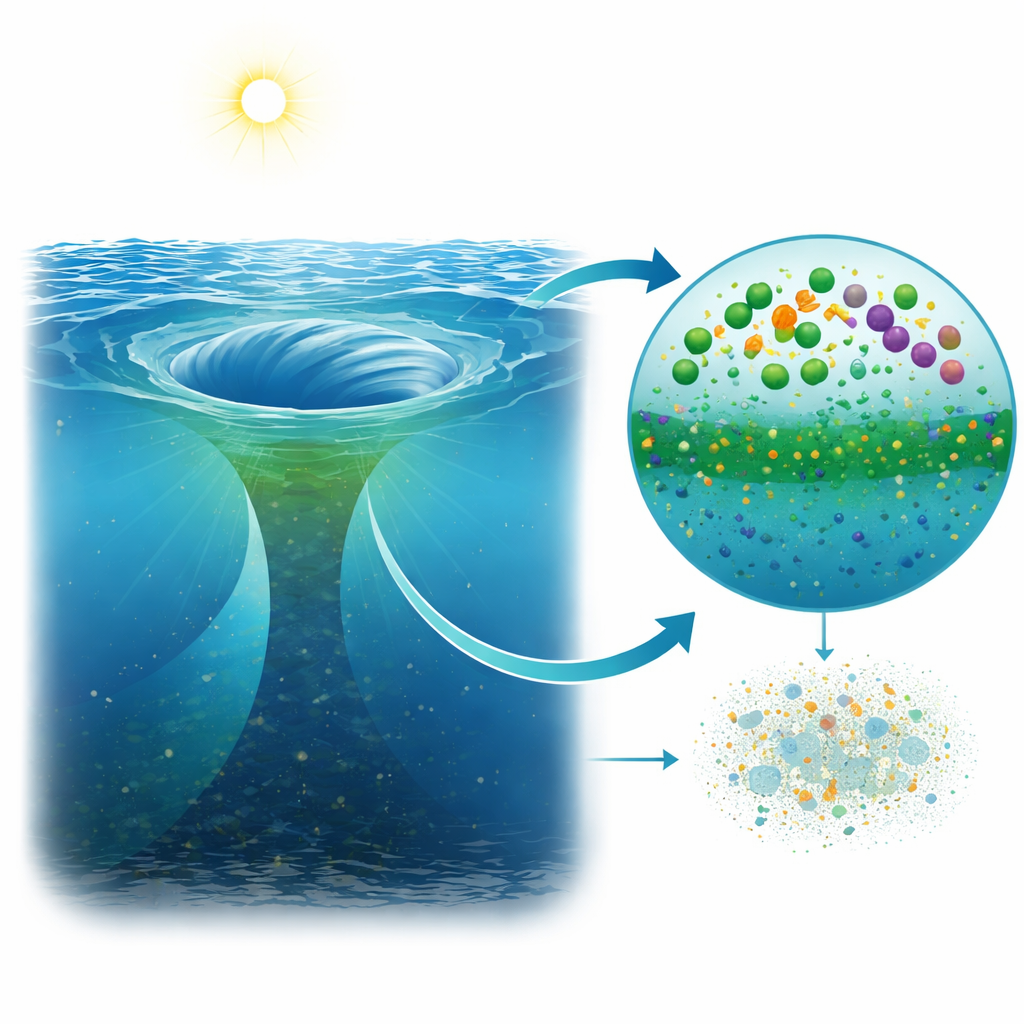
The researchers focused on a powerful rotating water mass, a cyclonic eddy, in the North Pacific Subtropical Gyre. Such eddies, spanning tens of kilometers, can last for weeks and are common in this region. Like a slow‑moving underwater storm, the eddy they studied pushed deeper, nutrient‑rich waters upward into the otherwise nutrient‑poor sunlit ocean. This uplift raised the DCM by roughly 15 meters and shifted dense layers of water upward by about 50 meters, bringing more nitrate and phosphate into reach of light‑hungry microscopic plants.
Robots following a moving green layer
To watch how life responded, the team deployed long‑range autonomous underwater vehicles (AUVs) alongside a research ship. One AUV repeatedly profiled the water column, while another was programmed to lock onto the DCM by tracking the temperature where chlorophyll peaked. Every few hours, this robot filtered seawater directly at that moving layer and preserved the RNA inside the resident microbes. RNA reveals which genes are being switched on at any moment, allowing the scientists to reconstruct the community’s activity in near‑real time while also measuring oxygen, light, particles, and nutrients.
Who thrives when nutrients rise
The uplifted DCM turned out to be a hotspot of activity for light‑using microbes. Photosynthetic cyanobacteria, especially a low‑light form of Prochlorococcus, and small eukaryotic algae became major contributors to the gene expression signal. Their genes for capturing light, fixing carbon, and taking up nitrogen were heavily used, and cell counts of photosynthetic picoeukaryotes increased. At the same time, abundant heterotrophic bacteria and archaea exploited the newly produced organic matter, expressing many genes for importing and breaking down small nitrogen‑ and carbon‑rich compounds. Overall, the eddy temporarily turned this dim layer into a more productive, metabolically intense zone compared with typical conditions nearby.
Daily rhythms in the ocean’s twilight
Even in this low‑light environment, the microbes followed a clear daily schedule tied to the rising and setting sun. Roughly one‑fifth of all gene expression cycled over 24 hours. Chlorophyll levels and oxygen rose during the day, then declined at night, consistent with daytime photosynthesis and nighttime respiration. In the early morning, genes for harvesting light and fixing carbon were most active. By afternoon and evening, genes for cell division and nitrogen use ramped up, and at night, machinery for building proteins peaked. These patterns show that the familiar day‑night rhythm seen near the surface extends deep into the ocean’s twilight, though with somewhat weaker intensity.
From bloom to recycling crew
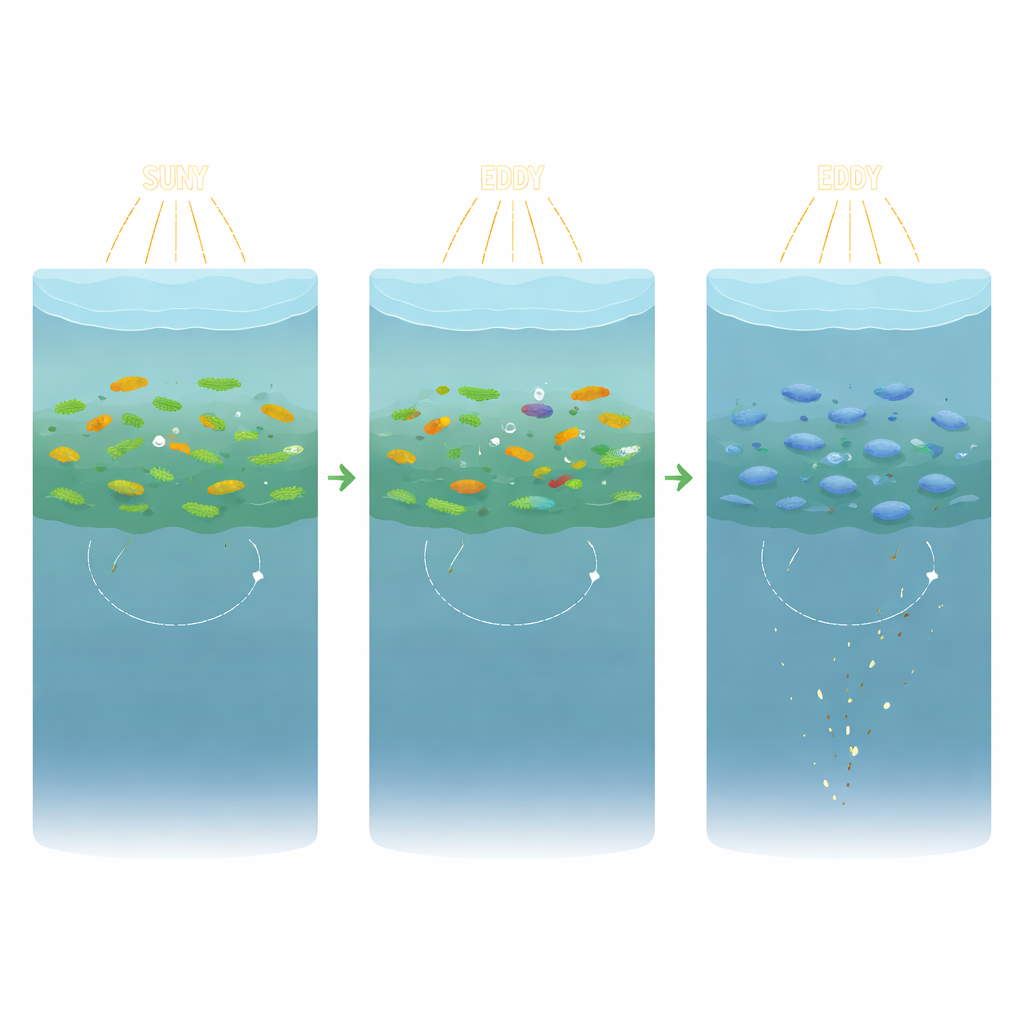
As weeks passed, the eddy weakened, its sea surface signature relaxed, and the DCM sank slightly deeper and warmed. During this transition, total RNA levels and the dominance of photosynthetic microbes declined. Taking their place, ammonia‑oxidizing archaea and protein‑degrading archaea became more transcriptionally active, expressing genes for oxidizing reduced nitrogen and breaking down organic material. Particle‑related signals indicated that while more material was produced, only modest amounts sank deeper, implying that much of it was rapidly recycled in place rather than exported to the deep sea.
What this means for Earth’s carbon engine
For a layperson, the key message is that the ocean’s microscopic residents are highly responsive to both the steady drumbeat of day and night and to more sporadic physical disturbances such as eddies. When an eddy lifts nutrients into the DCM, light‑using microbes bloom and intensify the local carbon and nutrient transformations. As the eddy fades, a different cast of microbes steps in to recycle that burst of organic matter, often preventing much of it from sinking into the deep ocean. Together, these fast shifts in microbial timing and community makeup help determine how efficiently the upper ocean turns sunlight and nutrients into biomass and how much of that biomass ultimately escapes into the depths, affecting the planet’s long‑term carbon balance.
Citation: Peoples, L.M., Eppley, J.M., Barone, B. et al. Diel and eddy driven changes in microbial gene expression and biogeochemistry in the oceanic chlorophyll maximum. Nat Commun 17, 3636 (2026). https://doi.org/10.1038/s41467-026-70228-2
Keywords: ocean eddies, marine microbes, deep chlorophyll maximum, plankton gene expression, ocean biogeochemistry