Clear Sky Science · en
Inhibiting Mrt4-rRNA interaction with fumaramidmycin-based derivatives as an antifungal strategy
Why a new way to fight deadly fungi matters
Drug‑resistant fungal infections are a growing but often overlooked threat, killing millions of people each year. Many of the most dangerous fungi, including the hospital‑borne super‑fungus Candida auris, are becoming harder to treat because they have learned to evade today’s medicines. This study describes a new kind of antifungal compound that attacks a previously untapped weak point in fungal cells: the machinery that builds their protein‑making factories. By homing in on a fungal assembly factor called Mrt4 and sparing its human counterpart, the work points to a fresh strategy for outsmarting resistant fungi.
Turning an old antibiotic idea into a new antifungal weapon
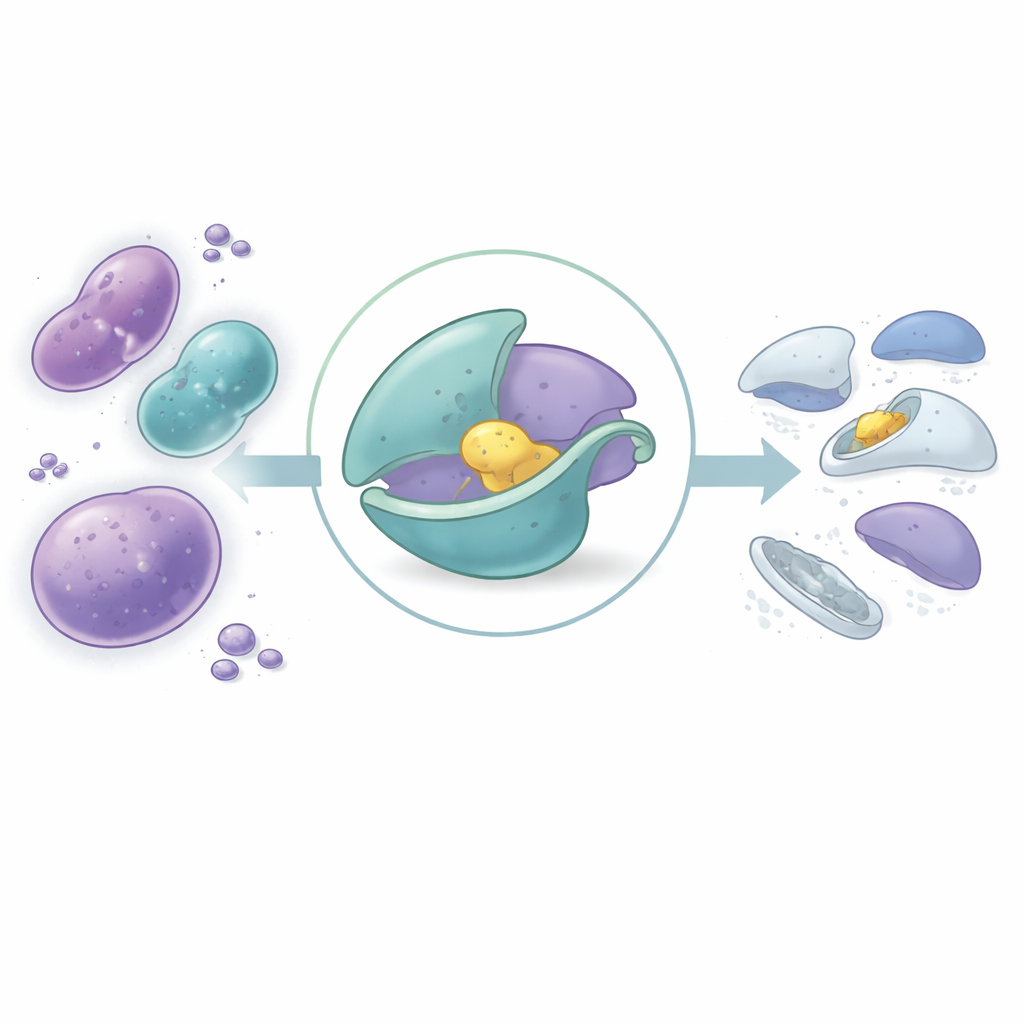
The researchers began with fumaramidmycin, a decades‑old natural antibiotic known to work against bacteria but not fungi. They redesigned its chemical structure, systematically testing “cis” and “trans” variants and different side groups to see which versions could stop the growth of hard‑to‑treat Candida species, including drug‑resistant C. albicans and C. auris. A particular cis‑configured molecule, called compound 20, emerged as a standout. It killed fungi at very low doses, blocked the formation of invasive filaments and sticky biofilms, and triggered damaging bursts of reactive oxygen inside fungal cells. Just as important, it showed relatively low toxicity toward several human cell types and did not appear to damage DNA or red blood cells in standard safety tests.
Hunting down the hidden target inside fungal cells
To understand how compound 20 works, the team used a clever chemical “tag and pull” approach. They built two probe versions of the drug: an active cis form and an inactive trans form, both equipped with a small chemical handle. After letting these probes react with fungal proteins, they used click chemistry and mass spectrometry to see which proteins were captured. Many common enzymes showed up at first, but most proved to be bystanders rather than the true cause of fungal death. By directly comparing proteins bound by the active versus inactive probe, and by adding unmodified compound 20 in competition experiments, one protein kept rising to the top: Mrt4, a factor that helps assemble the large half of the ribosome, the cell’s protein‑making machine.
Blocking the assembly of fungal protein factories
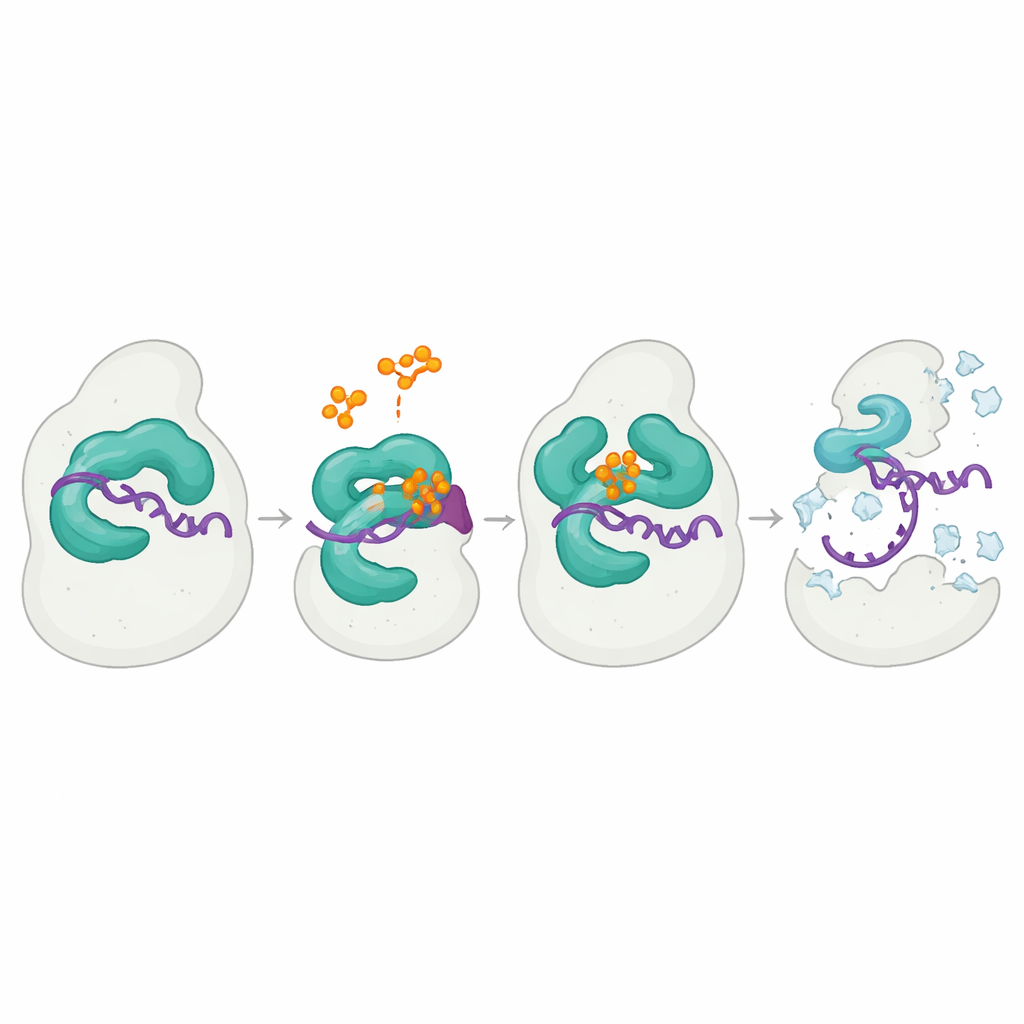
Genetic tests in yeast and Candida strengthened the case for Mrt4 as the key target: cells with only one working copy of the MRT4 gene became especially sensitive to compound 20. The researchers then showed that purified Mrt4 protein from Candida binds tightly to its partner ribosomal RNA, and that compound 20 disrupts this interaction in a dose‑dependent way. Detailed biochemical work revealed that the drug forms covalent bonds with two specific cysteine amino acids on Mrt4. Computer simulations and mutation experiments indicated that attaching the compound at both sites subtly reshapes the protein’s surface, weakening its grip on RNA and preventing normal ribosome assembly. In living fungal cells, this showed up as a buildup of incomplete ribosomal subunits and a shortage of fully formed ribosomes.
Hitting fungi hard while sparing human cells
A crucial question was whether a drug that attacks Mrt4 would also harm human cells, which rely on their own version of this protein. The team found that human Mrt4 binds RNA similarly but responds very differently to compound 20: its binding to RNA is only mildly affected. Structural modeling suggests that one of the key cysteine sites targeted in fungi is missing in humans, and the chemical environment around the remaining cysteine is quite different. As a result, the same covalent modification that destabilizes fungal Mrt4‑RNA binding appears largely harmless in the human protein. This selectivity not only explains the low toxicity seen in cell tests but also highlights how subtle structural differences can be exploited to create fungus‑specific medicines.
From insect larvae and mice toward future therapies
To see whether the new compound could work in living organisms, the authors tested it in infected wax moth larvae and in a mouse model of invasive Candida infection. In larvae, treatment with compound 20 sharply reduced fungal burden and extended survival, performing comparably to the standard drug fluconazole. In mice, the drug alone modestly lowered fungal counts in the kidneys, but its effect grew much stronger when combined with an enzyme inhibitor that slows breakdown of ester‑containing drugs. Together, the combination cut fungal load more than sixfold and preserved kidney structure with far less inflammation.
A fresh angle on beating resistant fungi
Overall, the study shows that carefully tuned fumaramidmycin‑based molecules can latch onto Mrt4 in fungal cells, disrupt a critical Mrt4‑RNA partnership, and derail the assembly of ribosomes while largely sparing the human version of the protein. For non‑specialists, the core idea is that instead of punching holes in fungal membranes or walls, this strategy quietly sabotages the fungi’s ability to build their protein‑making machinery in the first place. Although further optimization is needed to improve drug stability and dosing, this work opens a promising avenue for developing next‑generation antifungal therapies against some of the most dangerous and drug‑resistant fungal pathogens.
Citation: Cao, H., Tu, J., Chen, J. et al. Inhibiting Mrt4-rRNA interaction with fumaramidmycin-based derivatives as an antifungal strategy. Nat Commun 17, 3422 (2026). https://doi.org/10.1038/s41467-026-70226-4
Keywords: antifungal resistance, Candida auris, ribosome assembly, covalent inhibitors, fungal infections