Clear Sky Science · en
Oligomeric-solvent engineering of hierarchical hydrogen-bonding networks for multifunctional glass interlayers
Windows That Do Much More
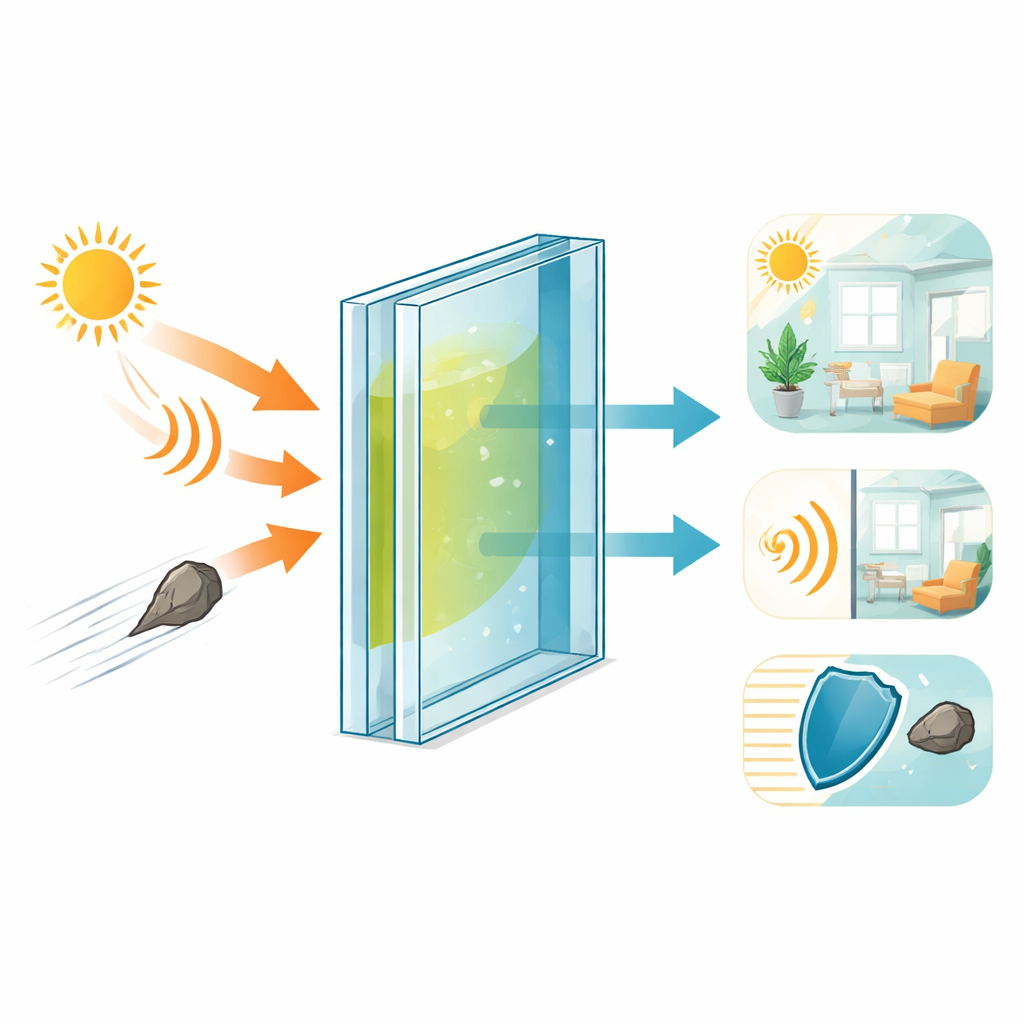
Imagine a window that not only lets in light, but also keeps rooms cooler on hot days, quiets traffic noise, and stops glass from shattering dangerously if struck. This paper describes a new kind of clear, jelly-like layer that can be sandwiched between glass panes to create such “smart” windows. By carefully designing how tiny molecular attractions inside the gel work together, the researchers turn an ordinary plastic into a see-through, shock-absorbing, sound-dampening, heat-buffering material suitable for real buildings.
Turning Brittle Plastic into a Gentle Cushion
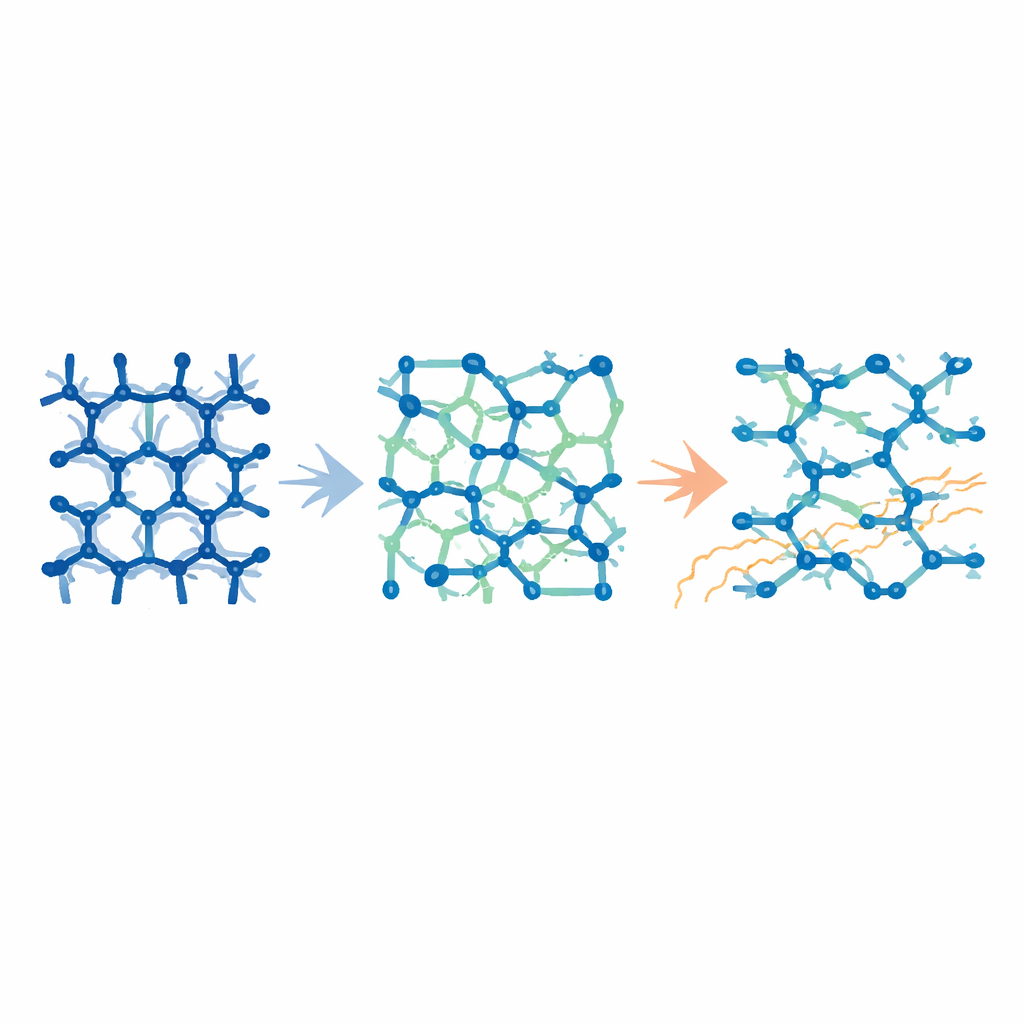
At the heart of the work is a common plastic called poly(methacrylic acid), which by itself is hard, glassy, and prone to cracking. The team mixes it with a short-chain liquid form of polyethylene glycol, a syrupy substance already widely used in everyday products. Instead of acting like a simple filler, this liquid weaves between the plastic chains and links them through many tiny attractions known as hydrogen bonds. Because these attractions come in different strengths, the resulting network behaves like a solid and a liquid at the same time: firm enough to hold its shape, yet able to yield, stretch, and soak up energy when stressed.
Building a Hierarchy of Invisible Connections
To understand this network, the researchers probed it with light- and heat-based techniques, computer simulations, and mechanical tests. They found that some attractions between the plastic chains are very strong and act like permanent anchors, while others, especially those involving the liquid component, are weaker and more flexible. As temperature rises, these weaker links break and reform first, followed by the stronger ones, spreading out how the material absorbs heat. Computer models show the liquid molecules wedging between plastic chains, shortening and multiplying the connections and preventing the solid from packing too tightly. The result is a smooth, uniform gel that remains transparent and stable over a wide range of temperatures.
Strong, Tough, Self-Healing Gel
Mechanical tests reveal that this gel can stretch several times its original length before failing and that it resists cracks far better than the original plastic. Even when a cut is introduced, the material can still bear significant loads, and the damaged pieces can slowly knit back together at room temperature without any external help, thanks to the reversible nature of the internal attractions. In dynamic tests, where the material is repeatedly stretched and released, it consistently converts much of the applied mechanical energy into harmless internal motion and heat, rather than passing it on as jolts or vibrations. This balanced mix of firmness and flow makes it an excellent damping material for both impacts and continuous vibrations.
Cooling, Cushioning, and Quieting in One Layer
The same internal network that damps motion also helps regulate temperature. When heated, the breaking of many small attractions absorbs heat over a broad temperature range, slowing how quickly the material warms. Experiments under intense lamp light show that gel samples remain much cooler than their surroundings. In drop tests, thin gel films dramatically reduce impact forces on underlying plates and can keep glass from breaking under a falling steel ball. Acoustic tube measurements show that gel blocks absorb and reflect sound more effectively than standard window interlayers, especially in the frequency range typical of traffic and human activity, cutting noise levels by tens of decibels.
From Lab Gel to Real-World Smart Glass
To demonstrate practical use, the researchers laminated the gel between glass sheets to create prototype window panels. These panels remain highly transparent, yet rooms built from them stay noticeably cooler under simulated sunlight, quieter under artificial noise, and safer when struck by falling objects compared with rooms made from conventional glass. The gel adheres strongly to glass and other surfaces and continues to perform well after exposure to heat, moisture, and light. In simple terms, by cleverly arranging invisible molecular “Velcro” inside a soft, clear material, the team has created a versatile glass interlayer that can make buildings more comfortable, energy-efficient, and safe without sacrificing the view.
Citation: Li, M., Hu, L., Pi, M. et al. Oligomeric-solvent engineering of hierarchical hydrogen-bonding networks for multifunctional glass interlayers. Nat Commun 17, 3607 (2026). https://doi.org/10.1038/s41467-026-70223-7
Keywords: smart windows, polymer gels, laminated glass, sound and impact damping, thermal regulation