Clear Sky Science · en
Phytochromes facilitate social behaviour in marine diatoms
Microscopic Dancers in the Sea
Far below the ocean’s glittering surface, microscopic algae called diatoms drift and sink, quietly helping to fuel the planet’s food webs and regulate Earth’s climate. This study reveals that some of these tiny organisms do more than passively float: they sense subtle changes in underwater light and respond with a coordinated “wobbling dance.” By uncovering how special light-sensitive proteins guide this social motion, the work suggests that invisible light signals help structure marine life in ways scientists are only beginning to understand.
How Tiny Cells Read the Colors of Light
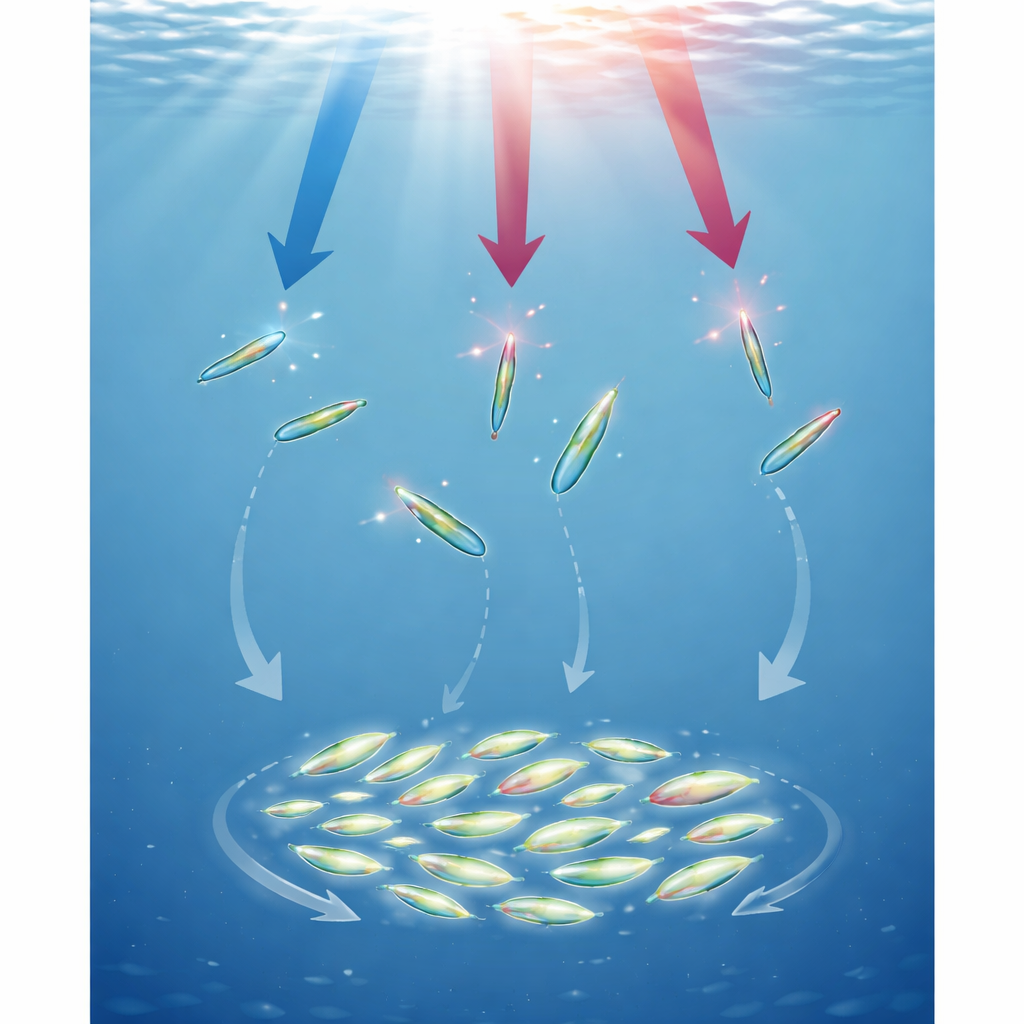
Diatoms harvest sunlight to power photosynthesis, but they must also cope with constantly changing light as waves, clouds, and depth alter the colors that reach them. Many land plants use proteins called phytochromes to detect red and far-red light and adjust growth accordingly. In the ocean, however, those colors fade within just a few meters of the surface, raising a puzzle: why do some marine microbes, including diatoms, still carry phytochromes? Earlier work showed that diatom phytochromes in the species Phaeodactylum tricornutum can respond not only to red and far-red light but also across a broad span of underwater colors, hinting that they might serve as versatile light sensors tuned to life in the sea.
A Surprising Group Dance
The researchers compared normal P. tricornutum cells with genetically edited strains lacking the key phytochrome protein. Suspended in water and illuminated with carefully controlled wavelengths, the normal cells behaved in a striking way: under blue and far-red light they sank while wobbling in sync, like a slowly rotating school of microscopic dancers. Using laser-based measurements to track how the elongated cells oriented as they fell, the team showed that the whole population shifted into a coordinated rhythm. In contrast, cells missing phytochromes never developed this shared wobble, even though they were otherwise similar. This demonstrated that the light-sensing proteins are essential for organizing the collective motion.
Light Colors as a Depth and Neighbor Signal
The team then explored how different mixes of blue, red, and far-red light shape this behavior. When they started with blue light that promotes wobbling and gradually added more red light—as would happen in shallower waters—the strength of the synchronized dance decreased, although its tempo stayed the same. Increasing only blue or far-red light intensity did not have this effect, confirming that the balance of colors matters more than brightness alone. These findings suggest that diatom phytochromes help cells interpret the changing color of light with depth, favoring coordinated motion in deeper, blue-rich layers of the water column, where red light is scarce and conditions are calmer.
Silent Light Messages Between Neighbors
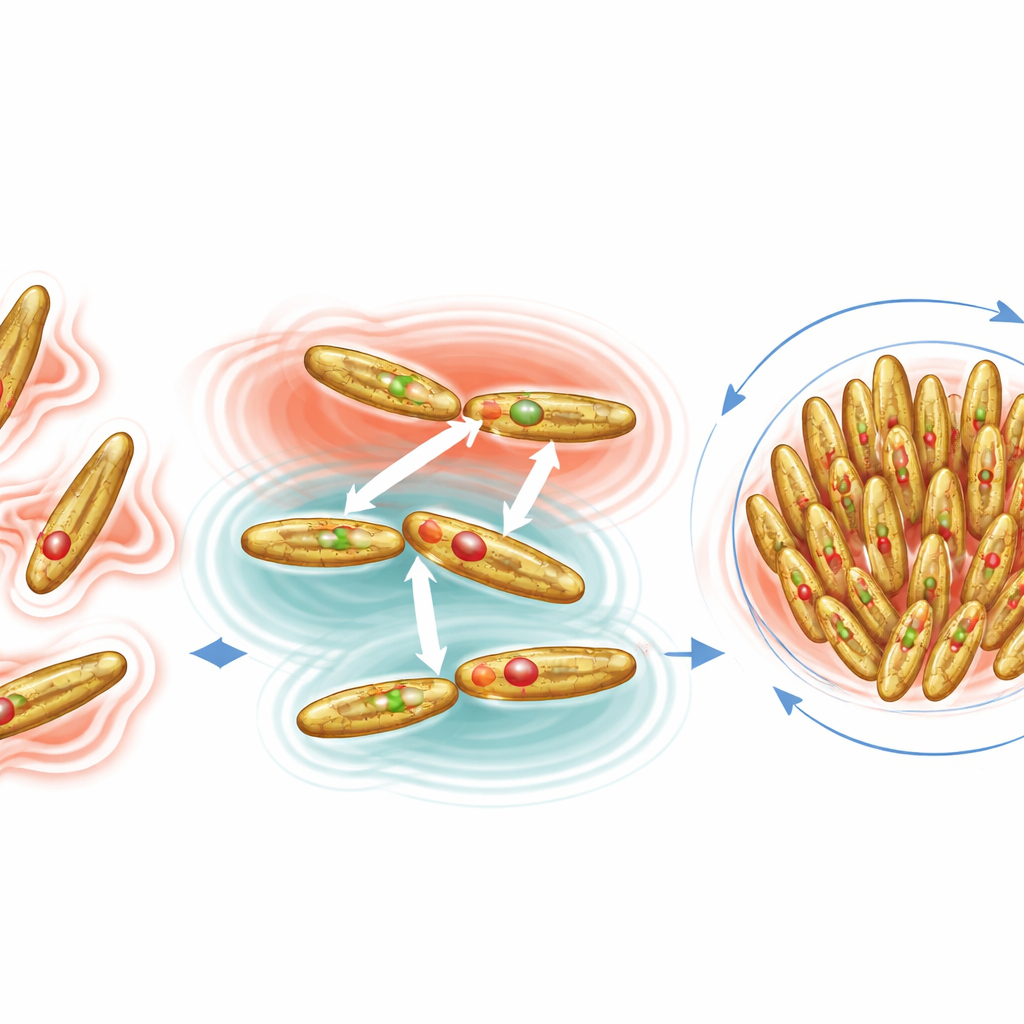
A key question is how free-floating cells, separated in the water, manage to move together. Physical disturbances or dissolved chemicals seem too slow or too weak to explain the tight timing observed. The authors instead focused on a subtle glow: when diatoms absorb blue light for photosynthesis, they re-emit a tiny fraction as red and far-red fluorescence. Because cells are elongated and wobble as they sink, this glow varies rhythmically in direction and intensity, potentially creating a flickering signal that neighbors can sense. Measurements confirmed that the natural fluorescence of normal cells oscillates at the same period as their wobbling, whereas cells without phytochromes lack a coherent population-wide light rhythm.
Testing Artificial Light Pulses
To probe whether this flickering glow could truly act as a communication channel, the researchers replaced the natural fluorescence with artificial red or far-red light pulses that mimicked its rhythm. Normal cells and control strains quickly locked onto the pulsed signal and began wobbling together, even though the average light level was low. Phytochrome-deficient mutants, by contrast, remained unsynchronized under the same conditions. Notably, constant red light alone could not trigger the group dance, but red light modulated at the wobbling frequency readily did—again, only when phytochromes were present. This points to a specialized response pathway that allows diatoms to detect quickly changing light and use it to align their behavior.
Why These Tiny Dances Matter
For non-specialists, the idea that microscopic algae “talk” with light may seem abstract, but it has real-world implications. The coordinated wobbling of sinking diatoms could influence how fast they fall, how efficiently they capture light, and how often they encounter one another to exchange genes or form pairs. All of these factors affect how carbon and nutrients move through the ocean and how blooms of algae develop and fade. This work shows that phytochromes do far more in the sea than simply guide photosynthesis: they help turn faint, color-shifting light into a social signal that organizes the lives of some of the ocean’s most important microbes.
Citation: Font-Muñoz, J.S., Jaubert, M., Sourisseau, M. et al. Phytochromes facilitate social behaviour in marine diatoms. Nat Commun 17, 3766 (2026). https://doi.org/10.1038/s41467-026-70219-3
Keywords: marine diatoms, light sensing, phytochromes, cell communication, collective behavior