Clear Sky Science · en
Long-range spatial extension of exciton states in van der Waals heterostructure
Light Particles on a Giant Invisible Grid
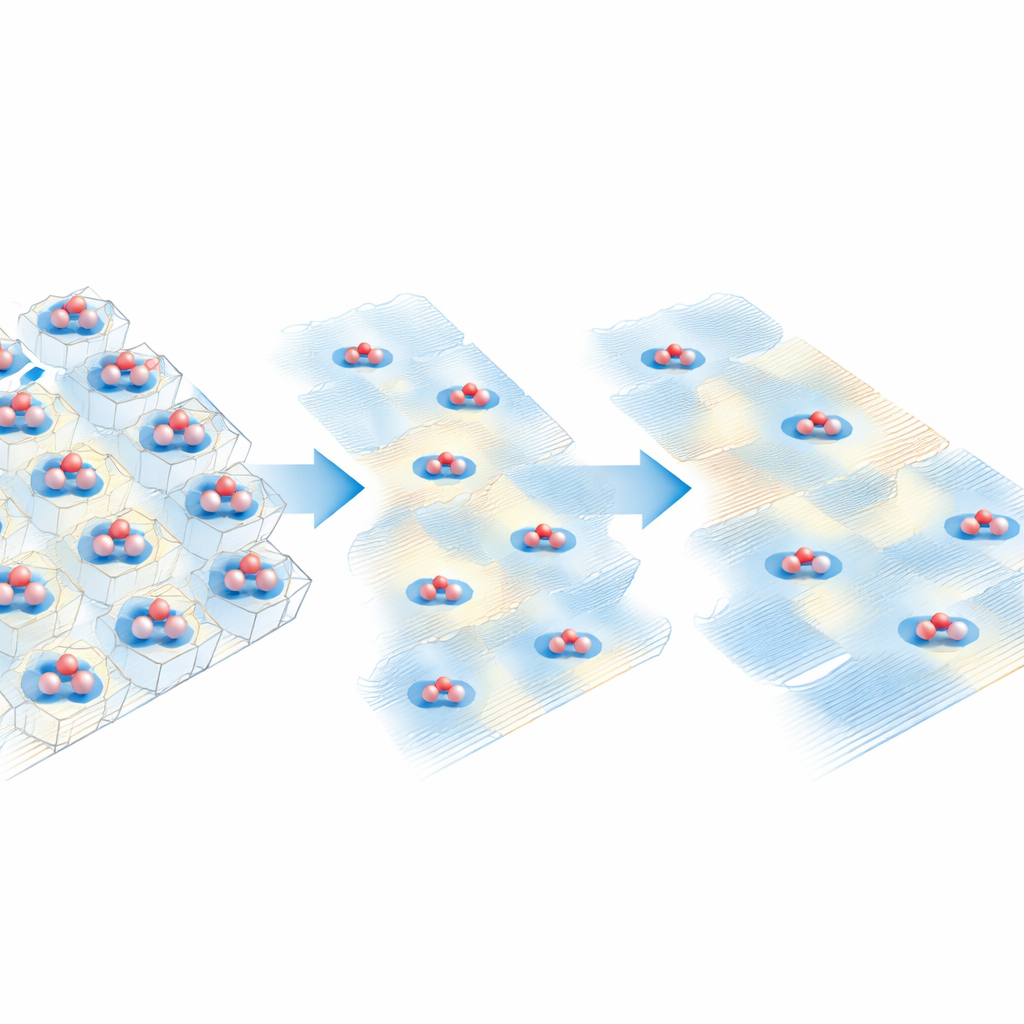
Imagine tiny packets of light energy that can move through a material the way cars move through a city. These packets, called excitons, normally live in small, crowded neighborhoods just a few billionths of a meter across. In this study, physicists discovered that in a carefully built stack of ultra-thin crystals, some of these excitons can spread out across areas thousands of times larger than usual, hinting at new ways to control the flow of light and energy in future technologies.
A New Playground for Light and Matter
The researchers worked with a special kind of material called a van der Waals heterostructure, made by stacking two single-atom-thick semiconductor layers—MoSe2 and WSe2—on top of each other with a slight twist. This twist creates a repeating interference pattern known as a moiré lattice, like the large-scale ripples you see when two fine meshes are overlaid. In this landscape, electrons and holes (missing electrons) sit in separate layers but still attract each other, forming long-lived “indirect excitons.” Because these excitons live longer than usual, they are promising building blocks for carrying information and energy over long distances in atomically thin devices.
Reading the Fingerprints of Trapped Light
To understand how these excitons behave, the team used photoluminescence—a method where they shine a laser on the material and measure the color of the light it emits. Typically, excitons trapped in tiny random imperfections of a material produce very sharp, narrow lines in the emission spectrum, each line acting like a fingerprint of a localized state. In most semiconductors, such trapped states are confined to nanometer-scale regions. Here, the scientists again observed these narrow spectral lines, which suggested that excitons were confined—but the question was: confined by random defects, or by the ordered moiré pattern created by the twist between layers?
From Trapped Islands to Long-Distance Travel
By gradually increasing the density of excitons with stronger laser excitation, the researchers saw a remarkable change. At low density, many narrow emission lines appeared, signaling excitons sitting in well-defined local pockets. As the density increased, these narrow lines faded away and were replaced by a broad spectral feature, at the same time that excitons began to travel long distances across the sample. This anticorrelation showed that the narrow lines were linked to localized exciton states: when the excitons were mostly stuck, the narrow lines were strong; when excitons started to move freely, the lines disappeared.
Surprisingly Large Patches of Trapped States
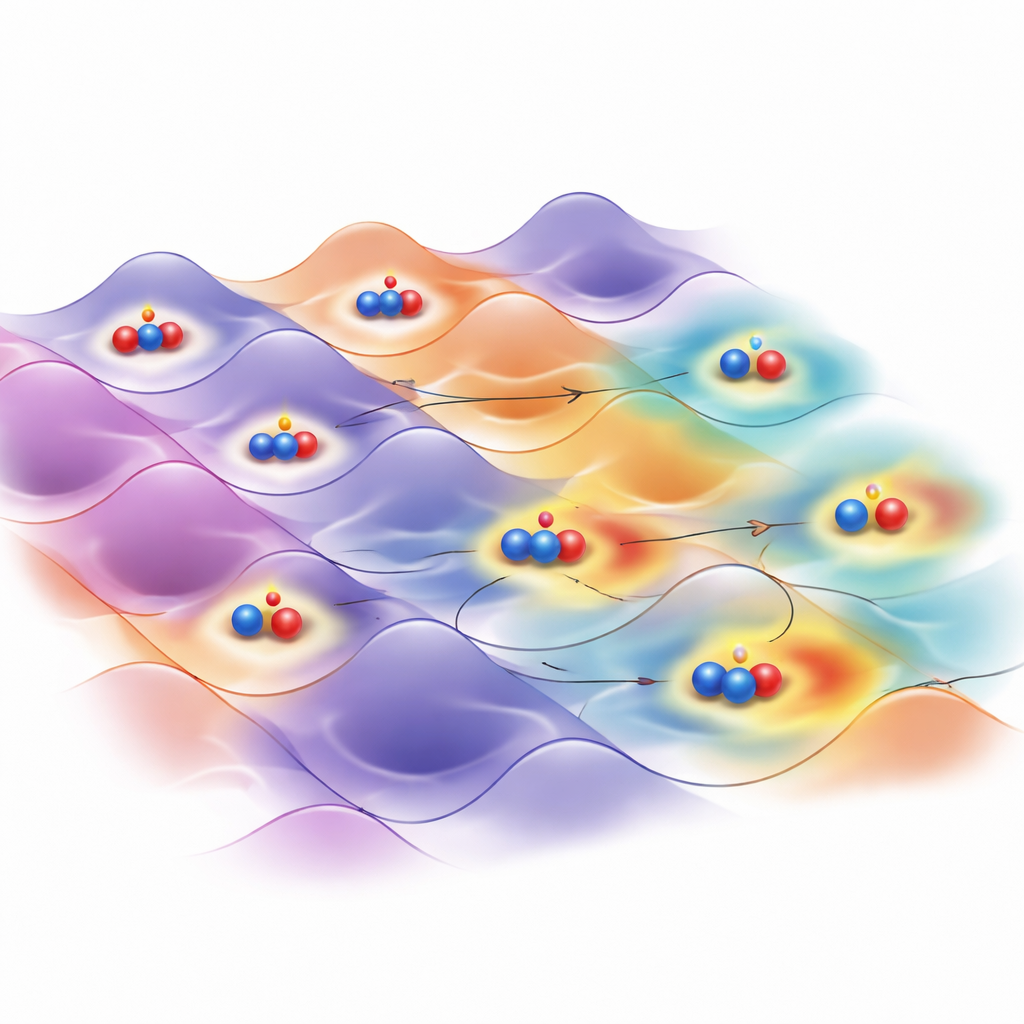
The most striking finding came from mapping where, in space, the light associated with each narrow line originated. Instead of being confined to tiny spots, the exciton states tied to these sharp lines stretched over distances of several micrometers—thousands of times larger than typical localized states—and could cover areas approaching ten percent of the entire sample. Such macroscopic extension is not expected if the trapping comes purely from random disorder, which tends to create small, isolated pockets. Instead, it points to an underlying ordered landscape: a moiré potential that is only weakly disturbed by imperfections, allowing the same exciton state to repeat coherently over large regions.
Why This Matters for Future Devices
These observations show that in this twisted, atomically thin crystal stack, excitons are confined not by a messy, random environment but by an orderly moiré grid with only gentle disorder. This ordered confinement lets localized exciton states extend over surprisingly large areas, smoothing the way for excitons to move efficiently between regions. For a layperson, the takeaway is that researchers have found a way to create large, gently defined “districts” for light-like particles in a two-dimensional material. Such control over where excitons live and how they travel could be crucial for future low-power optoelectronic devices, quantum-light sources, and perhaps even exotic states of matter where excitons flow without resistance.
Citation: Zhou, Z., Szwed, E.A., Brunner, W.J. et al. Long-range spatial extension of exciton states in van der Waals heterostructure. Nat Commun 17, 3503 (2026). https://doi.org/10.1038/s41467-026-70218-4
Keywords: excitons, moiré materials, van der Waals heterostructures, quantum light transport, two-dimensional semiconductors