Clear Sky Science · en
VISTA drives pancreatic tumor progression through modulation of the tumor-associated macrophage polarity
Why this research matters
Pancreatic cancer is one of the hardest cancers to treat, in part because its surroundings in the body shut down helpful immune responses. This study uncovers a new "off switch" on certain immune cells that helps pancreatic tumors grow, and shows that disabling this switch can wake up the body’s own defenses.
The challenge of a shielded cancer
Pancreatic ductal adenocarcinoma, the most common form of pancreatic cancer, has a very low long term survival rate and often resists surgery, chemotherapy, and newer immunotherapies. A major reason is its tumor microenvironment, the tightly packed mix of cells and tissue around the tumor. This environment is crowded with immune cells that, instead of fighting the cancer, are pushed into a peacekeeping role that protects the tumor. Among them, tumor associated macrophages act as cellular managers that can either inflame and attack or calm and suppress. Understanding what tips these cells toward helping the tumor is crucial for finding better treatments.
A hidden brake on immune cells
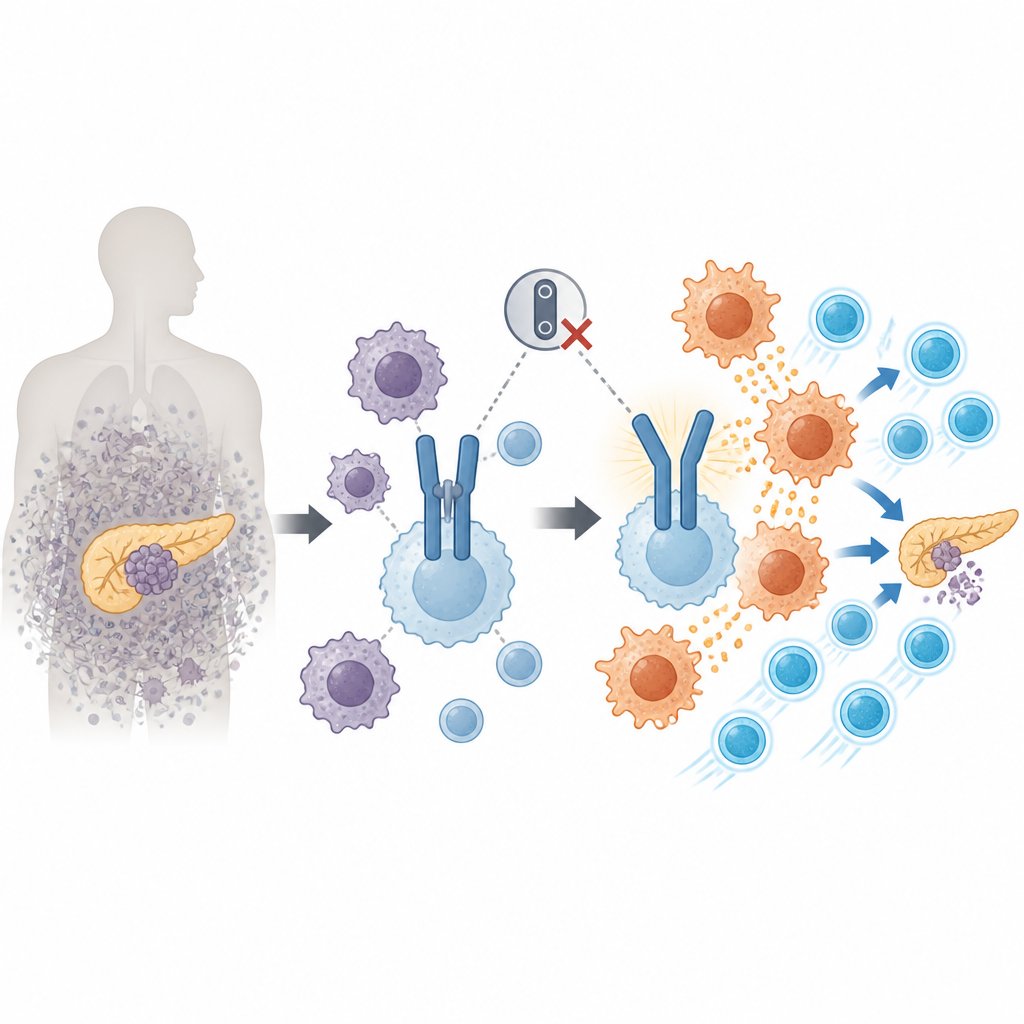
The researchers focused on a molecule called VISTA, found mainly on myeloid cells such as macrophages in tumors. Using mouse models of pancreatic cancer, they compared normal animals with those lacking VISTA. Mice without VISTA developed much smaller tumors and survived longer. Blocking VISTA with an antibody produced similar benefits. Detailed analysis showed that tumors from VISTA deficient mice contained more macrophages and more killer T cells, especially CD8 T cells, which are key players in destroying cancer cells. Importantly, these T cells looked more active and less worn out, suggesting that VISTA normally helps enforce an exhausted, ineffective state.
Reprogramming the tumor’s caretakers
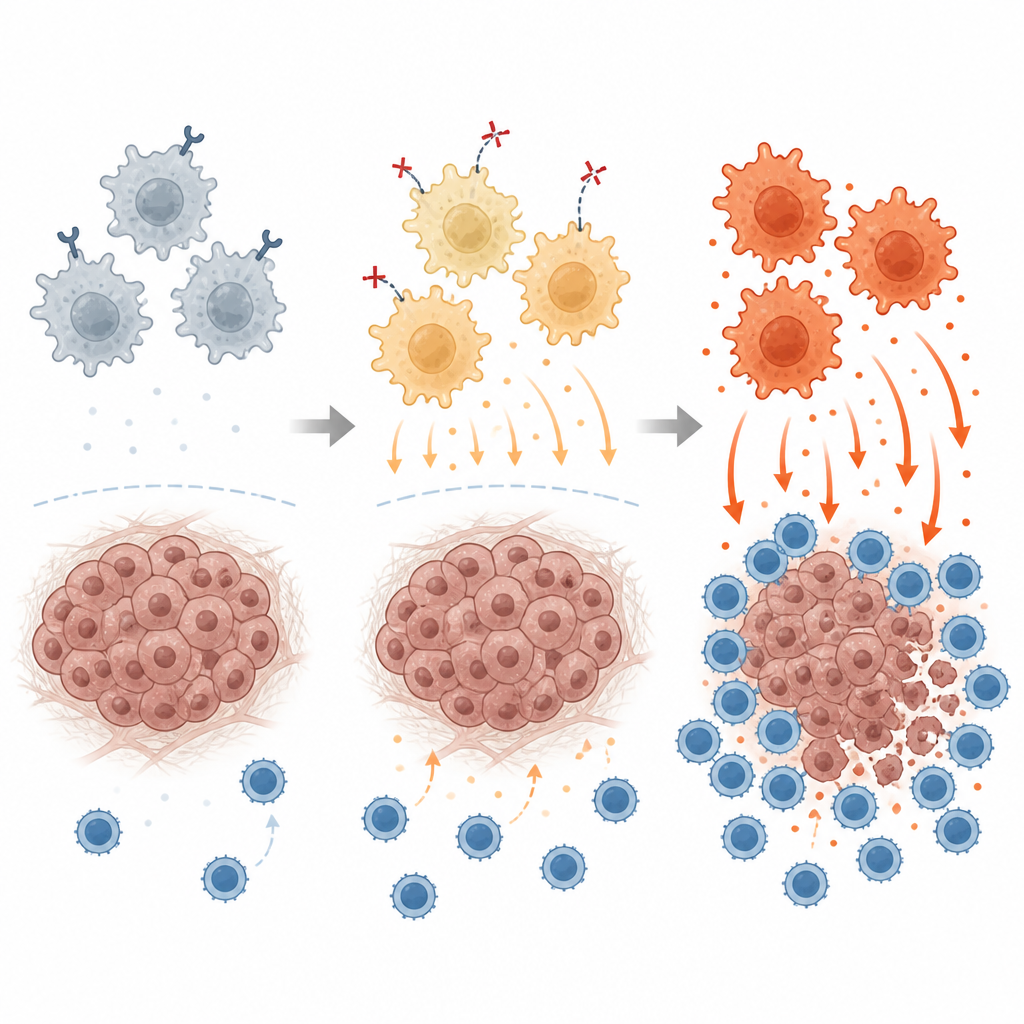
Single cell gene profiling allowed the team to trace how VISTA reshapes macrophage behavior. In usual tumors, a dominant macrophage subgroup expressed genes linked to tissue repair and suppression, including one called SPP1, which is associated with tumor friendly behavior. In VISTA deficient tumors, macrophages shifted toward a different program marked by the chemokine CXCL9, which attracts and supports CD8 T cells. The balance of CXCL9 to SPP1 emerged as a simple readout of whether macrophages were in a tumor fighting or tumor supporting mode. VISTA loss drove this ratio upward, favoring a more inflammatory, T cell inviting environment. The study also found that VISTA deficient macrophages were better at chopping up tumor proteins and presenting them to T cells, strengthening targeted immune attacks.
A communication highway for T cells
By mapping how different immune cells talk to each other, the authors showed that VISTA controlled a key signaling route linking macrophages and CD8 T cells. When VISTA was absent, CXCL9 made by macrophages bound more strongly to its partner receptor CXCR3 on CD8 T cells, pulling these T cells into the tumor and boosting their function. Blocking either interferon gamma, which helps induce CXCL9, or the CXCR3 receptor erased the protection seen in VISTA knockout mice. This indicates that the interferon gamma–CXCL9–CXCR3 chain is central to how VISTA shapes the tumor environment. Human pancreatic cancer samples and public datasets revealed similar patterns, with high VISTA matching more suppressive macrophages and more exhausted T cells.
Toward better treatment combinations
Recognizing that patients often receive chemotherapy, the team tested whether VISTA blockade could work alongside gemcitabine, a standard drug for pancreatic cancer. In another mouse model, using both treatments together shrank tumors more than either alone. Immune profiling showed that the antibody against VISTA pushed macrophages toward the CXCL9 rich state and increased the number of CXCR3 positive CD8 T cells in tumors, echoing the genetic findings. This suggests that targeting VISTA could help convert a resistant, immune cold pancreatic tumor into one that responds better to both drugs and immune based therapies.
What this means for patients
In simple terms, this study identifies VISTA as a key controller that tells certain immune cells in pancreatic tumors to protect rather than attack. Turning off VISTA flips these cells into a tumor fighting mode, draws in more active killer T cells, and makes chemotherapy work better in mice. While more work is needed before this strategy reaches the clinic, the findings highlight VISTA as a promising target for new treatments aimed at unlocking the immune system against pancreatic cancer.
Citation: Shin, SK., Kim, G., Park, S.M. et al. VISTA drives pancreatic tumor progression through modulation of the tumor-associated macrophage polarity. Nat Commun 17, 4582 (2026). https://doi.org/10.1038/s41467-026-70215-7
Keywords: pancreatic cancer, VISTA, tumor microenvironment, macrophages, CD8 T cells