Clear Sky Science · en
Pressure dependence of surface tension of polymer melts under high vacuum
Why this hidden force at surfaces matters
From smartphone chips to medical implants, many modern technologies rely on thin plastic-like coatings and polymer films only a few molecules thick. A key invisible player in how these materials behave is surface tension—the pull that makes liquid surfaces act like stretched skin. Engineers usually tune this property with temperature or by adding chemicals. This study reveals that simply changing air pressure, especially pushing it down to high vacuum, can dramatically alter the surface tension of molten polymers in a way scientists did not expect, opening new possibilities for nanoscale patterning and manufacturing.
How scientists usually think surfaces behave
For decades, measurements on polymer melts at ordinary or high pressures have painted a straightforward picture. Warm a molten polymer and its surface tension gently falls in a nearly straight-line fashion. Squeeze it with higher gas pressure and the surface tension also tends to decrease slightly, often because gas dissolves into the material or blurs the density difference between the polymer and the surrounding fluid. These trends have become textbook assumptions that underlie many models of foaming, blending, wetting, and particle dispersion in plastics processing.
Building a window into polymers in near-empty space
The new work tackles a regime that has been largely ignored: what happens when the surrounding air is almost completely removed. The team built a custom vacuum oven in which both temperature and pressure can be precisely controlled over an enormous range, from normal atmospheric pressure down to about one ten-thousandth of a pascal—a near-empty environment. Using a simple but sensitive pre-coated capillary method to track how far molten polymers climb inside a narrow tube, they measured surface tension for several common materials, including polyethylene glycol, polystyrene, polyisoprene, polypropylene, and polydimethylsiloxane, across this vast pressure window.
A surprising twist when the air is pumped away
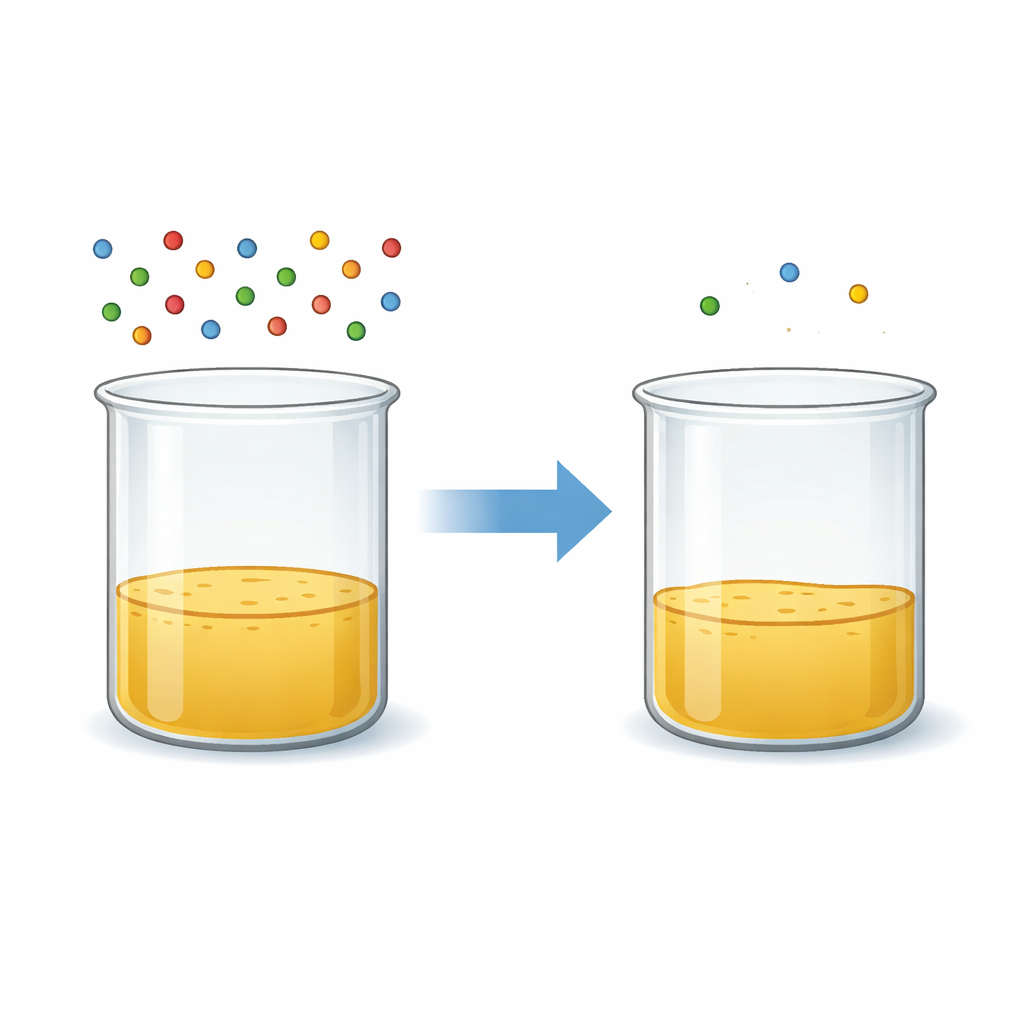
At everyday pressure, the polymers behaved as expected: their surface tension dropped slightly and approximately linearly as the temperature rose, confirming that the homemade setup agreed with established data. The surprise appeared when the air was pumped out. As pressure fell below about 103 newtons per square meter—far below normal atmospheric levels—the surface tension of every polymer tested dropped sharply. In other words, in the low-pressure, high-vacuum regime, reducing the amount of air caused a strong decrease in surface tension, opposite to the gentle trends seen when pressure is increased in conventional high-pressure studies. This effect was robust across different polymer chemistries and across samples with very different chain lengths, suggesting that molecular weight and distribution play only a minor role compared with how the surface interacts with air itself.
Reading the pattern with a simple surface model
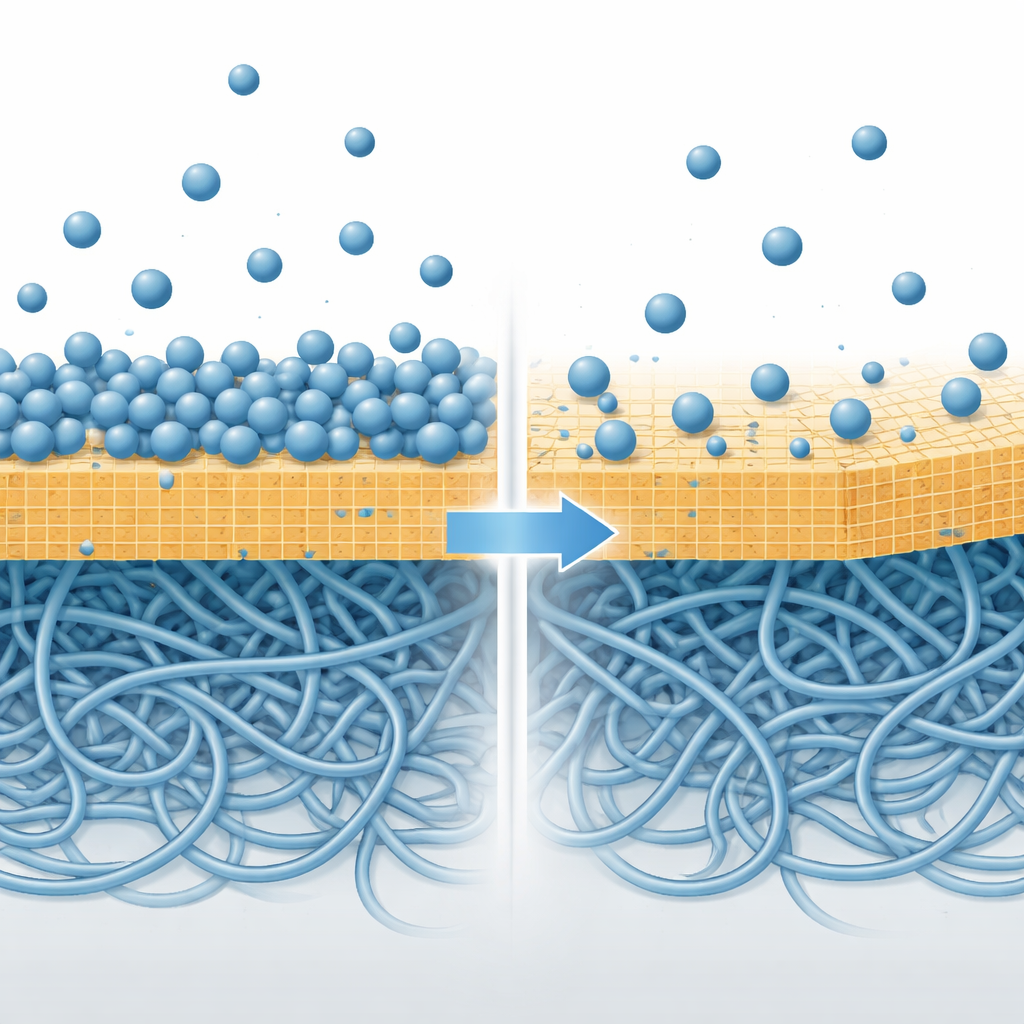
To make sense of this behavior, the researchers built a minimalist theoretical picture of the boundary where polymer meets air. They imagined a grid of sites at the surface that could be occupied either by air molecules or by empty space, with the overall surface energy depending on how many of these sites are filled. Rather than assuming air molecules simply follow ideal-gas statistics, they allowed for a kind of "adsorption"—a preference for air molecules to linger at the surface—which they described using a mathematical form known as the Hill equation, often used to capture cooperative binding in biochemistry. When they fitted this equation to their measurements over eight orders of magnitude in pressure, all of the data for all polymers collapsed onto a single curve. This "master curve" implies a universal mechanism: as pressure falls, fewer air molecules are available to occupy surface sites, so the surface energy, and thus surface tension, decline in a predictable, saturating way.
What this means for future materials and devices
In everyday language, the study shows that the "stickiness" of a polymer’s surface can be dialed down dramatically by nearly removing the surrounding air, and that this effect follows a simple, shared rule across very different plastics. This finding not only challenges long-held assumptions based mainly on high-pressure data, it also hints at practical levers for controlling how thin polymer films spread, rupture, or self-organize on surfaces—key steps in fabricating nanoscale patterns for microelectronics and other technologies. Because the underlying physics depends mostly on how gas molecules adsorb at a surface, the authors suggest that similar pressure-driven changes in surface tension may occur in many other materials and interfaces, making vacuum an unexpectedly powerful tool for engineering surfaces.
Citation: Shastry, T., A. P., A., Panda, A.S. et al. Pressure dependence of surface tension of polymer melts under high vacuum. Nat Commun 17, 3433 (2026). https://doi.org/10.1038/s41467-026-70208-6
Keywords: polymer surface tension, high vacuum, air adsorption, nanopatterning, thin polymer films