Clear Sky Science · en
Volatile resorption expedites eruption onset in large silicic systems
Why giant eruptions matter for us
Super-eruptions from large volcanic calderas are rare but world-changing events, capable of burying regions in ash and altering climate. Scientists know these eruptions come from enormous underground magma reservoirs, yet it has been surprisingly hard to explain what finally tips such sluggish systems into violent eruption. This study looks inside those deep magma bodies and uncovers a counterintuitive process—called volatile resorption—that can quietly stiffen the magma and make it pressurize faster, potentially shortening the countdown to a major eruption.
Hidden bubbles under the volcano
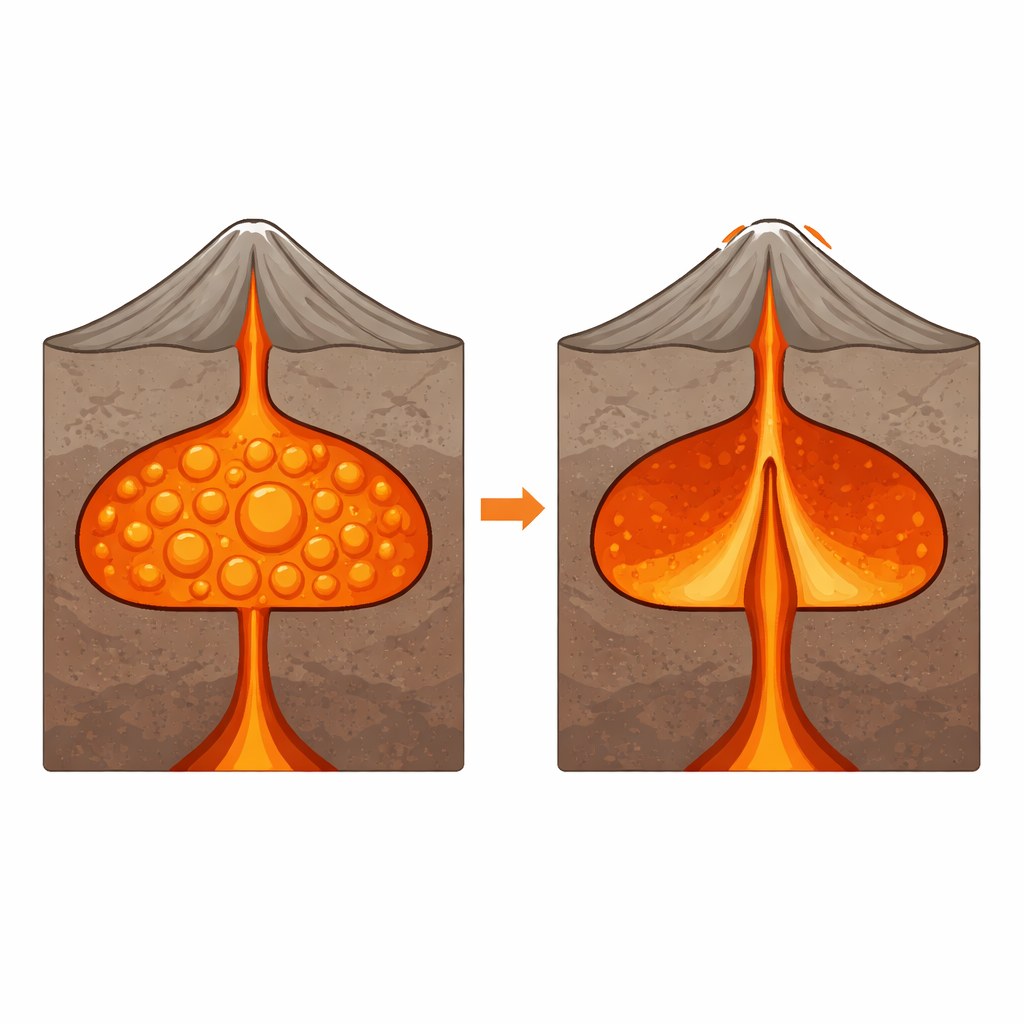
Deep beneath many large volcanoes, molten rock contains dissolved gases such as water and carbon dioxide. As the magma cools and crystallizes over thousands of years, some of these gases separate out as bubbles, forming a magmatic gas phase. These bubbles act like tiny cushions: they make the magma more compressible, so the whole reservoir can absorb some added magma without a big jump in pressure. For a giant, long-lived magma body, this cushioning effect helps explain why it can slowly grow to hundreds of cubic kilometers without erupting very often.
When gas goes back into the melt
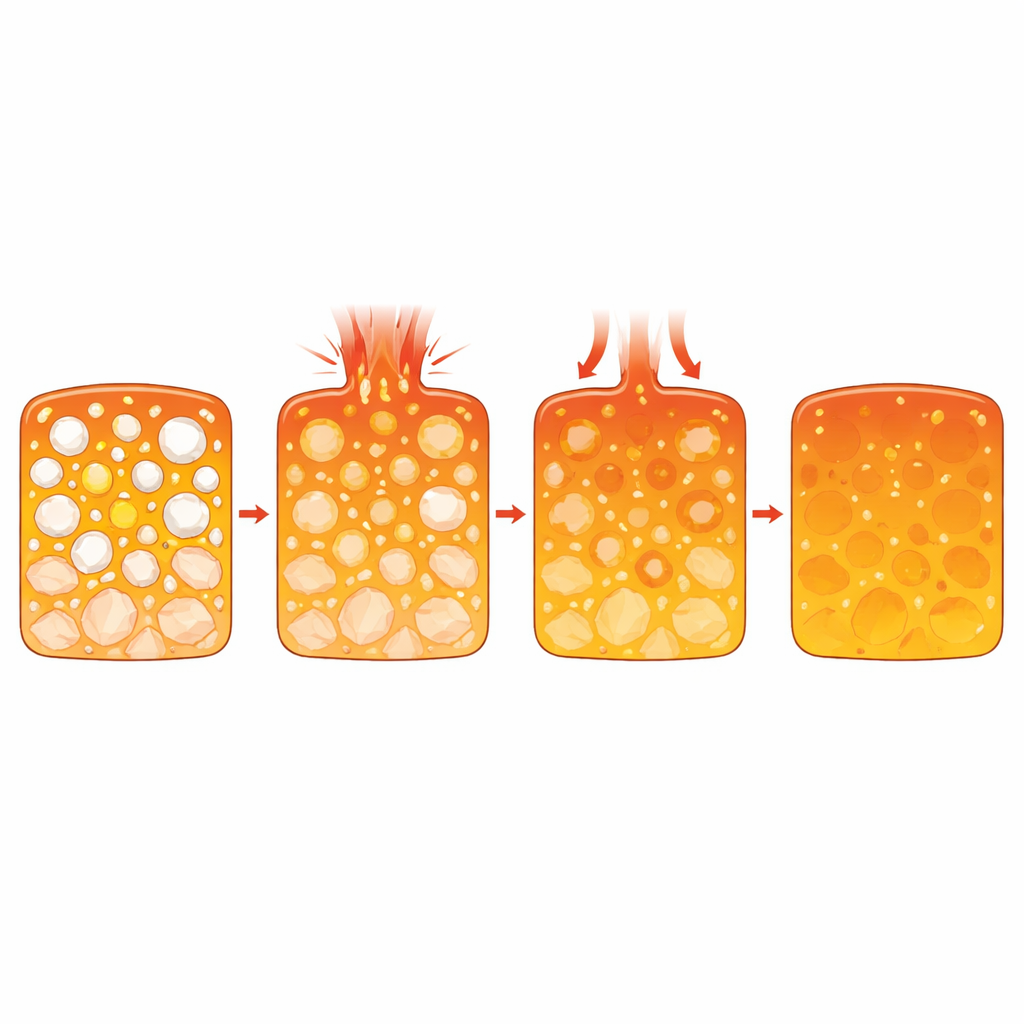
The new work focuses on what happens when a mature magma chamber is suddenly flooded with fresh, hotter magma from below. Using a detailed numerical model, informed by real chemical data, the authors show that such rapid recharge can actually drive the existing gas bubbles to dissolve back into the liquid magma. As pressure rises and crystals begin to melt, the magma can hold more dissolved water, so the free gas phase shrinks or even disappears. This is the opposite of the usual textbook picture where bubbles grow and help trigger eruption; here, they are being “resorbed” into the melt.
A natural test case in Japan
The team tested this idea using the Aso caldera in Japan, which produced a colossal eruption known as Aso-4 about 86,000 years ago. Geochemical clues preserved in tiny mineral and glass inclusions suggest that, shortly before Aso-4, the magma changed from being saturated with water-rich gas to being undersaturated—meaning much less free gas was present. Passive gas loss to the surface could not explain the observations. By simulating Aso’s magma chamber over the 5,000 years between a smaller earlier eruption and Aso-4, the authors found that high rates of magma recharge could reproduce the observed loss of gas bubbles through volatile resorption, especially when the chamber started near gas saturation.
How resorption speeds up the pressure build-up
When gas bubbles dissolve back into the melt, the magma becomes less squishy and more like a stiff, nearly incompressible fluid. In the model, this change means that any additional magma pumped into the chamber produces a larger increase in pressure. For Aso-like conditions, runs with strong resorption pressurized quickly enough to reach eruption-triggering levels in about 2,300 years, while otherwise similar runs that kept their gas phase never erupted within the same time window. Once the chamber crossed from gas-rich to gas-poor, pressurization accelerated further, because the last remaining “cushioning” effect of the bubbles vanished.
Looking for signals and future risks
The authors then generalized their simulations to a wide range of chamber sizes, depths, and magma compositions. They conclude that volatile resorption should be common in large silicic systems that experience strong pulses of magma input, such as other well-known caldera volcanoes. In these settings, short-lived but intense recharge episodes could both feed the magma body and, by shrinking the gas phase, make it more prone to rapid pressurization and earlier eruption. This process may leave detectable fingerprints: a decline in gas emissions at the surface, shifts in gas ratios, and evolving ground deformation patterns as the stiffening magma transmits pressure more efficiently. Recognizing such signs could improve early warning at some of Earth’s most hazardous volcanoes.
What this means for people living near volcanoes
For non-specialists, the key takeaway is that fewer bubbles in a magma chamber does not necessarily mean lower danger. Under the right conditions, the loss of gas cushions can make a giant magma reservoir behave more like a rigid piston, causing pressure to build up faster for the same amount of new magma added. The study suggests that volatile resorption is a natural and possibly widespread way for large volcanic systems to move more quickly toward eruption than previously thought. By searching for its geochemical and geophysical traces, scientists may be able to spot when a normally sluggish supervolcano is entering a more sensitive, eruption-prone state.
Citation: Keller, F., Townsend, M., Troch, J. et al. Volatile resorption expedites eruption onset in large silicic systems. Nat Commun 17, 3872 (2026). https://doi.org/10.1038/s41467-026-70206-8
Keywords: supervolcanoes, magma chambers, volcanic gases, eruption forecasting, caldera eruptions