Clear Sky Science · en
Machine learning helps to strongly reduce future warming uncertainty
Why this matters for our future
When scientists estimate how much the planet will warm, the range of possible futures is still wide, and that uncertainty affects everything from coastal planning to energy policy. This study shows that powerful computer learning techniques can squeeze much more information out of the warming we have already observed, sharply narrowing the range of likely future temperatures. That means clearer guidance on how quickly we may cross key international climate targets such as 1.5 °C and 2 °C of global warming.
Looking beyond the global average
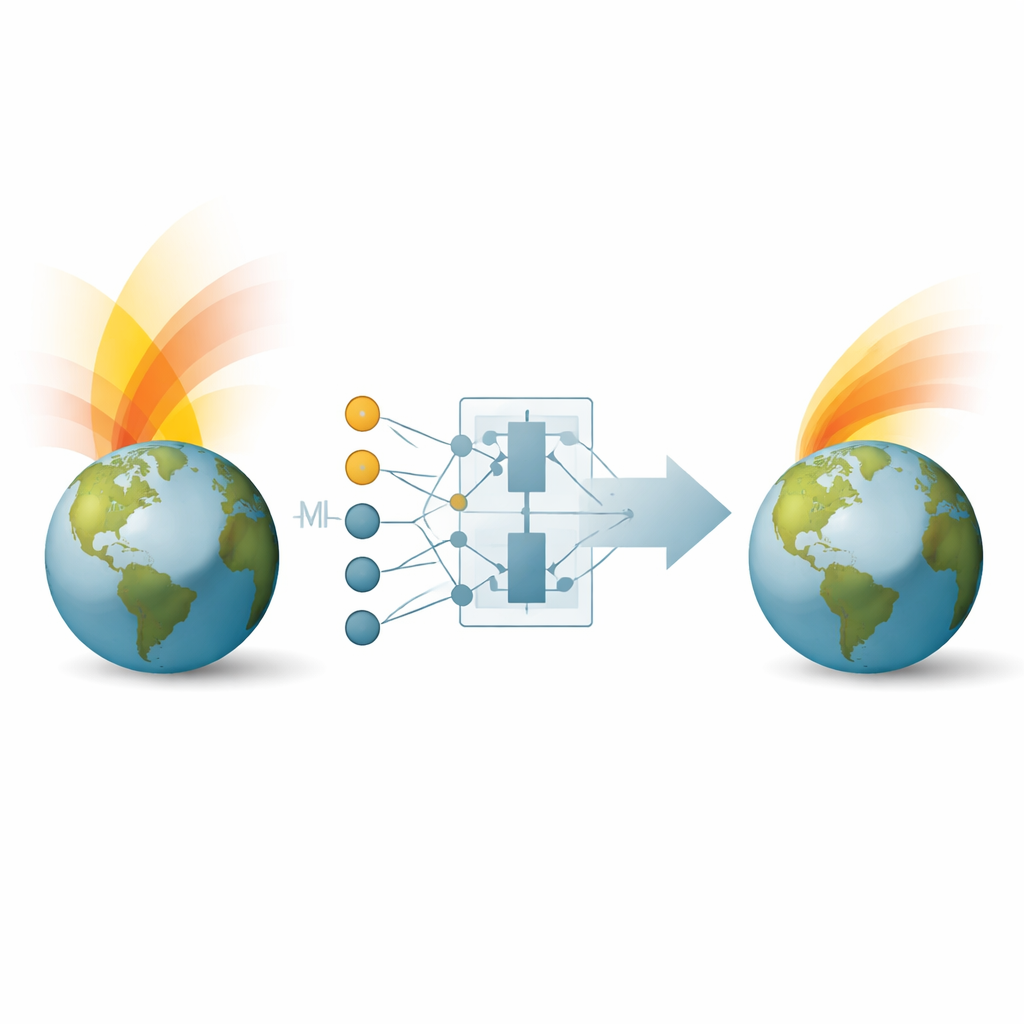
Until now, most efforts to refine future warming projections have leaned heavily on a single number: the rise in the planet’s average surface temperature. But global warming is not uniform. Some regions, such as the Arctic and parts of the tropics, are heating up much faster than others. The authors argue that these geographic differences contain valuable clues that are largely ignored when we focus only on the global average. They use a form of machine learning to read the full global map of temperature trends over the past 50 years and to connect those patterns to the range of warming outcomes produced by dozens of climate models.
Teaching a computer to learn from past warming
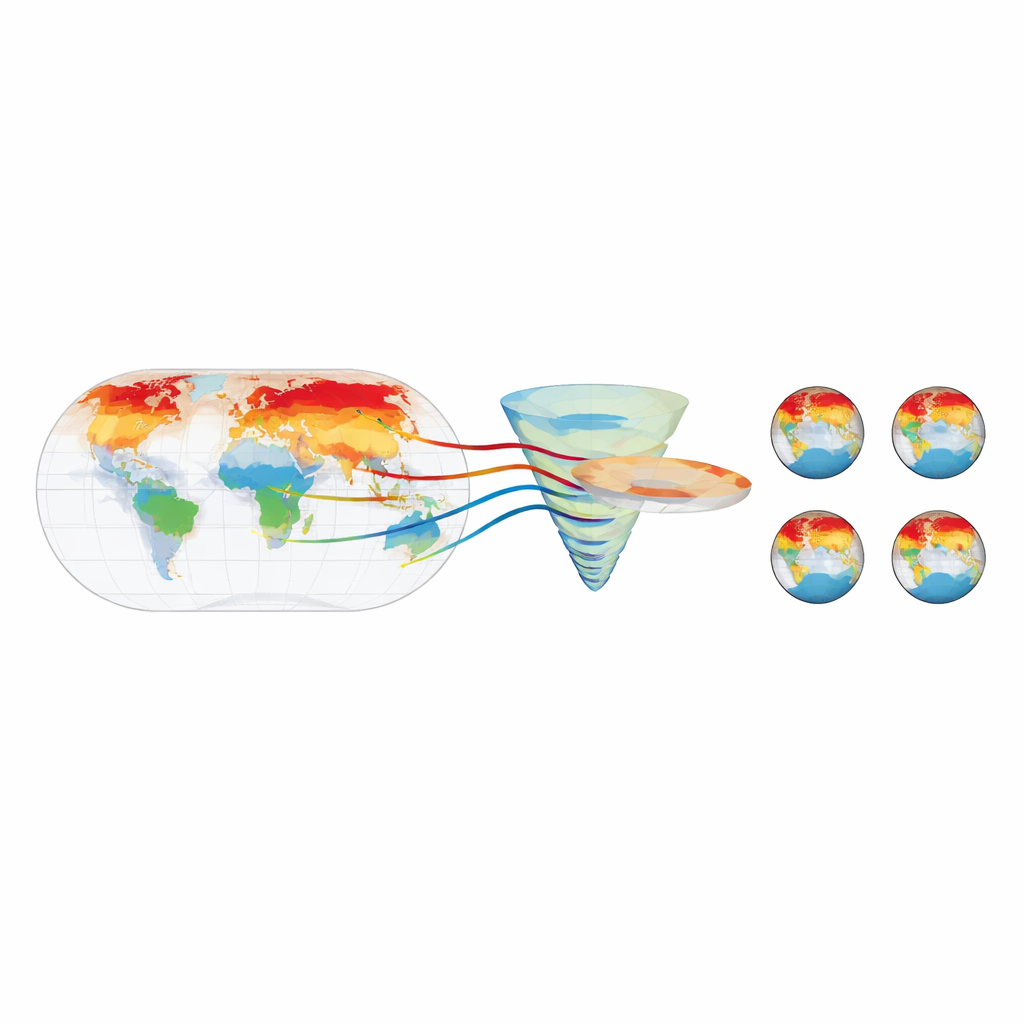
The team trains a learning algorithm on simulations from many climate models that participated in a major international comparison project. For each model run, they feed in the pattern of warming from 1971 to 2020 at every grid point on Earth and ask the algorithm to predict how much the model warms globally in three future time windows: near term (2021–2040), mid-century (2041–2060), and late century (2081–2100), under several different emissions pathways. By repeating this across hundreds of simulations, the system learns which parts of the world’s past warming patterns are most closely tied to eventual global temperature rise, and how strong those links are.
Finding key regions that shape the future
The learning system consistently discovers that certain regions punch far above their weight in determining future global warming. These include the Arctic, the Tibetan Plateau, South and Southeast Asia, the Amazon basin, and parts of the Indian and Southern Oceans. In these areas, local warming tends to scale in a stable way with the global average across time and across scenarios, reflecting strong and persistent climate feedbacks such as loss of reflective ice or changes in clouds. The algorithm naturally assigns greater weight to grid cells where different climate models agree on how sensitive temperatures are, and downplays locations where models diverge, such as parts of the Eurasian Arctic with uncertain sea-ice behavior.
Sharper projections and earlier thresholds
When the learned relationships are applied to actual observed warming maps from multiple temperature datasets, uncertainty in future global warming shrinks substantially. On average across scenarios and time periods, the method cuts the error variance by more than 70% compared with unconstrained model projections—about one and a half times the improvement achieved by methods that use only the global mean trend. Importantly, this approach narrows both the high and low ends of the range, so we are less likely to overestimate or underestimate future warming. For a mid-range to high emissions pathway often used in impact studies, the study finds that the chance of exceeding 2 °C of warming by mid-century rises to roughly 80% once spatial information is included, compared with about 70% when only the global average trend is used.
What this means for people and planning
The refined projections not only tighten estimates of global temperature rise; they also improve local warming maps used for impact assessments. Over most land areas, the spread in projected mid-century warming relative to today drops by tens of percent, yielding more precise estimates for agriculture, water resources, health risks, and infrastructure planning. At the same time, the elevated lower bounds of warming underline that key Paris Agreement thresholds are likely to be crossed sooner than some earlier constrained estimates suggested. In practical terms, this work shows that smarter use of existing temperature records—especially in a handful of climatically sensitive regions—can significantly sharpen our picture of the climate future and strengthen the case for faster and more targeted mitigation and adaptation.
Citation: Li, C., Wu, J., Wang, Z. et al. Machine learning helps to strongly reduce future warming uncertainty. Nat Commun 17, 3366 (2026). https://doi.org/10.1038/s41467-026-70205-9
Keywords: global warming projections, machine learning climate, warming patterns, climate uncertainty, Paris Agreement thresholds