Clear Sky Science · en
Chemodivergent Coupling of 1,3-Enynes with Anilines to Access Dihydropyrrole Skeleton under Palladium Catalysis
Turning Simple Ingredients into Useful Rings
Chemists are always looking for faster, cleaner ways to build the kinds of ring-shaped molecules that appear in medicines and natural products. This study introduces a versatile reaction that takes two simple, widely available building blocks and, just by changing the reaction conditions, can deliver two different families of ring structures that are valuable in drug discovery. It shows how fine control over a metal catalyst can guide molecules down one of two paths, much like directing traffic at a busy intersection.
Why These Rings Matter
Many modern drugs contain small rings that include nitrogen, because these shapes fit snugly into the pockets of biological targets such as enzymes and receptors. A particular ring type, the 2,5-dihydropyrrole, sits between fully saturated and fully aromatic rings, giving it a blend of flexibility and stability that can translate into useful biological effects. Despite this promise, current routes to these rings often require several steps, specially prepared starting materials, or expensive reagents. A direct, one-pot method that uses simple feedstock chemicals would therefore be highly attractive for both academic labs and pharmaceutical companies.
Two Outcomes from the Same Starting Mix
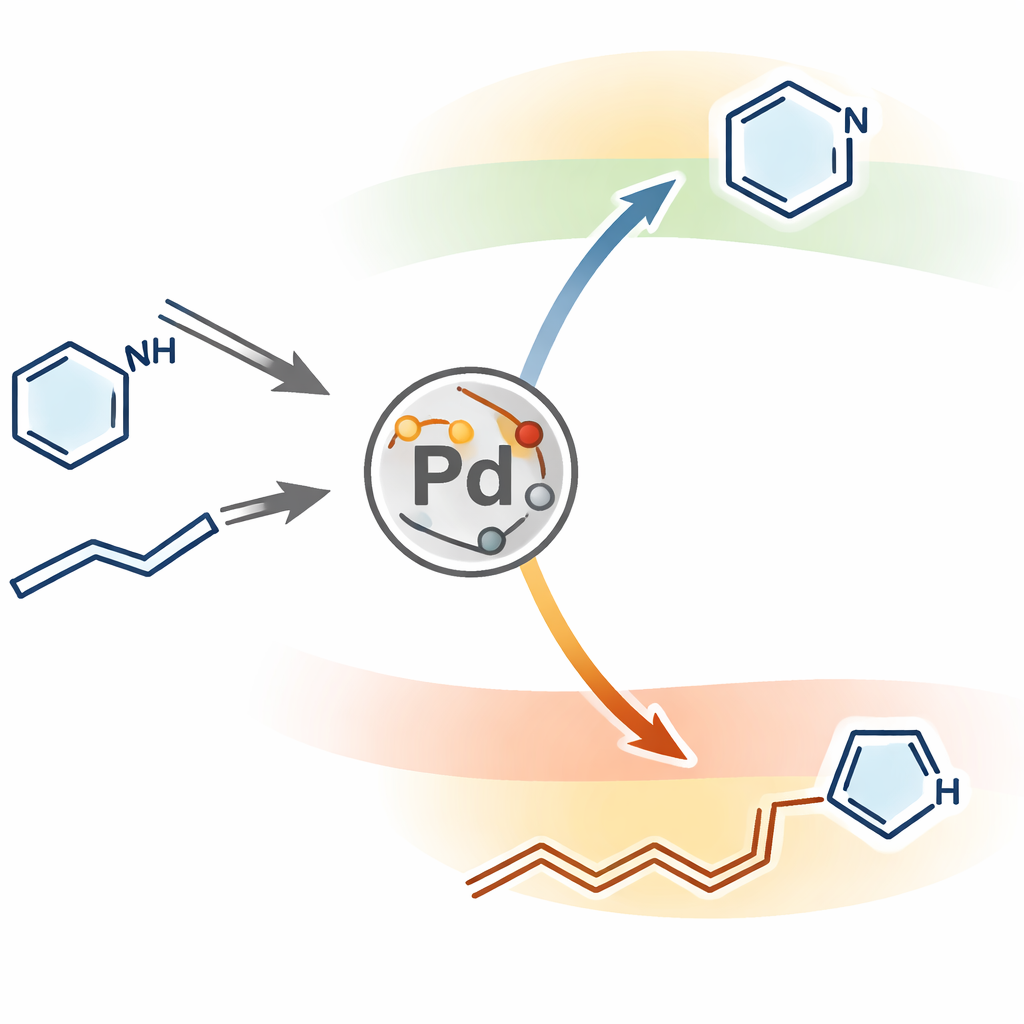
The authors focus on combining two common ingredients: anilines (simple nitrogen-containing aromatics related to many drug fragments) and 1,3-enynes (small chains that contain both a double and a triple bond). Under the influence of a palladium catalyst, this pair can react in two fundamentally different ways. In one mode, they join together once to form a compact five-membered nitrogen ring, a 2-substituted 2,5-dihydropyrrole. In the other mode, the same partners effectively add in a three-component fashion, stitching in a second enyne fragment to create a more extended product: a 2,5-dihydropyrrole bearing a butadiene-like tail. Crucially, the team shows that these two outcomes can be chosen at will by tuning the type of palladium used, the strength of an added acid, and the amount of supporting ligand.
How the Molecular Fork in the Road Works
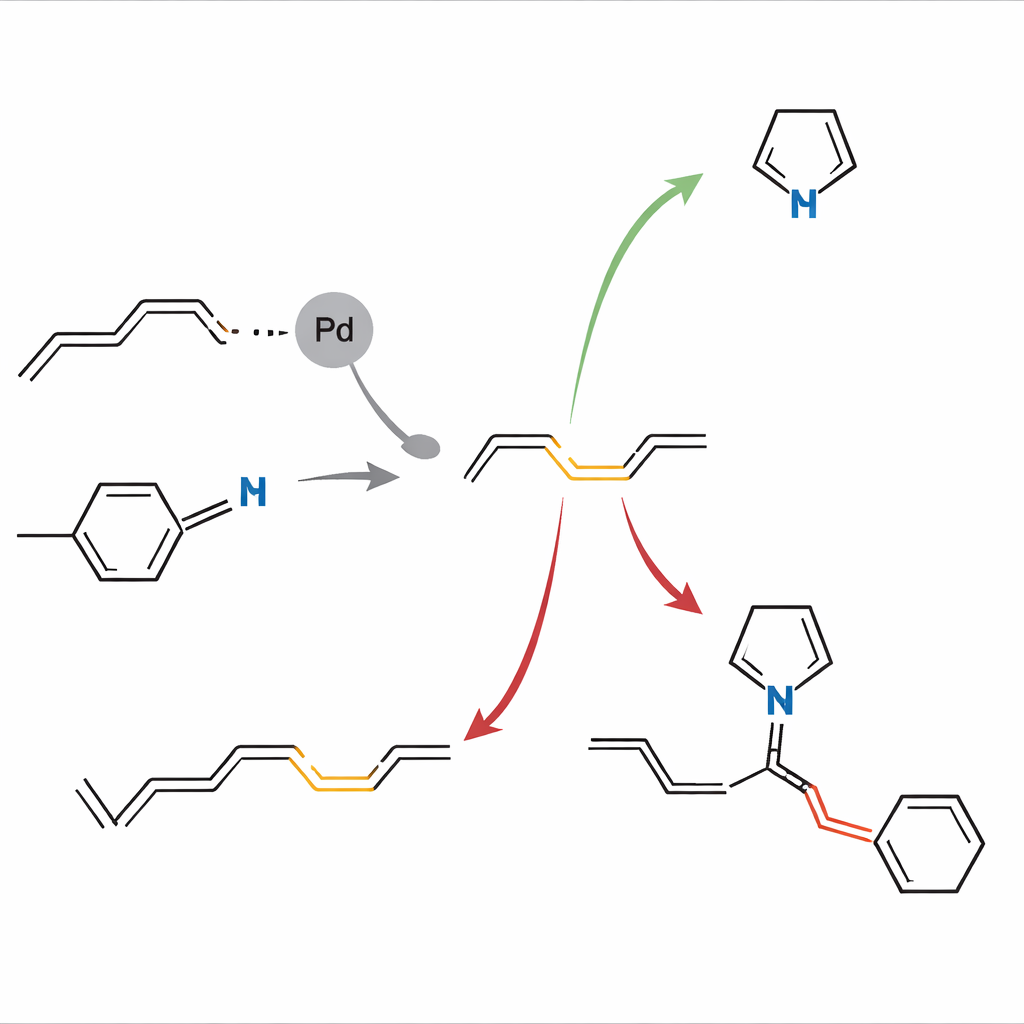
At the heart of this selectivity is a short-lived intermediate that resembles an allene, formed when palladium first helps an aniline add across the enyne. From that point, the reaction faces a fork in the road. One branch folds the intermediate back onto itself to close the five-membered ring in an intramolecular step. The other branch lets the intermediate grab a second enyne molecule before closing, building the longer telomeric product. Through kinetic experiments, isotope labeling, and control reactions, the authors show that palladium in a higher oxidation state speeds up the ring-closing route, while palladium in its zero-valent form, combined with a stronger acid and extra ligand, slows that closure and favors capture of the second enyne instead.
A Broad and Practical Reaction
Beyond explaining the mechanism, the study demonstrates how general and practical this strategy can be. A wide array of anilines and enynes, bearing electron-rich, electron-poor, bulky, or heteroatom-containing groups, all participate smoothly, usually in good to excellent yields and with high control over the geometry of the newly formed double bonds. The authors even develop a chiral version of the ring-forming path that delivers products with a defined handedness, an important feature in designing drugs. They also show that the new dihydropyrrole products can be further transformed—oxidized to fully aromatic rings, reduced, or elaborated into more complex architectures—opening many doors for downstream chemistry.
Upgrading Real Drug Fragments
To showcase real-world relevance, the team applies their method directly to several medicines and bioactive molecules that contain an aniline unit, such as local anesthetics and other pharmacologically active compounds. Without rebuilding these molecules from scratch, they can "plug in" the enyne partner and palladium catalyst to install the dihydropyrrole motif late in the synthesis. This type of late-stage modification is prized in medicinal chemistry because it allows rapid exploration of new analogues of known drugs, potentially uncovering improved activity or better safety profiles with minimal synthetic effort.
What This Means in Simple Terms
In everyday terms, this work shows chemists how to take two simple molecular ingredients and, by adjusting a few knobs on the reaction setup, decide whether they end up with a compact ring or a ring with an extended handle. The process wastes very little of the starting material and works on many different substrates, including complex drug-like structures. By revealing how a single, controllable intermediate sits at the center of this choice, the study offers both a practical tool for making useful molecules and a broader lesson in how careful control of reaction conditions can steer chemical traffic toward entirely different destinations.
Citation: Xu, SY., Li, XT., Wang, ZH. et al. Chemodivergent Coupling of 1,3-Enynes with Anilines to Access Dihydropyrrole Skeleton under Palladium Catalysis. Nat Commun 17, 3381 (2026). https://doi.org/10.1038/s41467-026-70201-z
Keywords: dihydropyrrole synthesis, palladium catalysis, chemodivergent reactions, 1,3-enyne chemistry, telomerization