Clear Sky Science · en
Tough hydrogels enabled by transient entanglements
Why stretchable gels matter
Imagine a soft contact lens that never tears, a joint implant that glides smoothly for years, or a wearable sensor that bends and twists with your skin without breaking. All of these rely on hydrogels—water-rich, jelly-like materials. Yet most hydrogels face a stubborn trade-off: make them strong and they become brittle, keep them stretchy and they tear easily. This paper introduces a simple new way to break that trade-off, creating hydrogels that are both extraordinarily tough and remarkably durable.
From simple gels to smart networks
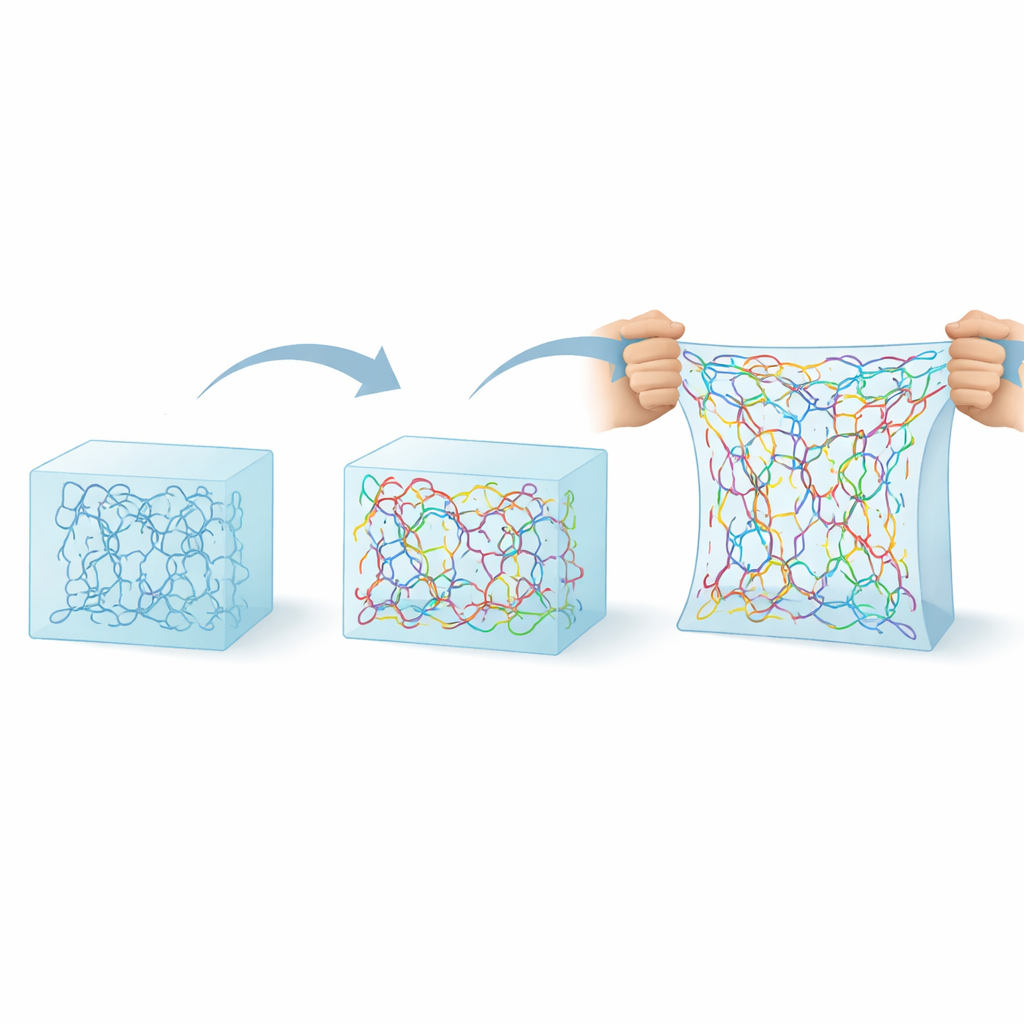
Conventional hydrogels are built from long molecular chains joined at fixed crossing points, forming a soft molecular net. In standard designs, increasing the number of these crossings boosts strength but also locks the net in place, so it snaps rather than stretches when pulled hard. To get around this, many researchers have built more complicated, multi-layered gels that combine several different networks or special chemical bonds. These designs can work well, but they are difficult to make and often require custom ingredients.
A new way to tie molecular knots
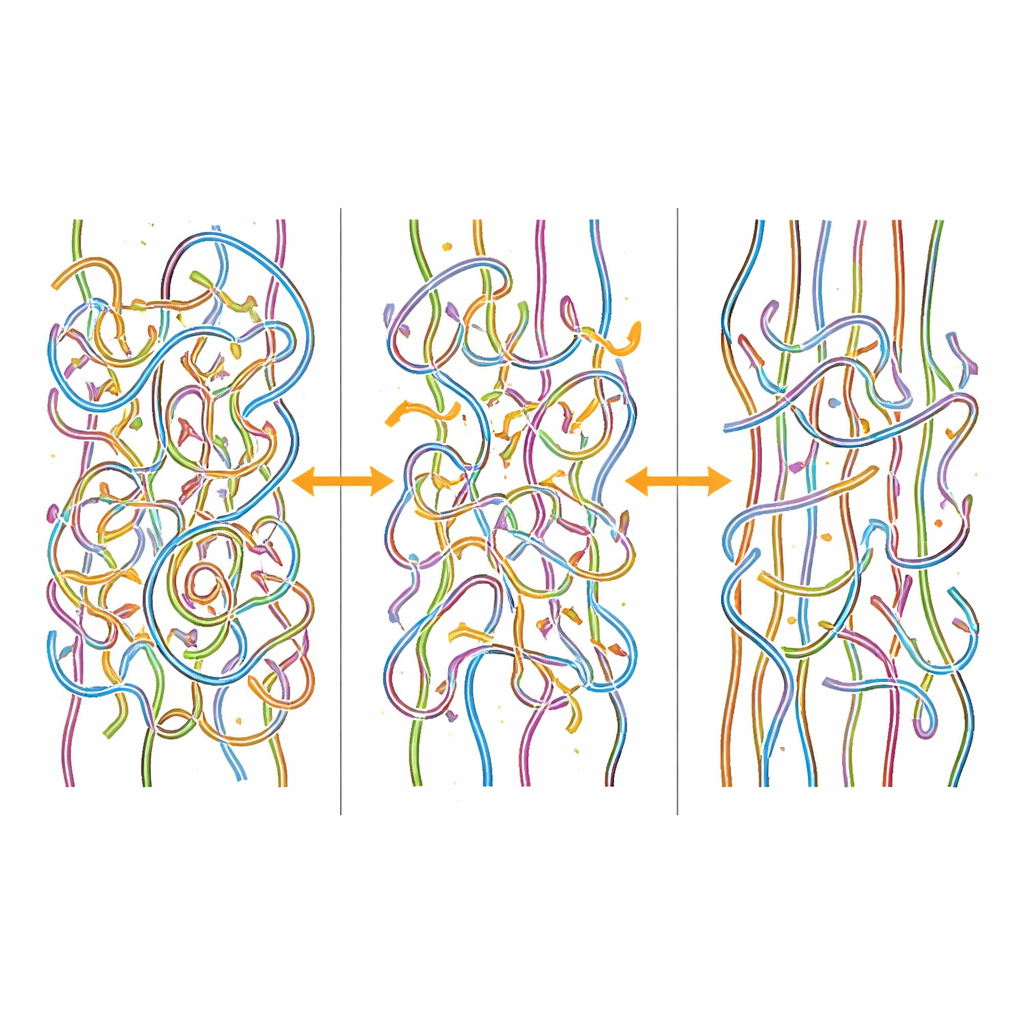
The authors focus instead on how the chains weave past each other—on their “entanglements.” In everyday terms, these are like knots and loops that form when strings are piled together. Earlier work used permanent entanglements: the chains could shift a bit but could not fully slip free, limiting how much energy they could absorb before the material failed. In this study, the researchers design a polyacrylamide gel filled with many “dangling” chain ends that thread and unthread around their neighbors. These temporary tangles, or transient entanglements, are created using a special linear cross-linking molecule that encourages side chains to form without locking everything rigidly together.
How slipping knots toughen the gel
To see how this new network behaves, the team combined mechanical testing with advanced measurements of molecular motion. Stress relaxation tests showed that a large fraction of the internal connections act like temporary links that can rearrange over time, while a smaller fraction are permanent chemical anchors. Nuclear magnetic resonance experiments resolved two distinct kinds of molecular constraints: tightly bound regions from permanent cross-links and more flexible regions arising from the transient tangles. Light scattering measurements revealed that these entanglements also smooth out irregularities in the network, giving a more uniform, transparent material with fewer weak spots where cracks can start.
Exceptional strength, stretch, and endurance
When stretched, the transiently entangled gels performed far beyond typical water-based materials. Samples could be elongated more than 30 to 50 times their original length, reaching fracture strains above 5000 percent and strengths around one megapascal, values rarely achieved in this class of gels. Importantly, the usual rule that stronger gels must be less tough was largely overcome: even as strength increased, the energy needed to tear the material changed only modestly. The gels also resisted repeated loading, with a fatigue threshold—how much energy per cycle they can withstand before cracks grow—that surpasses many other tough hydrogels and even natural rubber. Under compression, they tolerated heavy squeezing and sprang back to shape.
Slippery, long-lasting surfaces
The dense forest of water-loving dangling chains does more than toughen the interior; it also creates an ultra-slick surface. When used as a coating, these hydrogels exhibited friction coefficients several times lower than conventional gels and even lower than common plastics. In wear tests, regular hydrogels failed after a few hours, whereas the transiently entangled versions remained intact. Coatings applied to medical-grade catheters drastically reduced sliding resistance in water, thanks to a stable, trapped layer of water at the surface that acts like a microscopic lubricant film. Crucially, this hydration layer was long-lived, allowing the coating to remain slippery over many cycles of motion.
What this means for future soft materials
By carefully tuning how polymer chains entangle and then let go under stress, the authors show that a simple, single-network hydrogel can be both very strong and very tough, while also resisting fatigue and friction. Rather than relying on complex multi-layer architectures, their approach uses transient molecular knots to spread out forces and dissipate energy before damage occurs. This design principle could be applied to many other gel systems, opening the door to safer, longer-lasting soft devices—from medical coatings and flexible electronics to artificial tissues and low-friction seals—where extreme stretchability and durability are needed at the same time.
Citation: Yuan, Z., Cao, Z., Wang, H. et al. Tough hydrogels enabled by transient entanglements. Nat Commun 17, 4145 (2026). https://doi.org/10.1038/s41467-026-70194-9
Keywords: hydrogels, polymer networks, material toughness, wearable devices, lubricating coatings