Clear Sky Science · en
Quantifying the effects of response diversity dynamics on ecosystem stability
Why this matters for real-world lakes and beyond
As our climate warms and pollution reshapes lakes, forests, and oceans, one pressing question is whether these ecosystems can remain stable enough to keep providing clean water, food, and other benefits. This study looks at a subtle but powerful idea called “response diversity” – the way different species react differently to the same changes – and asks whether that variety in responses can act as a kind of insurance policy that keeps whole ecosystems from tipping into chaos.
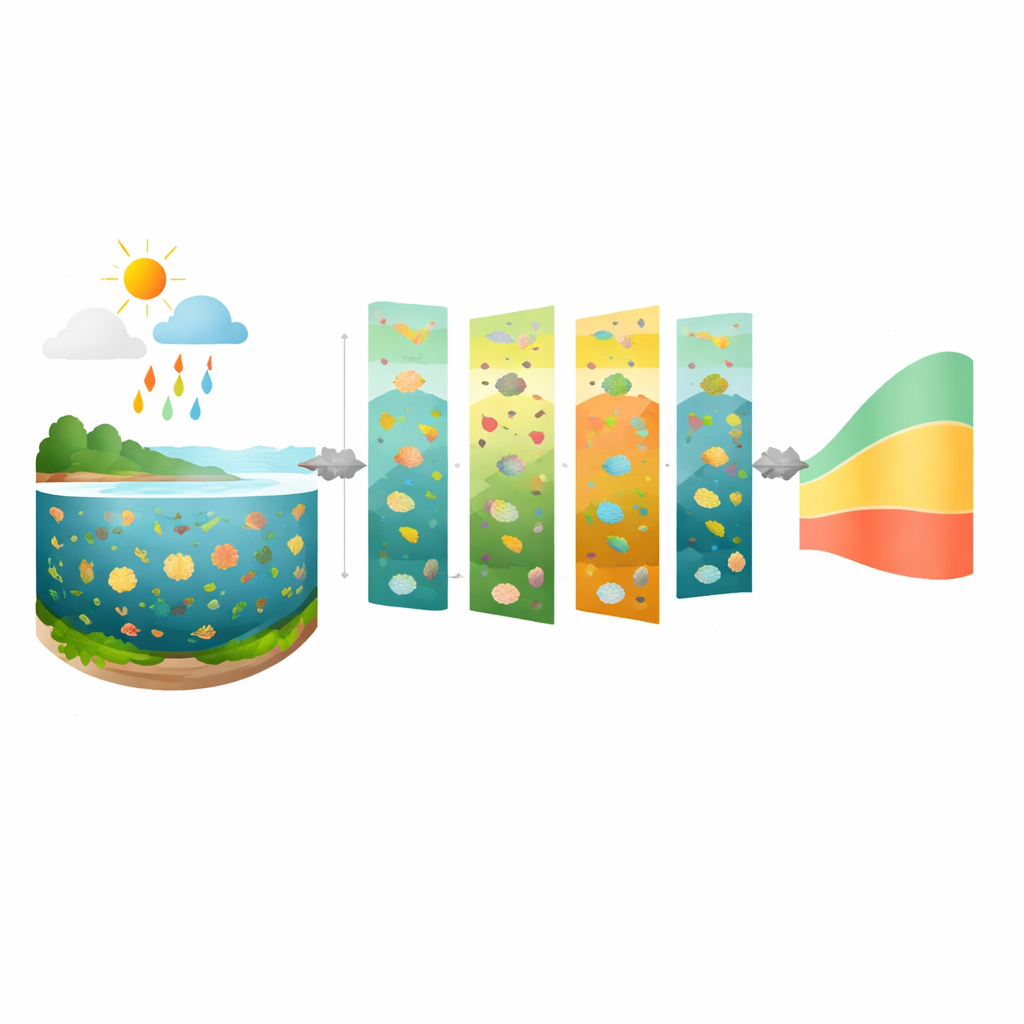
Many ways to weather the same storm
In any ecosystem, species share a habitat but do not react identically when the environment shifts. Some plankton bloom in warm, nutrient-rich water, others thrive when it is cooler or leaner. This mix of sensitivities is what ecologists call response diversity. The authors argue that this diversity is more important for stability than simply counting how many species are present. Traditional measures, like species richness, say little about whether the community can collectively ride out heatwaves, pollution pulses, or changing climate patterns. The challenge has been to move from this appealing idea to a practical way of measuring response diversity in complex, real-world systems that are constantly changing.
Following a lake community through decades of change
To tackle this, the researchers turned to nearly 50 years of monthly data from Lake Geneva in Europe. Over that period, the lake experienced warming as well as a rise and then decline in phosphorus pollution. The team tracked dozens of kinds of phytoplankton (microscopic plants) and zooplankton (tiny animals) along with physical, chemical, and climate variables such as water temperature, mixing depth, nutrients, and large-scale climate indices. Instead of assuming that species behave in a fixed way, they used a nonlinear time-series approach to estimate, month by month, how strongly each plankton group responded to every other group and to each environmental factor. These responses were recorded in large matrices that describe, at each moment, how a small push in one component would nudge the others.
Turning complex reactions into a measure of variety
From these response matrices, the authors computed how dissimilar the reactions of different species were to the same drivers. If species tended to react in very similar ways, response diversity was low; if their reactions differed widely in size or direction, it was high. This calculation was repeated through time and split into different categories: within a trophic level (phytoplankton responding to other phytoplankton, zooplankton to zooplankton), across trophic levels (for example, phytoplankton responding to zooplankton), and to environmental factors such as nutrients and temperature. The team also quantified an instability index for total phytoplankton and zooplankton biomass, based on how sensitive the community was to small disturbances at each time point. This allowed them to ask a direct question: when response diversity goes up or down, does overall biomass become more or less stable?
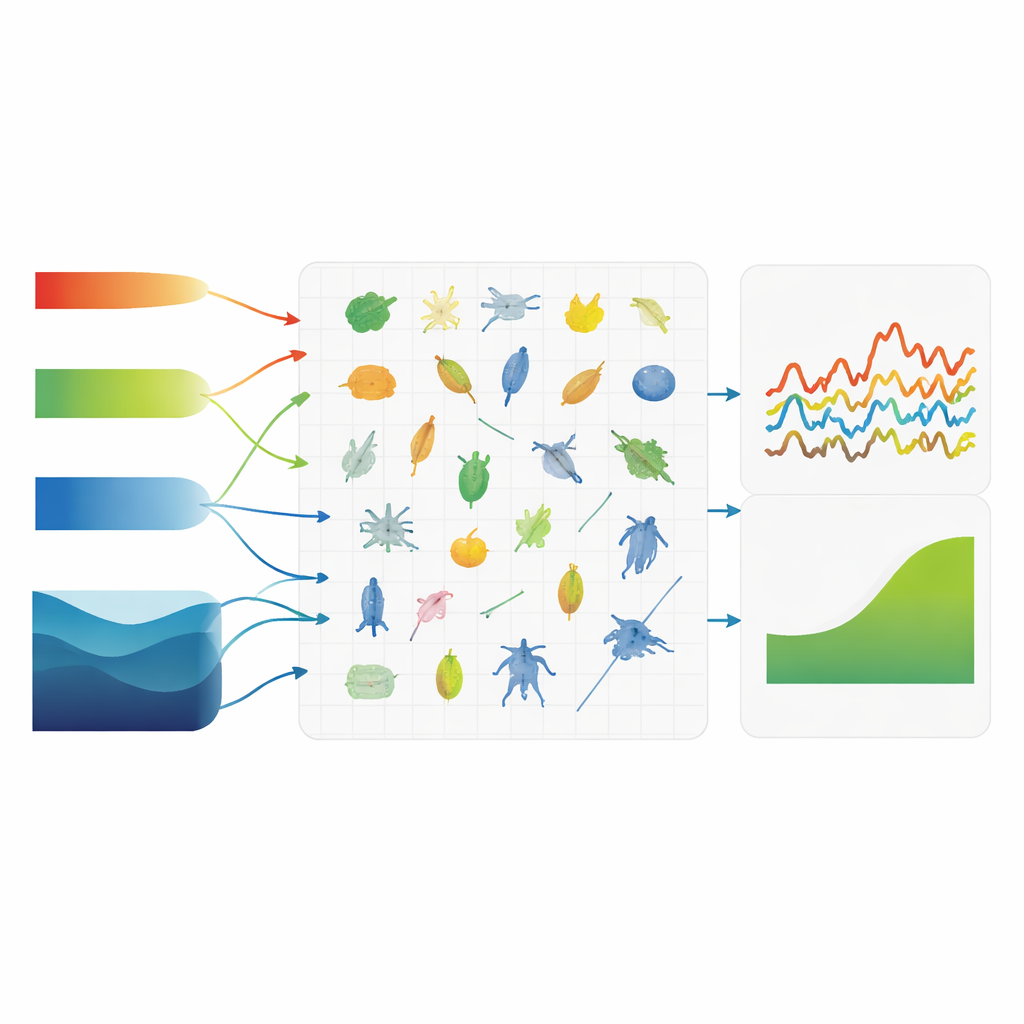
How variety in responses calms community swings
The results showed that higher response diversity within each plankton level buffered swings in that group’s total biomass. For phytoplankton, greater response diversity – especially that arising from interactions among different phytoplankton – consistently reduced instability. Zooplankton response diversity similarly helped stabilize zooplankton biomass. The strength of this stabilizing effect, however, was not constant. It waxed and waned with the seasons and over decades, depending on conditions such as water temperature, mixing depth, nutrient concentrations, and primary productivity. In contrast, diversity in how plankton responded to environmental variables alone was less clearly linked to stability than diversity arising from their interactions with one another, underscoring the importance of food web relationships.
What shapes response diversity in a changing world
The study also explored which environmental changes tend to strengthen or weaken response diversity itself. Rising phosphorus levels, for example, often increased response diversity in several categories, suggesting that nutrient enrichment can expand the range of ways species react – at least up to a point. Warming and stronger thermal stratification, on the other hand, tended to erode response diversity, especially for zooplankton. Over Lake Geneva’s history of pollution and partial recovery, phytoplankton response diversity generally rose while zooplankton response diversity declined, hinting at differing long-term sensitivities of producers and consumers to human-driven change. These findings suggest that policies affecting nutrients, temperature, and mixing can indirectly alter ecosystem stability by reshaping how species respond to their environment and to each other.
What this means for managing ecosystems
In simple terms, the study shows that ecosystems are more resilient when their inhabitants do not all react the same way to stress. A community where some species surge while others slump under a given disturbance can keep its overall biomass and functioning relatively steady, much like a diversified investment portfolio smooths financial ups and downs. By offering a practical way to track this response diversity over time, the framework developed here gives managers a new tool for diagnosing how close systems may be to losing resilience, and for assessing whether interventions – such as reducing nutrient inputs or adapting to warming – are strengthening or weakening the natural insurance built into biodiversity.
Citation: Hsieh, Ch., Pan, RY., Chang, CW. et al. Quantifying the effects of response diversity dynamics on ecosystem stability. Nat Commun 17, 4090 (2026). https://doi.org/10.1038/s41467-026-70192-x
Keywords: ecosystem stability, plankton communities, biodiversity, environmental change, lake ecology