Clear Sky Science · en
Plastic deformation in nanodiamonds
When the hardest gem starts to bend
Diamond is famous for being the hardest natural material, yet that very hardness usually comes with a serious drawback: brittleness. Hit a diamond hard enough and it will crack rather than bend. This study reveals a surprising twist to that story. When diamonds are shrunk down to particles only a few billionths of a meter across, they can deform in a smooth, plastic way more like a metal than a fragile crystal. Understanding how this happens could open new paths for making tiny, durable devices out of diamond.
Why small diamonds behave so strangely
In everyday materials, permanent shape change usually comes from defects inside the crystal that move around under stress. Metals have plenty of these mobile defects, so they bend rather than shatter. Diamond, built from stiff carbon bonds, normally lacks this easy motion and so fails by cracking. The authors wondered what would happen if they pushed this material to the extreme small scale. At just a few nanometers across, particles have far more surface area, far fewer internal defects, and may follow very different mechanical rules from the bulk gem stones we know.
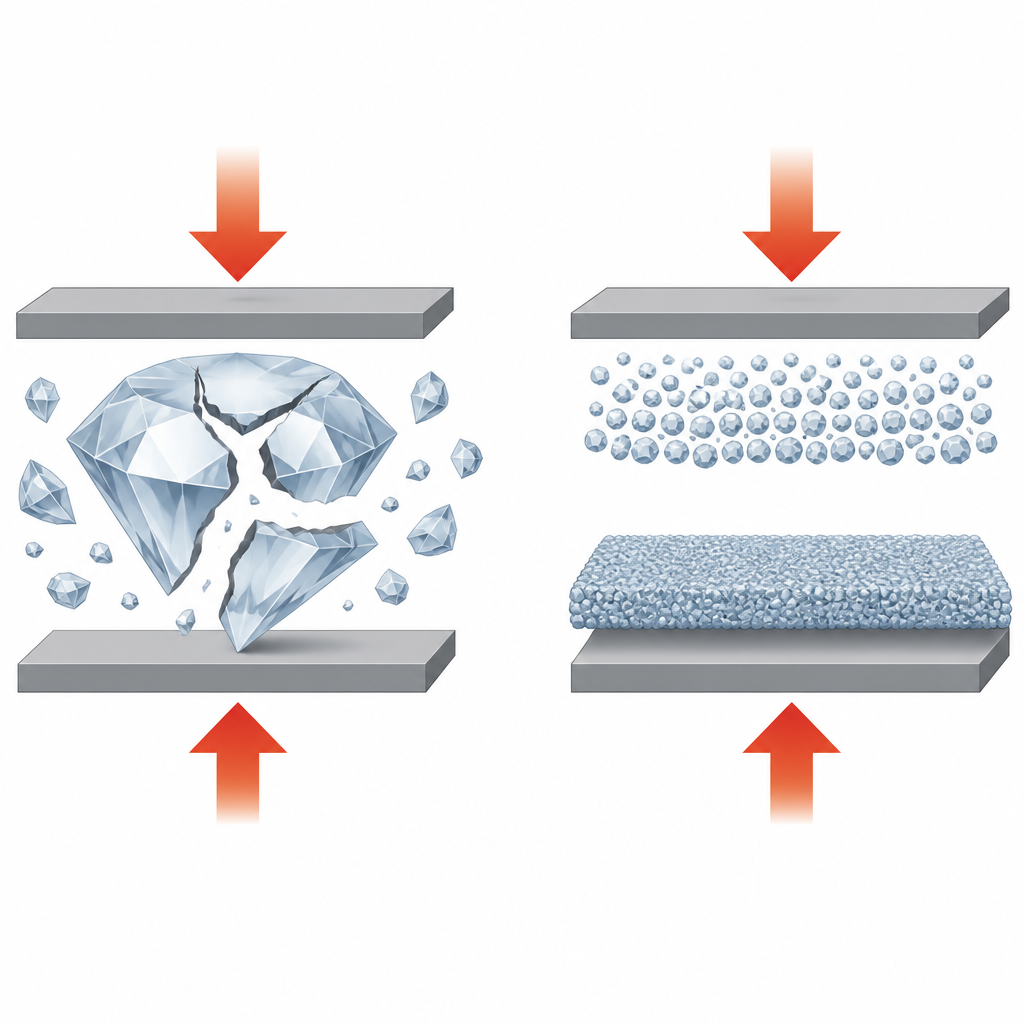
Squashing single nanodiamonds inside an electron microscope
To test this, the team trapped individual diamond nanoparticles between two larger diamond tips inside a transmission electron microscope. A highly sensitive vibration-based sensor let them measure how stiff the particle was and how much energy it dissipated while they slowly squeezed it. At the same time, they recorded atomic-scale images and used an electron spectroscopy method to track how the carbon bonds changed during compression. This setup allowed them to watch, in real time, how a single nanodiamond responded as it was flattened again and again.
A hidden soft network inside a hard crystal
The results were striking. For particles around seven to ten nanometers across, the first stage of loading was purely elastic: the diamond stored energy like a spring. Beyond a stress of roughly fifty to sixty billion pascals, a new behavior appeared. Thin regions of disordered carbon formed inside the crystal, creating an interconnected network that threaded through the particle. These amorphous paths split the diamond into tiny grains only a few nanometers wide. As compression continued, these grains slid, rotated, and rearranged along the soft network, allowing the particle to flatten by more than ninety percent of its original height without cracking or falling apart.
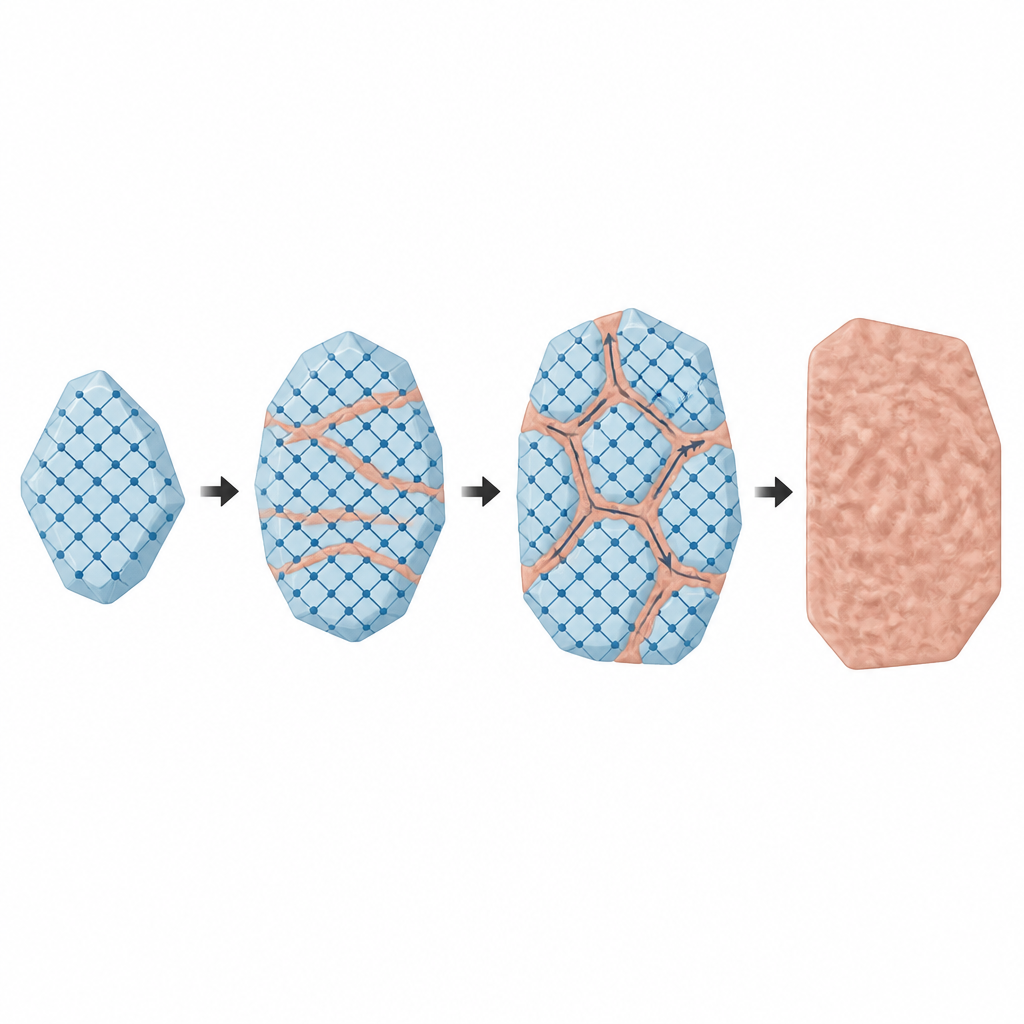
Size limits and computer views of the process
The researchers found that this unusual plastic behavior only occurred when the particles were smaller than about thirteen nanometers. Larger nanodiamonds, between roughly seventeen and one hundred nanometers, responded in a more familiar way by forming sharp cracks and splitting, with no continuous soft network. Computer simulations backed up the experiments, showing the same sequence: local disorder forming under high stress, growth of a thin web of amorphous carbon, sliding of nanograins, and finally a nearly fully amorphous state that could be squeezed to near single-atomic-layer thickness. The simulations also confirmed that this mechanism did not depend on the crystal orientation or starting structure of the particle.
From brittle gems to flexible building blocks
Beyond explaining a new way that diamond can deform, the study hints at practical uses. The same soft network that lets a nanodiamond flatten without breaking also lets separate particles fuse together under pressure in a kind of cold welding. The team showed that several nanodiamonds could be pressed into one larger, mechanically sound particle while still keeping the ability to deform. For non-specialists, the key message is that even the hardest known material can act ductile when confined to the nanoscale. By harnessing this size-dependent softening, engineers may be able to shape and assemble diamond building blocks for future nanoelectronic, mechanical, and quantum devices in ways that were impossible with brittle bulk crystals.
Citation: Zhang, J., Liu, C., Li, X. et al. Plastic deformation in nanodiamonds. Nat Commun 17, 4290 (2026). https://doi.org/10.1038/s41467-026-70189-6
Keywords: nanodiamond, plastic deformation, amorphous carbon, nanoscale mechanics, brittle to ductile transition
See more on the researcher's website: http://www7.zzu.edu.cn/diamond/