Clear Sky Science · en
Quantifying the trade-off between spring phenology and lethal frost risk: a meta-analysis
Why spring’s timing matters to everyday life
Each year, many of us notice when trees leaf out earlier or flowers bloom sooner than they used to. These shifts in spring’s arrival are more than a curiosity: they influence food production, wildlife, water resources, and even allergy seasons. A major worry has been that earlier springs expose plants to late cold snaps, killing new leaves and blossoms. This study asks a simple but crucial question: as the climate warms and spring advances, are plants actually facing a higher risk of deadly frost, or have they evolved ways to keep that danger in check?
Plants walk a tightrope in early spring
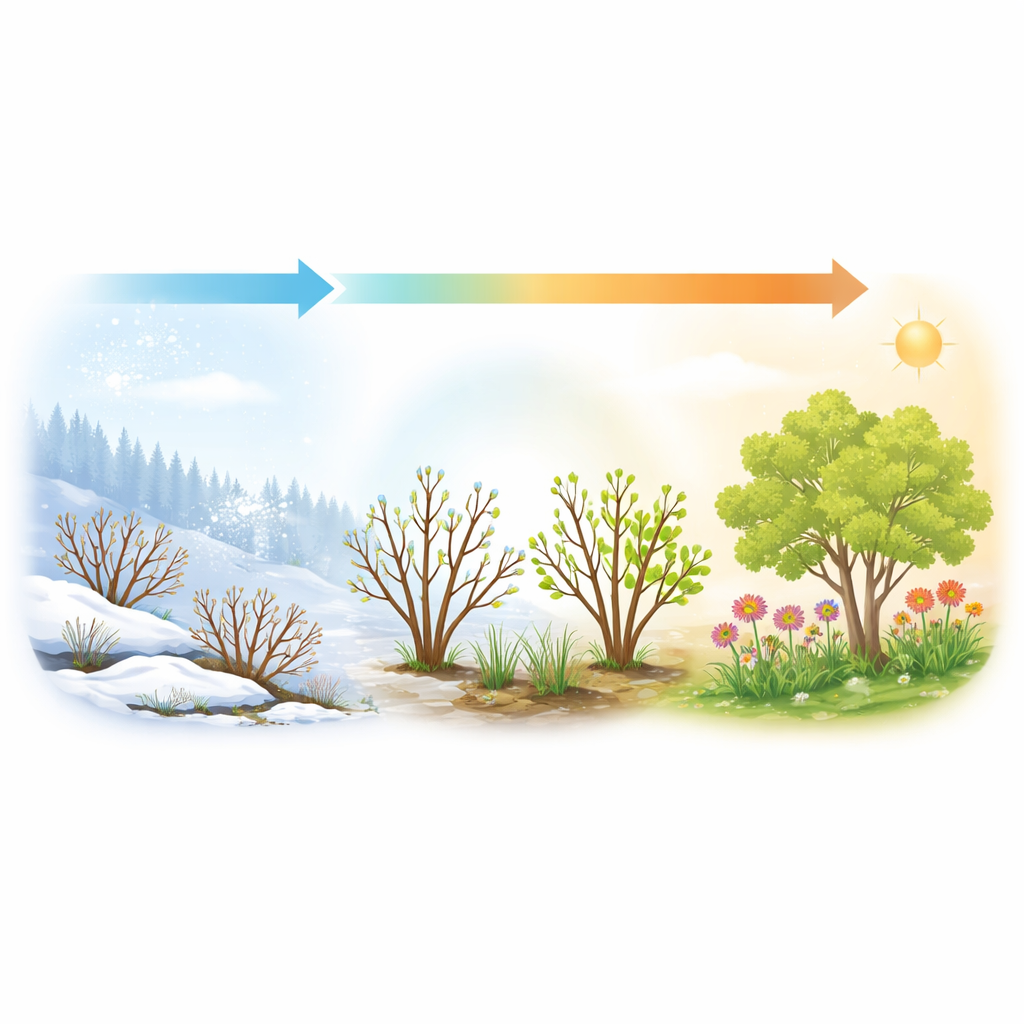
Plants face a fundamental dilemma every spring. Sprouting early lets them capture more sunlight, grow faster, and outcompete neighbors. It can also help them dodge some insects and diseases and claim the best spots for growth. But stepping out too soon risks being hit by a hard freeze that can kill young leaves, buds, and even entire plants. Waiting longer reduces this frost danger but shortens the growing season and hands an advantage to bolder competitors. Over evolutionary time, species have tuned the timing of their spring growth to balance these opposing pressures, settling into strategies that maximize survival and reproduction in their home climates.
A global look at frost danger and plant defenses
To see how this balancing act plays out worldwide, the authors gathered data from 88 studies covering 193 plant species at 126 sites spanning most of Earth’s major land ecosystems. For each species, they examined how cold it had to get before half of its tissues died—a measure of “freezing resistance.” They also calculated a “safety margin,” the gap between the typical coldest night during spring growth and the temperature that would kill the plant’s tissues. A large gap means low risk of lethal frost; a narrow gap means plants are living dangerously. Across forests, grasslands, and shrublands, and across trees, shrubs, and herbs, they found that plants generally begin spring growth with surprisingly strong freezing resistance and wide safety margins, indicating that lethal frost during this period is rare.
Climate and biology shape frost protection
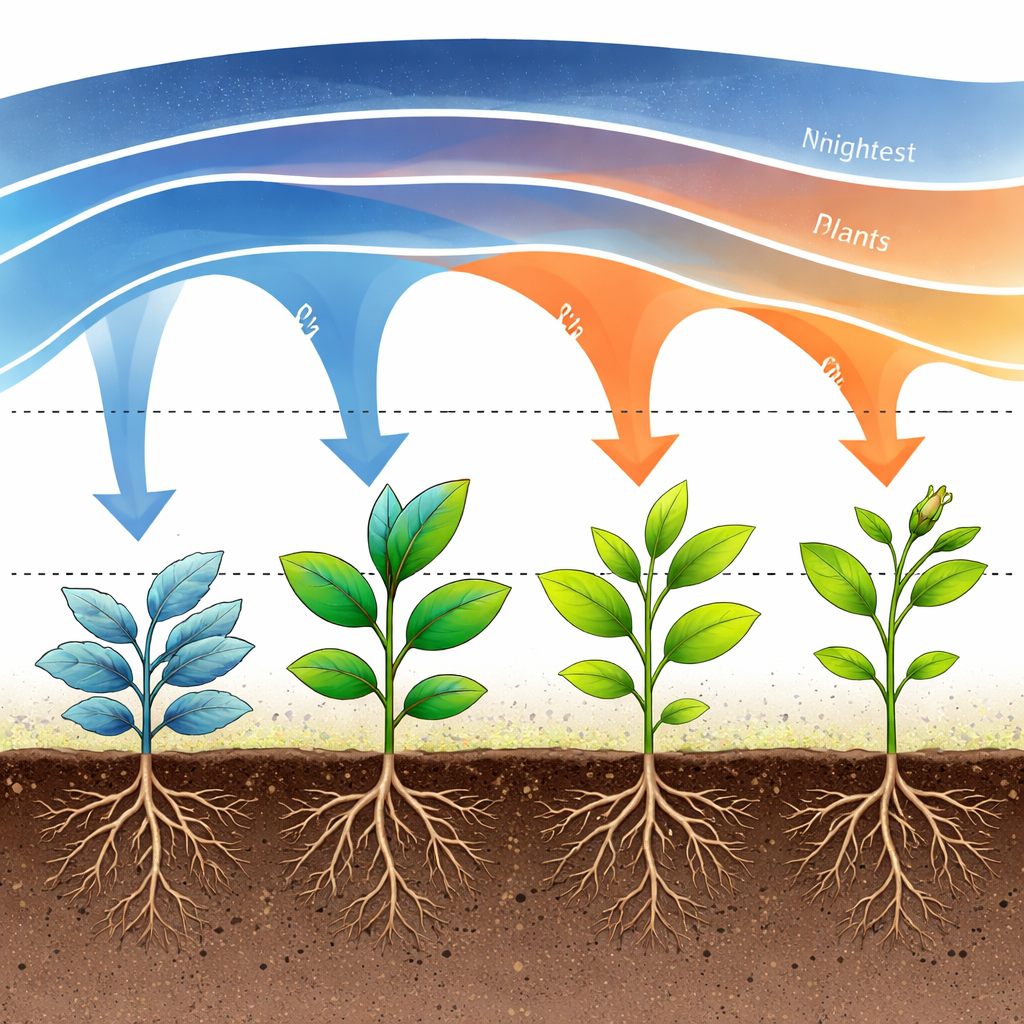
By combining climate records with plant data, the team explored what controls freezing resistance and safety margins. They found that warm-season temperatures, typical spring nighttime lows, and the frequency of frost days were particularly important. In colder, more frost-prone regions, plants tended to be tougher, with tissues that can withstand lower temperatures. Yet the safety margin—the buffer between actual spring temperatures and the temperature that would cause serious damage—remained fairly consistent among different types of plants and ecosystems. This suggests that species have converged on a similar level of protection: they tolerate enough cold to ride out typical spring conditions without paying the extra cost of making their tissues even more frost-proof than necessary.
Future warming and the myth of rising frost risk
To look ahead, the researchers used eight established models of spring timing, driven by climate projections from the latest generation of global climate models. They compared three futures: low, moderate, and high greenhouse gas emissions. In all cases, spring growth was predicted to advance—plants will start earlier in the year. Yet under low and moderate warming, the safety margin against lethal frost stayed essentially unchanged. In the high-warming scenario, the safety margin even widened, meaning plants would face less risk of deadly frost despite earlier emergence. Field experiments and additional modeling suggest that plant freezing resistance may stay roughly stable under modest warming, and that any weakening of defenses under extreme warming could be partly offset by this larger safety buffer.
What this means for our changing springs
These results challenge the common assumption that earlier springs automatically spell disaster for plants. Instead, the study shows that plants have evolved strategies—strong cold tolerance and flexible responses to multiple cues like temperature and day length—that keep lethal frost risk low, even as the climate warms. While local damage from late freezes will still occur, especially in regions with highly variable temperatures, the global picture is one of resilience rather than looming collapse. For the broader public, this means that shifting springs are indeed transforming ecosystems, but not always in the straightforwardly negative ways we might expect. Future models that aim to predict crop yields, forest health, or carbon uptake will need to account not only for air temperatures, but also for the biological safeguards plants use to navigate the perils of an unpredictable spring.
Citation: Yan, Z., Chen, C., Liu, Y. et al. Quantifying the trade-off between spring phenology and lethal frost risk: a meta-analysis. Nat Commun 17, 3519 (2026). https://doi.org/10.1038/s41467-026-70187-8
Keywords: spring phenology, frost risk, freezing resistance, climate warming, plant adaptation