Clear Sky Science · en
Coordination restraint of Rh-Cu diatomic catalyst and C-H bond oxygen insertion for methanol synthesis
Turning a Tough Gas into a Useful Liquid
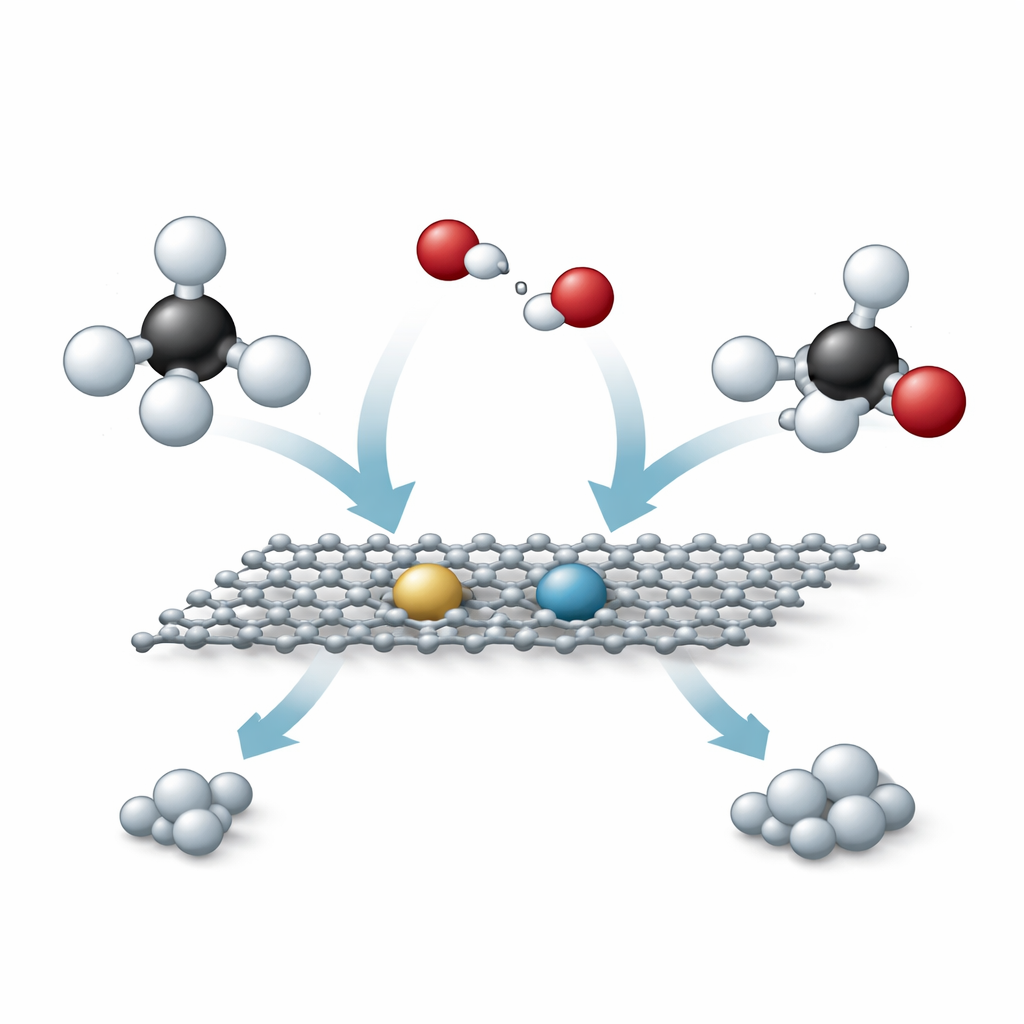
Methane is the main component of natural gas and a powerful greenhouse gas, but it is hard to turn directly into valuable liquid products. Industry usually burns methane to make synthesis gas first, then converts that mixture into fuels and chemicals in several energy‑intensive steps. This study reports a new type of catalyst made from just two metal atoms—rhodium (Rh) and copper (Cu)—anchored on a thin carbon sheet. It can convert methane straight into methanol, a liquid that can be used as a fuel and chemical feedstock, with unusually high selectivity. The work shows how carefully arranging and electronically tuning just two neighboring atoms can steer a reaction down the desired path and avoid wasting methane as carbon dioxide.
Why Methane Is So Hard to Tame
Methane molecules are compact and symmetrical, with strong carbon–hydrogen bonds that resist breaking. Once those bonds finally do break, the resulting methyl fragments are extremely reactive and tend to keep reacting until they are fully burned to carbon dioxide. This makes it difficult for conventional catalysts to both activate methane efficiently and stop the reaction at the partially oxidized stage needed for methanol. Single‑atom catalysts, where isolated metal atoms sit on supports, offer high efficiency but provide only one type of active site. That single site struggles to handle methane, reactive oxygen, and fragile intermediates all at once, so reactions drift toward over‑oxidation rather than the desired liquid product.
Building a Two‑Atom Reaction Team
The researchers tackled this problem by designing a dual‑atom catalyst in which one rhodium atom and one copper atom sit next to each other on a nitrogen‑doped graphene‑like carbon sheet. They used a "host–guest" metal–organic framework as a template and then heated it so that it collapsed into a thin, nitrogen‑rich carbon layer while locking Rh and Cu into neighboring positions. Advanced electron microscopy showed that the metals are mostly present as isolated pairs rather than larger particles, and X‑ray techniques confirmed that each metal atom is bonded to nearby nitrogen atoms and to its partner, with a Rh–Cu distance of about 2.4 ångströms. Spectroscopic studies and magnetic measurements further revealed that this structure introduces controlled defects and strong interactions between the metals and the carbon support, helping stabilize these tiny active sites during reaction.
How the Two Metals Share the Work
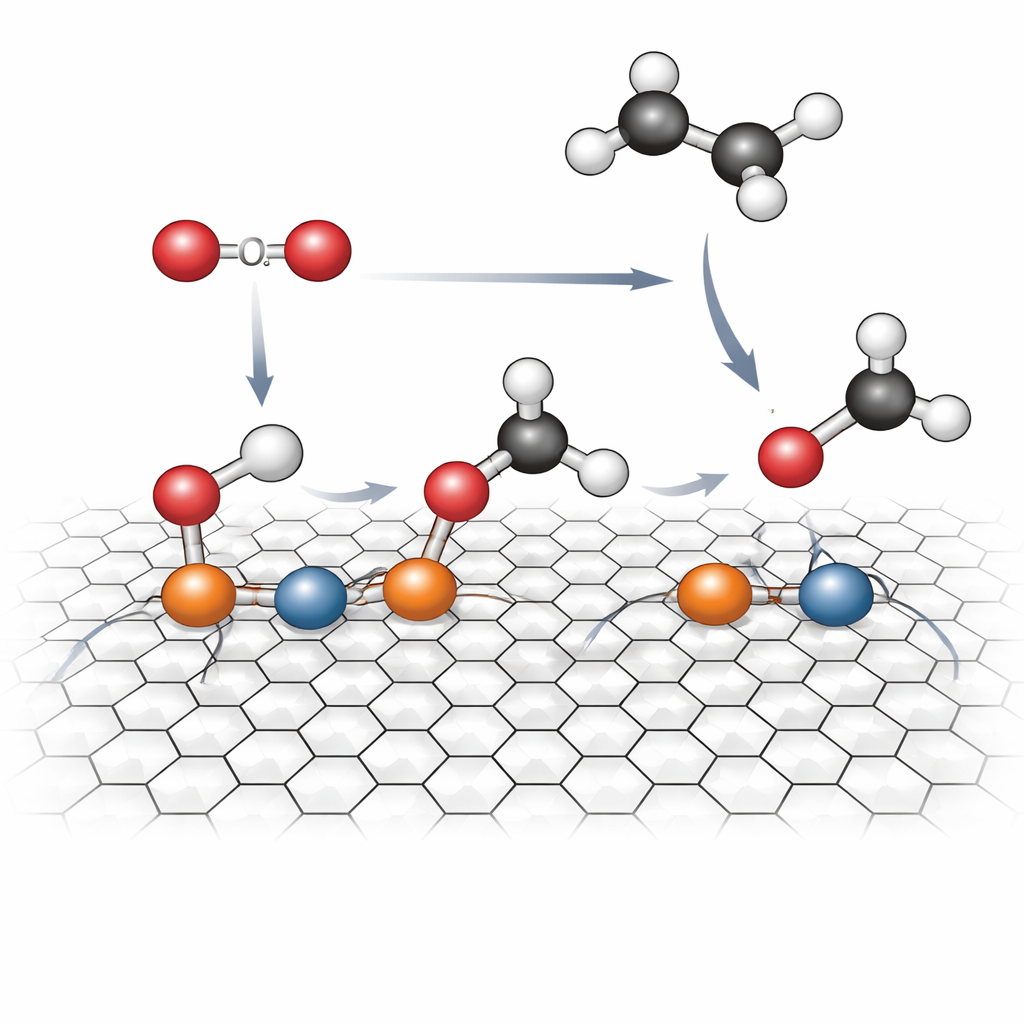
When methane and oxygen flow over this catalyst, the Rh–Cu pair behaves very differently from single‑metal sites. Kinetic measurements show that, under the right oxygen pressure, the catalyst turns methane into methanol with a selectivity of about 81 percent and an activity roughly three times higher than a Rh‑only single‑atom catalyst. Experiments using isotopes and infrared spectroscopy, combined with detailed quantum‑chemical calculations, reveal why. Oxygen first bridges the Rh and Cu atoms, forming a stable yet reactive “oxygen bridge.” Copper holds onto this oxygen more strongly, effectively caging it and preventing it from attacking methane too aggressively. Rhodium, which now binds oxygen more weakly because of electronic shifts caused by its copper neighbor, is free to focus on gently breaking methane’s C–H bond. This cooperative behavior stabilizes a key intermediate in which oxygen has inserted into a C–H bond to form a methoxy group, which is the direct precursor to methanol.
Following the Reaction Step by Step
The computational models map out the full reaction path on the dual‑atom site. Under the most favorable conditions, methane meets the oxygen bridge spanning Rh and Cu. A first C–H bond breaks at Rh, forming a methoxy group on Rh and a hydroxyl group near Cu. These two intermediates then combine by transferring a hydrogen atom, releasing methanol from the surface and leaving behind a rebuilt oxygen bridge ready to activate another methane molecule. The overall process releases energy and has a lower energy barrier for forming methanol than for pushing the reaction on to carbon dioxide. In contrast, when only Rh or only Cu atoms are present, oxygen binds and reacts in a way that favors repeated dehydrogenation of the carbon fragment, driving the system toward full combustion products rather than the valuable liquid intermediate.
What This Means for Cleaner Fuel Use
For non‑specialists, the key message is that the authors have shown how arranging just two different metal atoms side by side on a carbon sheet can fundamentally change the fate of methane. Copper acts like a smart brake on reactive oxygen, while rhodium serves as a precise tool for gently opening methane’s tough bonds. Together they guide oxygen to insert neatly into a single C–H bond, forming methanol instead of burning the molecule all the way to carbon dioxide. Although this is still a laboratory study, the concept of dual‑atom catalysts that divide and coordinate tasks at the atomic level could help make direct, energy‑efficient upgrading of methane—and other small molecules—more practical in the future.
Citation: Zhao, H., Gao, Y., Wang, Y. et al. Coordination restraint of Rh-Cu diatomic catalyst and C-H bond oxygen insertion for methanol synthesis. Nat Commun 17, 3299 (2026). https://doi.org/10.1038/s41467-026-70182-z
Keywords: methane to methanol, dual atom catalysts, rhodium copper catalyst, selective oxidation, nitrogen doped carbon