Clear Sky Science · en
Physical echo state network based on the nonlinearity and dynamic response of ambipolar heterostructure transistors
Why This Matters for Everyday Tech
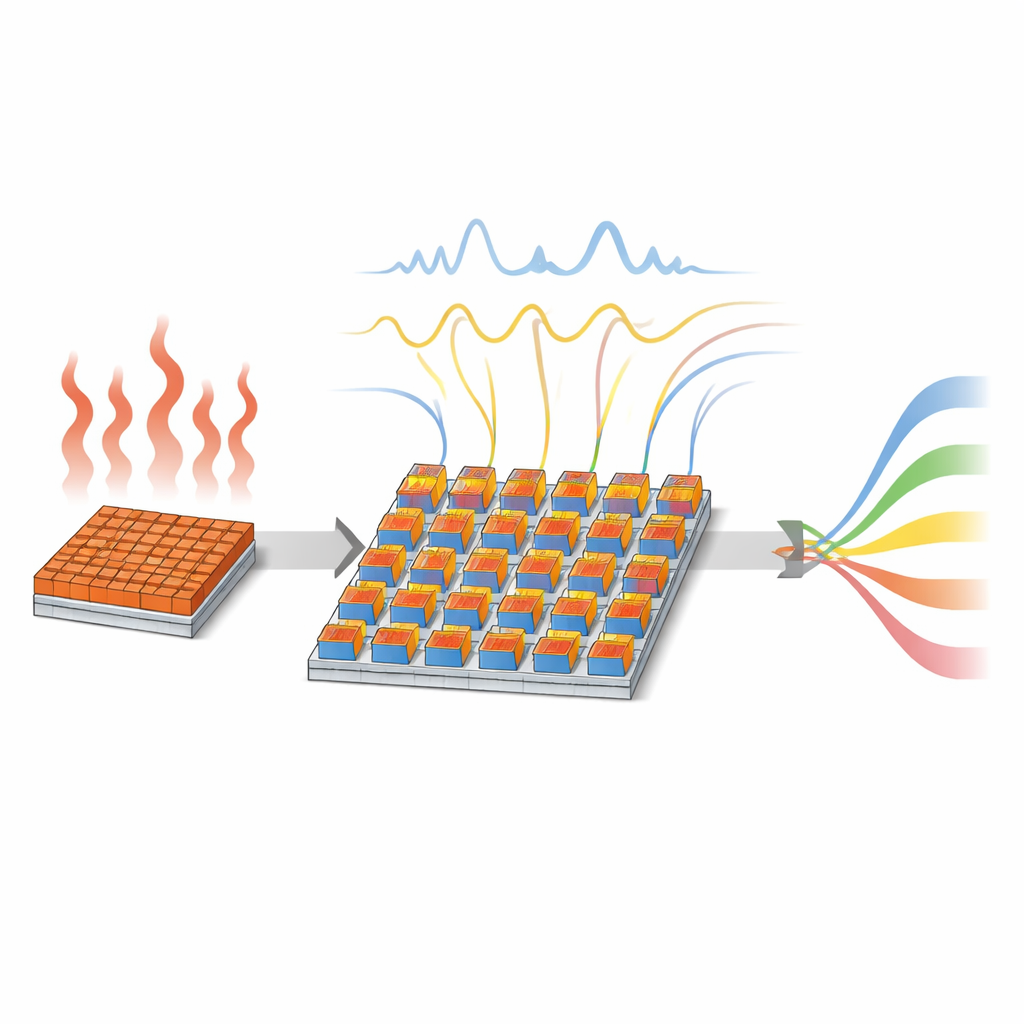
From voice assistants to weather apps, many of today’s smart tools depend on spotting patterns that change over time, such as spoken words, heartbeats, or storm tracks. Traditional computer chips struggle to handle this kind of time‑based data efficiently because they were never designed to work like a brain. This paper reports a new kind of hardware building block—tiny devices called ambipolar transistors—wired together to mimic a particular brain‑inspired network known as an echo state network. The result is a physical computing system that can recognize images, interpret signals, and predict how complex processes will unfold, all while using very little energy.
A New Kind of Brain‑Inspired Circuit
Conventional chips separate memory and processing, shuttling data back and forth in a way that wastes time and power. Neuromorphic computing takes a different route: it tries to bring memory and processing together in networks that behave more like groups of neurons and synapses in the brain. Echo state networks are a special type of such networks. They send incoming signals into a large, fixed web of interconnected units called a reservoir, where the signals are mixed and echoed over time. Only the final readout layer is trained, which greatly simplifies learning. The authors asked a key question: can this reservoir be built directly from physical devices instead of simulated in software, so that the hardware itself naturally performs the heavy lifting?
Ambipolar Transistors as Artificial Neurons and Synapses
The team engineered transistors made from a stacked organic–inorganic pair of materials: a zinc oxide layer and a polymer called P3HT. By carefully choosing the thickness of each layer, they created devices that can carry both positive and negative charge with similar ease—a property called ambipolar conduction. These transistors have a region where their electrical response is nearly linear, and another region where the response bends smoothly in an S‑shape, much like the mathematical tanh function used as an activation step in many neural networks. In the linear regime, they act like adjustable connections (synapses) performing weighted sums. In the saturated regime, they behave like neurons that squash signals into a limited range. Because the current through each device also depends on recent voltage changes, the hardware naturally remembers short‑term history, giving the reservoir a built‑in sense of time.
From Handwritten Digits to Chaotic Weather‑Like Systems
To test this physical echo state network, the researchers arranged these ambipolar transistors in arrays and linked them to simple input and output circuits. They first tackled pattern‑recognition tasks using well‑known image datasets. By feeding flattened images of handwritten digits and clothing items into the transistor reservoir, they achieved around 95% accuracy for digit recognition and 86% for fashion items in a basic operating mode, and nearly 97% and 87% respectively when they harnessed the devices’ dynamic behavior more fully through clever pulse‑based encoding. They then moved beyond static images to genuine time‑series problems. The system predicted the motion of a Lorenz attractor—a classic model of chaotic, weather‑like dynamics—with extremely low error, and also forecasted the movement and appearance of a real typhoon’s center over time.
Listening to Hearts and Reading Emotions
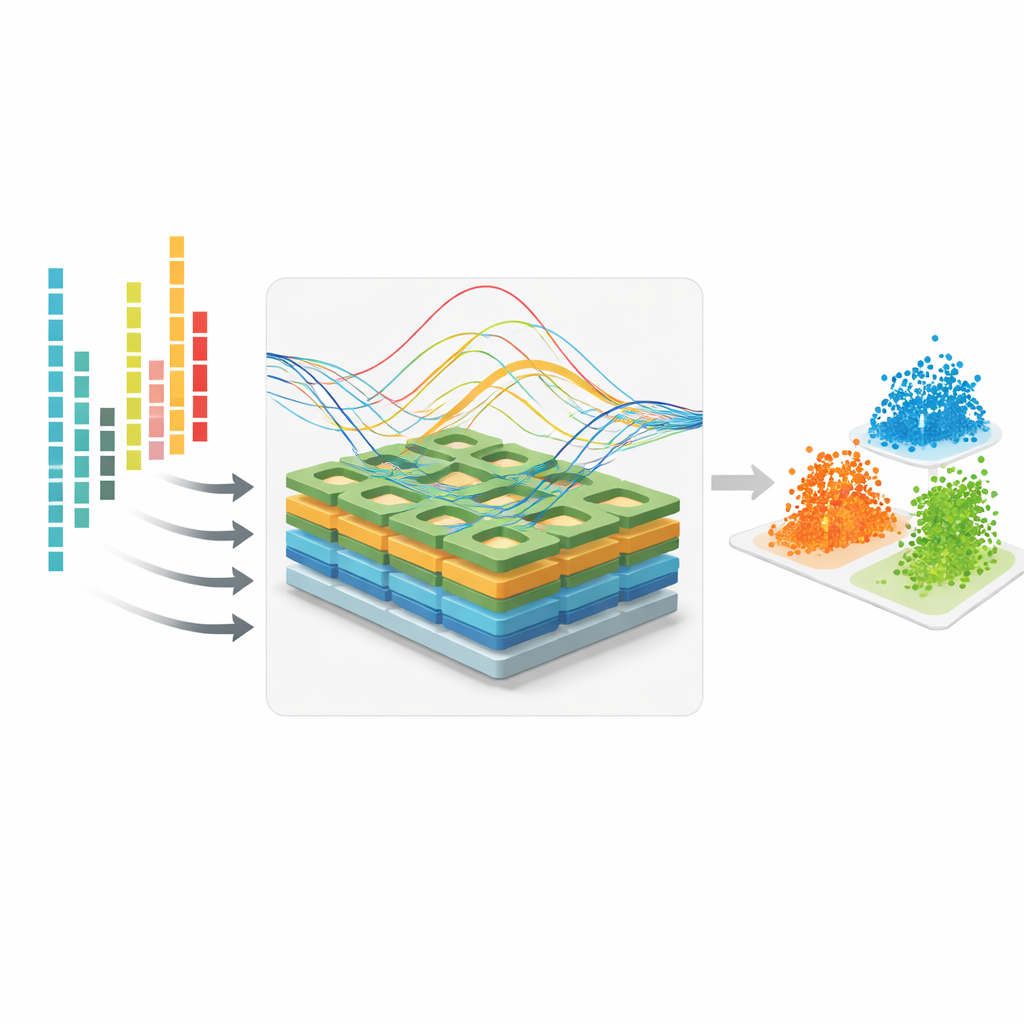
Because many real‑world problems involve more than one kind of data, the team also explored multimodal tasks. They converted electrocardiogram signals into both one‑dimensional waveforms and two‑dimensional time‑frequency images, sending each into the same ambipolar reservoir. By combining the resulting internal states, the system classified heart‑signal patterns more accurately than when using either mode alone. In another study, they used the reservoir as a front‑end for analyzing a dataset of human speech, text, and facial expressions. When these audio, language, and visual features were first processed through the ambipolar network and then passed to a standard software classifier, recognition accuracy rose noticeably compared with software alone. Across all these trials, ambipolar devices consistently outperformed simpler n‑type or p‑type transistors, thanks to their balanced response to positive and negative signals and richer internal dynamics.
What This Means for Future Smart Devices
For non‑specialists, the key takeaway is that this work turns a mathematical idea—the echo state network—into tangible hardware where each transistor behaves a bit like a tiny, responsive neuron and synapse combined. Because the reservoir’s internal connections never need to be trained, and because the devices themselves provide both nonlinearity and short‑term memory, the resulting system can handle tasks such as image recognition, signal analysis, and time‑series prediction with simpler algorithms and potentially far lower energy use. This suggests a path toward future chips that can more naturally process streams of information the way our brains do, enabling smarter, more efficient sensors, wearables, and forecasting tools without the heavy computational cost of today’s deep‑learning machinery.
Citation: Zhong, WM., Zhang, W., Zeng, YX. et al. Physical echo state network based on the nonlinearity and dynamic response of ambipolar heterostructure transistors. Nat Commun 17, 3321 (2026). https://doi.org/10.1038/s41467-026-70171-2
Keywords: neuromorphic hardware, echo state network, ambipolar transistor, time series prediction, reservoir computing