Clear Sky Science · en
Unleashing the power of zero-valent platinum single atoms for enhancing low-temperature oxygen activation
Cleaning Dirty Air with Tiny Metal Helpers
Many cities struggle with invisible toxic fumes released by paints, fuels, and industrial solvents. One of the most common culprits is toluene, a volatile organic compound that harms both air quality and human health. Scrubbing such pollutants from exhaust streams usually takes a lot of heat and energy, making the process costly. This study explores how to build a new kind of ultra-efficient catalyst that can remove these chemicals at much lower temperatures, potentially cutting energy use while keeping the air cleaner.
Why Single Atoms Matter
Catalysts are materials that speed up chemical reactions without being used up. Precious metals like platinum are very good catalysts, but they are rare and expensive. Traditionally they are used as tiny nanoparticles, where much of the metal stays buried and inactive. More recently, researchers have developed “single-atom catalysts,” where individual metal atoms are spread out on a support so that nearly every atom can participate in the reaction. However, these single atoms are often locked into a positively charged state by surrounding oxygen atoms, which makes them less able to activate oxygen gas, a key step in burning away pollutants like toluene.
Building a New Kind of Active Site
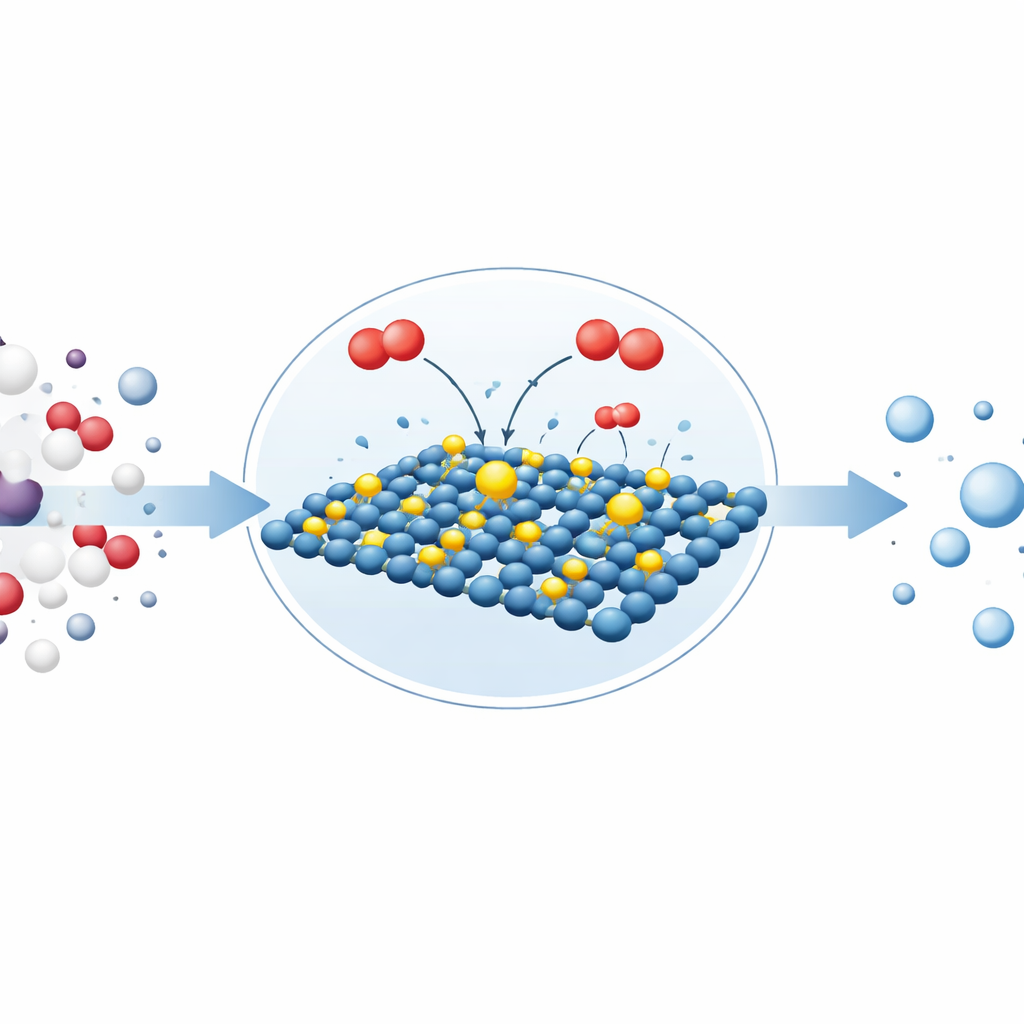
The team set out to create platinum single atoms that behave more like metallic platinum in a wire or particle—that is, in a so-called zero-valent state with a rich supply of electrons. They anchored platinum atoms onto ultrathin sheets of a cobalt oxide material that already contains many atomic-scale defects. Using a gentle hydrogen treatment at only 180 °C, they removed carefully selected oxygen atoms from around the platinum without allowing the atoms to clump together. This produced isolated platinum atoms that were no longer surrounded by oxygen but instead bonded more directly to nearby cobalt atoms. Advanced microscopy and computer simulations confirmed these single atoms were indeed in a near-zero-valent state and remained stable on the two-dimensional support.
Turning Oxygen into a Stronger Cleaning Agent
To understand why these new sites work better, the researchers compared two versions of the catalyst: one with conventional high-valent platinum atoms and one with zero-valent platinum atoms. They found that the zero-valent sites pulled oxygen molecules from the air onto the surface far more strongly and stretched the bond between the two oxygen atoms, making it easier for that bond to break. In essence, the platinum atoms donated electrons into the oxygen, turning it into highly reactive forms that are much better at attacking toluene. Measurements of oxygen species on the surface and tests of how easily the material could be reduced all pointed to much more active oxygen on the zero-valent platinum catalyst.
Faster Breakdown of Toluene at Lower Heat
When the team flowed toluene and oxygen over the catalysts, the zero-valent platinum atoms dramatically outperformed both the high-valent platinum version and the bare cobalt oxide. The new catalyst reached 90% conversion of toluene to carbon dioxide at about 140 °C, while the other materials needed substantially higher temperatures. Normalizing by surface area and platinum content showed that each zero-valent platinum atom was several to nearly ten times more efficient at driving the reaction. The catalyst also maintained its activity for at least 48 hours and remained effective even in moist air, a common challenge for real-world applications.
A Smoother Chemical Pathway
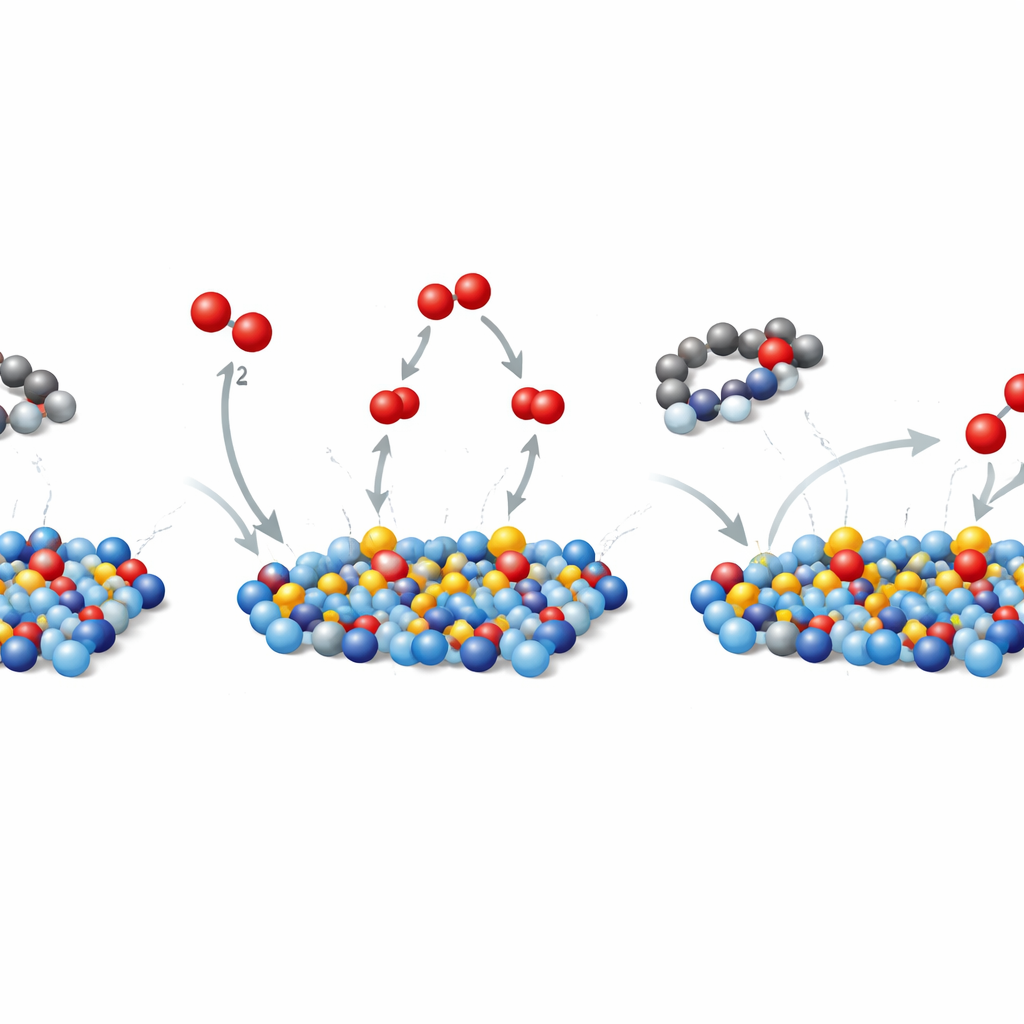
Detailed infrared and mass-spectrometry studies revealed that toluene does not simply burn in one step. Instead, it passes through a series of intermediate compounds before its ring structure opens and it is finally converted into smaller molecules and then carbon dioxide and water. Computer modeling showed that on the zero-valent platinum sites this sequence of steps follows a different and more energy-efficient route than on cobalt oxide alone. The new pathway both lowers the energy barriers for the early oxidation steps and makes ring opening easier, which helps explain why the catalyst works so well at relatively low temperatures.
What This Means for Cleaner, Cheaper Pollution Control
In everyday terms, the researchers have designed a highly frugal and powerful “chemical filter” where each individual platinum atom is used to its full potential. By keeping platinum in a zero-valent, electron-rich state and anchoring it on a specially engineered oxide sheet, they drastically improve the way oxygen is activated and how stubborn molecules like toluene are broken down. This concept could guide the design of next-generation catalysts for air purification and industrial emission control, helping to remove harmful fumes more efficiently while using less precious metal and less energy.
Citation: Li, R., Huang, Y., Zhu, D. et al. Unleashing the power of zero-valent platinum single atoms for enhancing low-temperature oxygen activation. Nat Commun 17, 3350 (2026). https://doi.org/10.1038/s41467-026-70170-3
Keywords: single-atom catalysts, toluene oxidation, oxygen activation, platinum on cobalt oxide, air pollution control