Clear Sky Science · en
Bulk polarization fields and interfacial electron sink in MXene-modified iodine-doped Bi4Ti3O12 enhance piezocatalytic H2O2 generation
Cleaner Chemicals from Everyday Vibrations
Hydrogen peroxide is a workhorse chemical found in wound disinfectants, household cleaners, and industrial bleaching. Yet most of it is still made in huge factories using an energy-hungry process that creates transport and safety challenges. This study explores a very different route: using tiny electric fields generated when a special crystal is shaken in water, turning ordinary vibrations into a green way to make hydrogen peroxide right where it is needed.
Turning Motion into Chemical Power
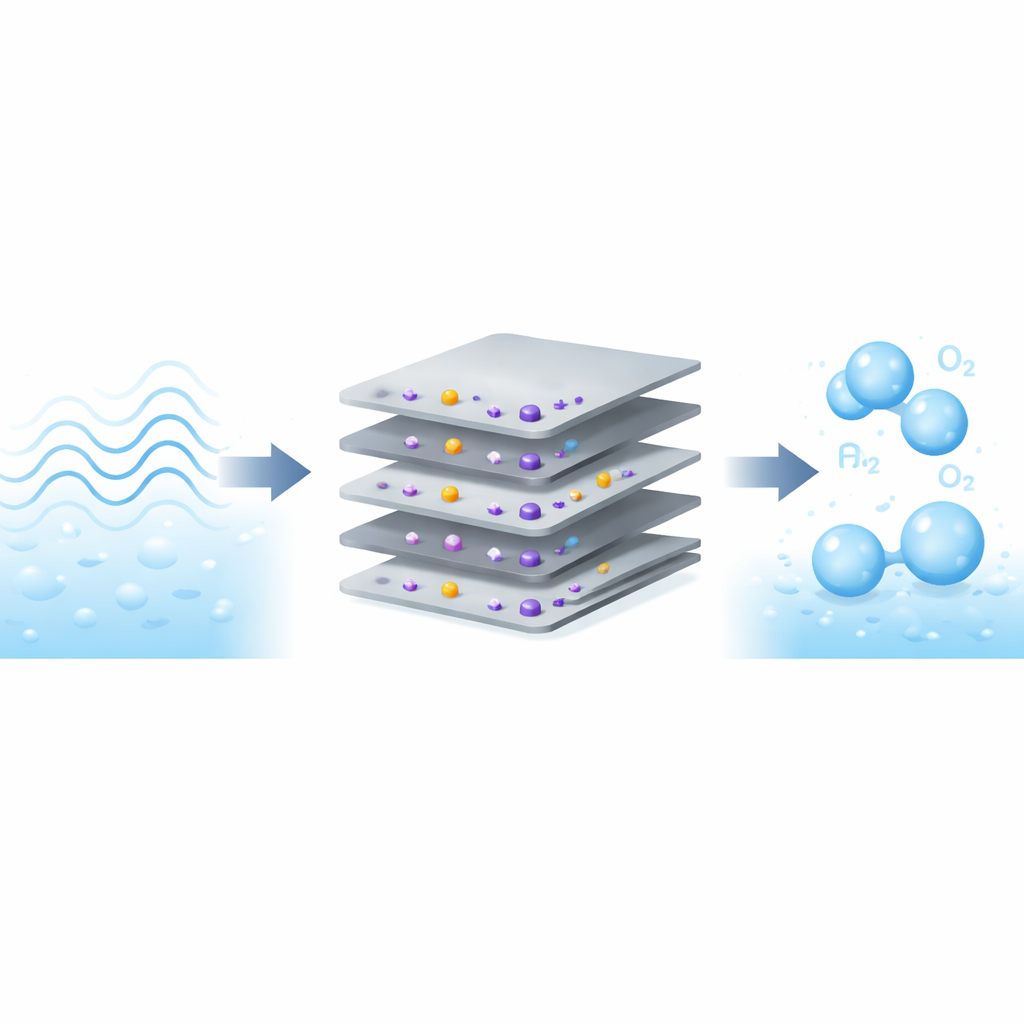
At the heart of the work is a material called bismuth titanate, a type of crystal that develops positive and negative charges when it is mechanically stressed, such as by ultrasound waves in water. These internal charge imbalances can drive chemical reactions, in a process known as piezocatalysis. In water exposed to air, negatively charged regions can help incoming oxygen molecules gain electrons, while positively charged regions can help water molecules give them up. Together, these steps can form hydrogen peroxide from nothing more than water, oxygen, and mechanical motion. However, standard bismuth titanate struggles because many of the newly created electrons and holes simply recombine inside the material before they can do useful chemistry.
Upgrading the Crystal with Smart Add-Ons
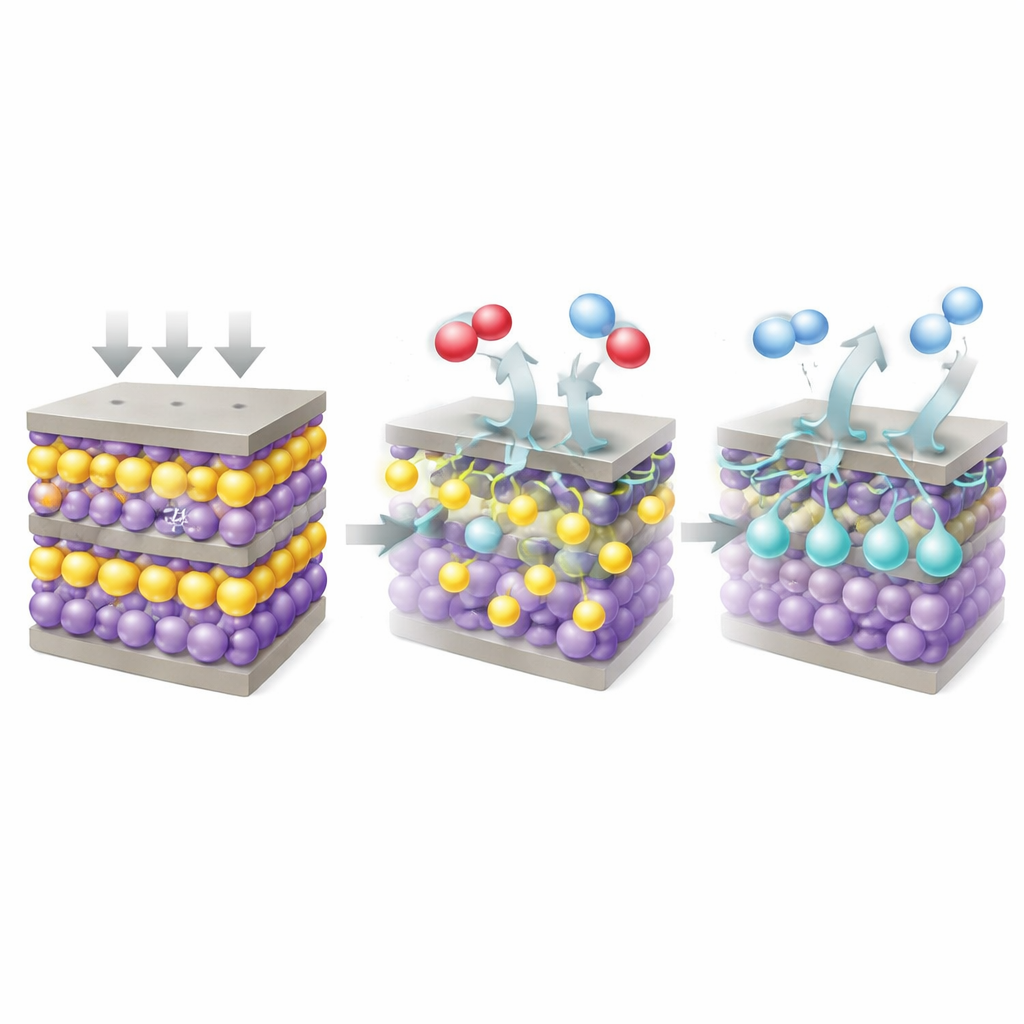
The researchers tackled these weaknesses with a two-part redesign. First, they subtly inserted iodine atoms into the crystal lattice. This bulk modification strengthens the material’s internal polarization—the separation of positive and negative charges under strain—so that electrons and holes are pulled farther apart and survive longer. Second, they coated the crystal surface with ultrathin sheets of a conductive material called MXene. These nanosheets act like electron drains at the surface, quickly pulling out mobile electrons and holding them where oxygen molecules can readily accept them. Together, iodine inside the crystal and MXene on the outside create a “dual-field” system that both generates stronger internal charge separation and offers efficient escape routes for those charges at the surface.
Faster Chemistry and More Peroxide
To see whether this design really works, the team compared plain bismuth titanate with iodine-doped versions and MXene-coated versions. Under identical ultrasonic shaking in air-saturated water, the fully modified catalyst—iodine-doped and MXene-decorated—produced hydrogen peroxide at about 5890 micromoles per gram per hour, far outperforming the unmodified material and most similar systems reported to date. Electrical measurements showed that the upgraded catalyst has lower resistance to charge flow and a stronger piezoelectric response, meaning it generates more useful charges under the same mechanical force. Computer simulations backed this up by showing how iodine changes the electronic structure in ways that make it easier to form key reaction intermediates, while MXene improves how oxygen sticks to the surface and how readily it is reduced to hydrogen peroxide.
From Peroxide Production to Water Cleanup
The hydrogen peroxide made by this vibrating catalyst proved to be more than a laboratory curiosity. Collected solution from the reactor efficiently killed several types of bacteria and broke down a range of dye and drug pollutants in water. One test focused on sulfamethoxazole, a common antibiotic that can persist in the environment. Chemical analysis mapped how this molecule was stepwise attacked and transformed into smaller fragments by the peroxide-rich solution. To check safety, the team exposed zebrafish embryos to water containing either the original antibiotic or its degradation products. While the drug itself caused severe developmental problems and high mortality, the treated solution produced survival, hatching, and swimming behavior nearly indistinguishable from clean water, indicating that the breakdown products were far less toxic.
Toward On-Demand, Safer Oxidants
Overall, this work shows that carefully tuning both the interior and the surface of a piezoelectric crystal can convert everyday mechanical energy into a powerful, selective chemical tool. By combining iodine doping to boost internal electric fields with MXene sheets that act as electron sinks, the researchers created a compact solid that can turn water and oxygen into hydrogen peroxide without added chemicals or light. If scaled up and integrated into flow systems or flexible devices, such catalysts could enable on-demand peroxide production for disinfection and pollution control, reducing the need to transport and store large volumes of this reactive oxidant.
Citation: Ruan, X., Ding, C., Cai, H. et al. Bulk polarization fields and interfacial electron sink in MXene-modified iodine-doped Bi4Ti3O12 enhance piezocatalytic H2O2 generation. Nat Commun 17, 3915 (2026). https://doi.org/10.1038/s41467-026-70169-w
Keywords: piezocatalysis, hydrogen peroxide, MXene, water treatment, bismuth titanate