Clear Sky Science · en
Stereoselective depolymerization of chiral polyesters
Why smart plastic recycling matters
Many everyday “bioplastics,” such as clear coffee cups or food containers made from polylactic acid (PLA), are advertised as green alternatives to conventional plastics. Yet once these materials are used, turning them back into pure building blocks without wasting energy or quality is far from simple. This study shows how a carefully designed molecular tool can tell mirror-image versions of the same plastic apart and break down only the chosen one, offering a blueprint for smarter, cleaner recycling of advanced materials.
Mirror-image molecules in nature and materials
At the heart of the work is chirality, the idea of left- and right-handed forms of a molecule that are mirror images but not identical, much like your hands. Biology relies on this property: DNA, proteins and many natural molecules have a preferred handedness, and enzymes recognize and process only the matching form. Engineers have long copied this strategy for small molecules, building catalysts that steer reactions to favor one hand over the other. However, translating that level of picky recognition to long-chain plastics, which contain many repeated chiral units tangled in space, has remained a major challenge.
A designer pocket for choosing the right chain
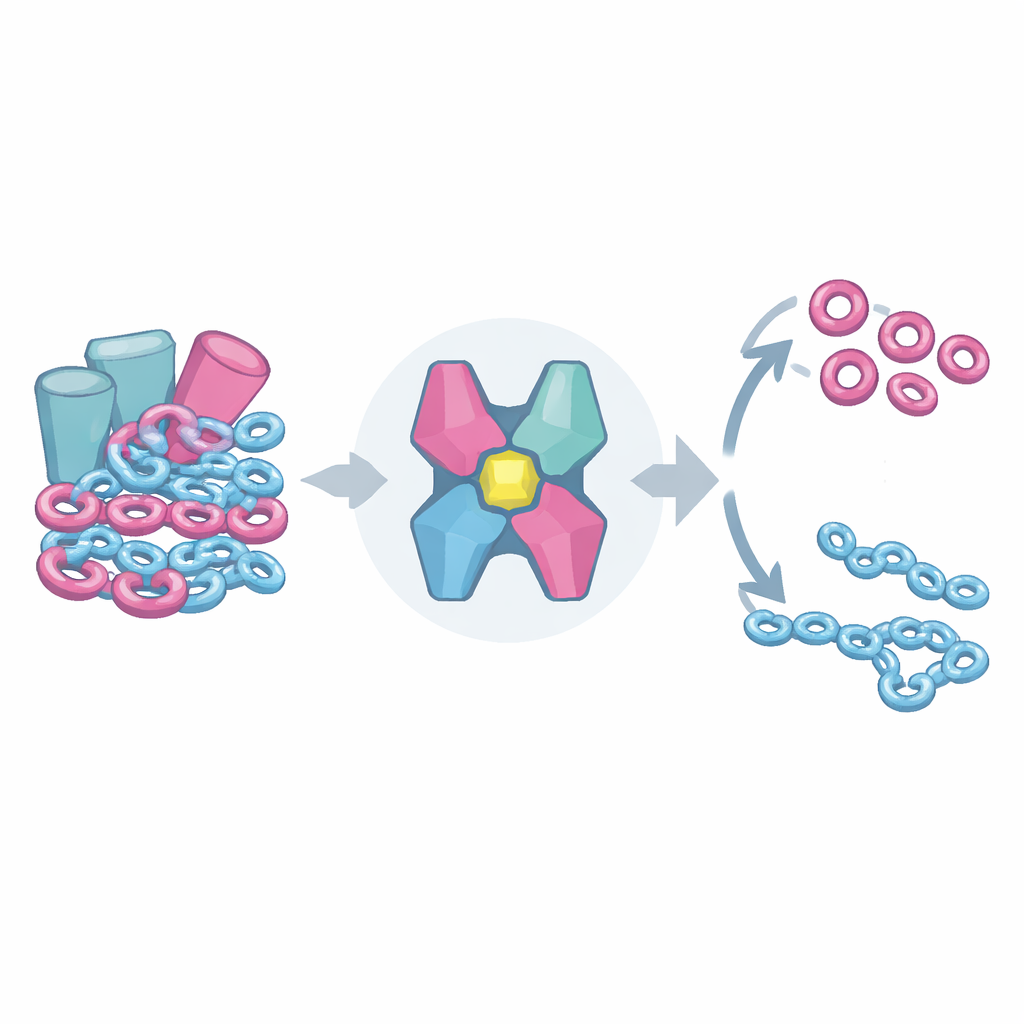
The authors focus on PLA, a widely used biodegradable plastic that can be built either from left-handed (PLLA) or right-handed (PDLA) building blocks, or from mixtures of both. They design aluminum-based catalysts surrounded by two linked organic “arms” that fold into a tight, chiral pocket known as a BisSalen-Al complex. This pocket is tuned so that it embraces only one handed form of the polymer chain end. When matched correctly, the catalyst latches onto the chain’s terminal group and begins to peel the plastic back into its original ring-shaped monomer, lactide, while largely ignoring the opposite-handed chains.
Unzipping plastic one unit at a time
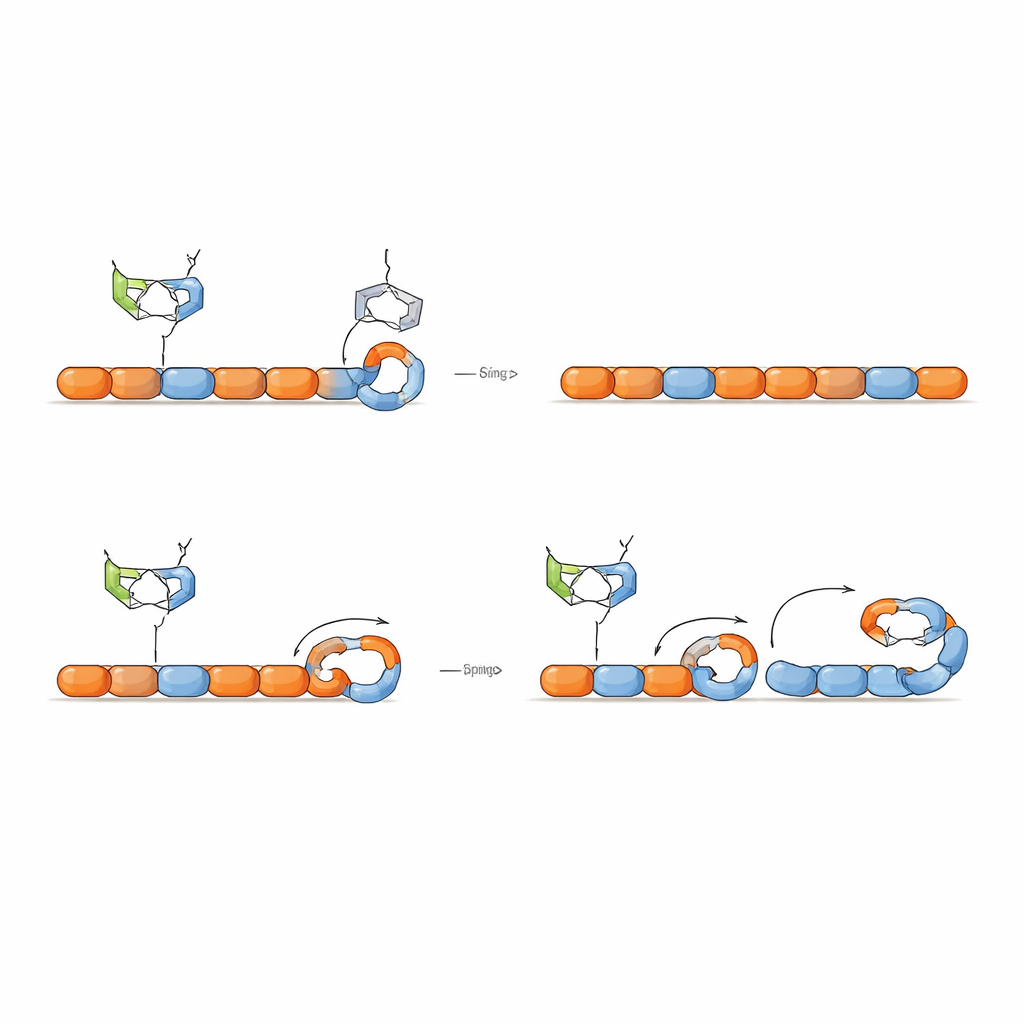
By carefully choosing solvent and temperature, the team ensures that PLA can, in principle, be converted back to lactide rather than simply falling apart into random fragments. Detailed kinetic studies reveal that earlier, more open catalysts cut into PLA at many points along the chain, giving only weak preference for one form over the other. In contrast, the new confined BisSalen-Al catalysts operate by an “unzipping” process: they activate the chain end and repeatedly fold it back in a back-biting motion, releasing one lactide ring at a time. Because the pocket fits only one handed chain end well, the reaction races ahead for the matched polymer while the mismatched one remains almost untouched, and the recovered monomer preserves its original handedness with very high purity.
Sorting mixed plastics from the inside out
The power of this approach becomes clear when the researchers tackle more realistic mixtures. In so-called stereocomplex PLA, left- and right-handed chains bundle together into especially strong crystals prized for their mechanical and heat resistance. When treated with a right-handed BisSalen-Al catalyst, only the right-handed chains are selectively unzipped back to monomer, leaving the left-handed chains largely intact as a separate, usable plastic. The team demonstrates a similar effect with block copolymers where left- and right-handed segments are linked, and even with commercial PLA cups containing mostly one handed form with additives. In each case, the catalyst’s built-in chiral preference directs which portions are recycled and which survive.
Peeking under the molecular hood
To understand why the selectivity is so strong, the authors combine X-ray snapshots of the catalyst’s structure with nuclear magnetic resonance experiments and computer simulations. The solid-state structure reveals a rigid, helical cavity around the aluminum center, while solution studies show how polymer chain ends or small model molecules exchange groups with the metal to form active species. Computer calculations of the full reaction pathway indicate that the key step is the ring-closing motion that releases lactide: the energy barrier for this step is much lower when the polymer’s handedness matches that of the catalyst pocket than when it does not. This large energetic gap explains how the catalyst can distinguish mirror-image chains even in complex mixtures.
What this means for future plastics
Overall, the study proves that enzyme-like, highly selective recognition is possible for whole plastic chains using fully synthetic catalysts. The BisSalen-Al system turns chosen chiral PLA segments back into optically pure lactide, which the authors then show can be repolymerized into high-quality, well-ordered PLA once again. In simple terms, they have built a molecular tool that can tell left-handed plastic from right-handed plastic and unmake only the one you choose, offering a promising route toward true closed-loop recycling and finer control over advanced polymer materials.
Citation: Yang, R., Xu, G., Guo, X. et al. Stereoselective depolymerization of chiral polyesters. Nat Commun 17, 3372 (2026). https://doi.org/10.1038/s41467-026-70164-1
Keywords: chiral polymers, polylactic acid recycling, asymmetric catalysis, stereoselective depolymerization, circular plastics