Clear Sky Science · en
Metamaterials and Fluid Flows
Shaping Air and Water with Smart Materials
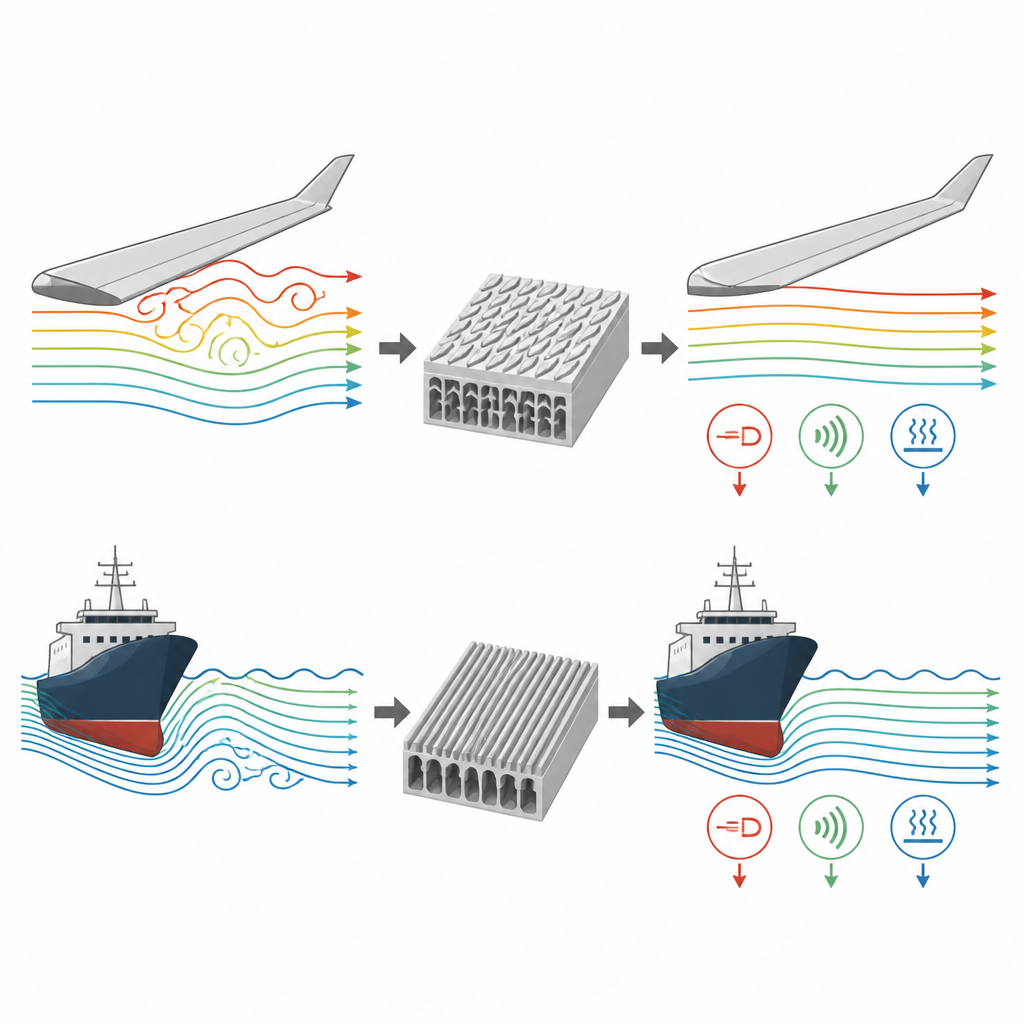
Every airplane, ship, wind turbine, and even tiny lab-on-a-chip device must push against air or water, wasting energy and often making a lot of noise. This review paper explores how a new class of “designed materials,” called metamaterials, can be built into surfaces and structures to gently steer these flows, cutting drag, vibration, and sound. By rethinking what a surface is at the microscopic level, engineers can turn once passive walls into active partners that manage how fluids move and waves travel.
Why Flow and Structure Need Each Other
When air or water moves past a solid object, such as a wing or a ship hull, the flow and the structure constantly interact. This interplay shapes fuel use, noise levels, and how quickly parts wear out. The authors show that metamaterials offer a new toolkit for this problem. Instead of using a smooth metal skin, designers can embed carefully patterned layers beneath or within the surface. These patterns guide mechanical and sound waves inside the solid, which in turn influence the flow just above it. The review lays out a common language and basic equations from fluid dynamics, acoustics, and solid mechanics that help predict how such coupled systems behave.
Taming Instabilities, Separation, and Turbulence
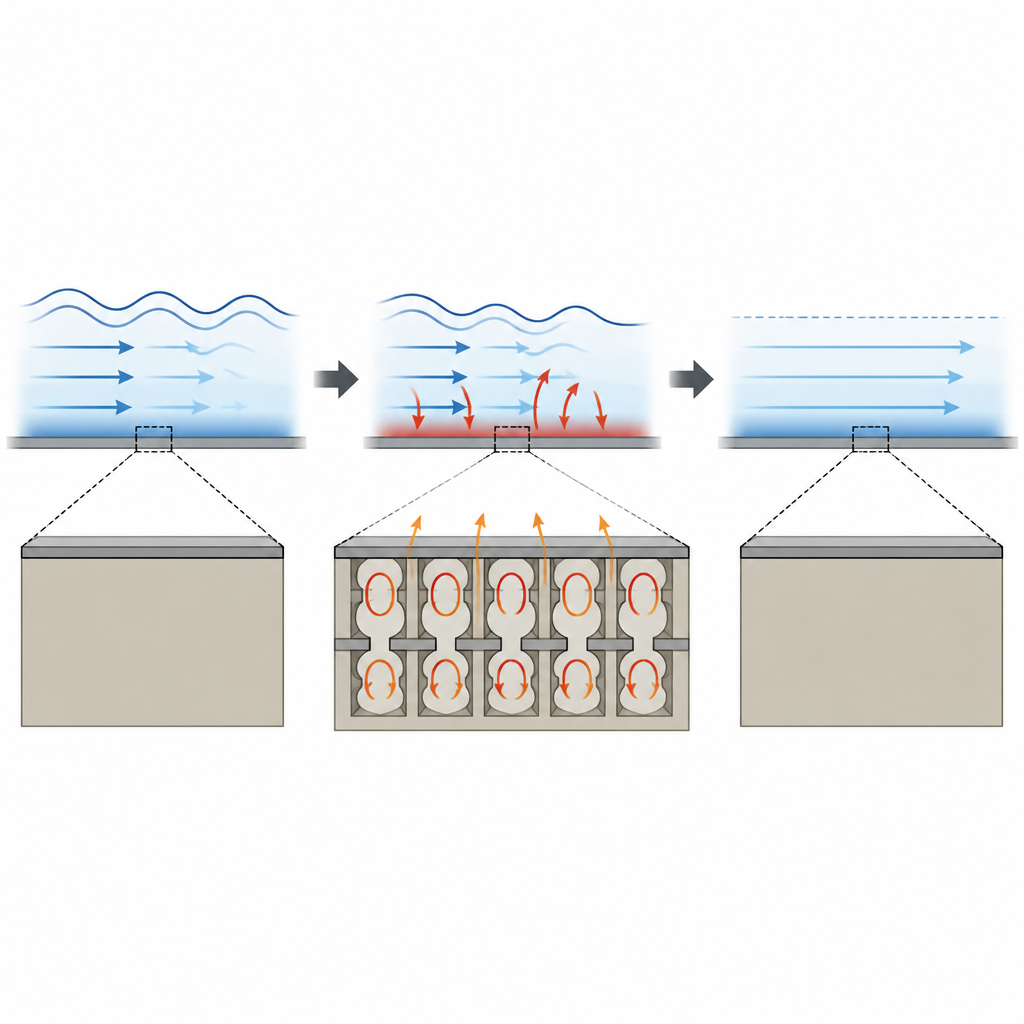
A major part of the article focuses on how structured materials can calm or reshape different types of flow. In gentle, smooth flows that are about to turn chaotic, tiny ripples can grow into full-blown turbulence. Special subsurface lattices, known as phononic subsurfaces, are designed to vibrate in just the right way to cancel out these ripples before they explode. Flexible or porous coatings and micro-patterned ribs can delay flow separation over wings and vehicle bodies, helping to maintain lift and reduce drag. For fully turbulent flows, engineered porosity, resonant cavities, and textured walls can disturb the self-sustaining cycles of swirling motion close to the surface, offering new routes to lower friction and heat transfer.
Quieting Noise and Guiding Tiny Particles
Flow often brings sound with it, from jet engines and wind turbines to office ventilation systems. The paper reviews how acoustic metamaterials that allow air to pass through while trapping sound can be built into ducts, inlets, and fairings. Using resonant chambers and labyrinth-like channels, these “ventilated” designs absorb or reflect targeted frequencies without blocking the flow. At much smaller scales, similar ideas power acoustofluidic devices, where sound waves inside microchannels push, trap, or sort tiny particles and biological cells. Metasurfaces and phononic crystals can create intricate sound fields that move droplets, collect nanoparticles, or assemble temporary crystal-like structures of particles, all without direct contact.
Pushing the Boundaries of Wave and Flow Control
Beyond immediate engineering uses, the authors highlight more exotic concepts that may soon influence flow control. Topological materials can host wave paths that cling to edges and corners and resist disruption, offering robust channels for vibration or sound even in complex fluid environments. Nonlocal materials behave as if distant regions are linked, leading to unusual internal flows and wave patterns. Space–time metamaterials, whose properties vary in both space and time, can steer waves differently in opposite directions and may be tuned to react to changing flow conditions. New theories connect these ideas to our understanding of how waves move in curved space, suggesting fresh ways to think about convection and aeroacoustic design.
From Smart Surfaces to Adaptive Machines
In closing, the article argues that metamaterials could transform how engineers manage air and water around structures. Instead of relying mainly on shaping large-scale geometry, future designs may embed smart, patterned layers that shape waves and flows from within. This approach could cut fuel use, reduce noise, and extend the life of machines in fields ranging from aviation and shipping to renewable energy and biomedical devices. The authors see the next big step as bringing together advanced modeling, modern fabrication, and data-driven control, so that surfaces can adapt in real time to the surrounding flow and quietly keep complex systems running more efficiently.
Citation: Avallone, F., Bosia, F., Chen, Y. et al. Metamaterials and Fluid Flows. Nat Commun 17, 4144 (2026). https://doi.org/10.1038/s41467-026-70163-2
Keywords: metamaterials, fluid flow control, aeroacoustics, turbulence, acoustofluidics