Clear Sky Science · en
In-situ formatting benzisoxazole-linked covalent organic framework for enhanced photocatalytic hydrogen peroxide generation
Cleaner Chemistry from Sunlight and Air
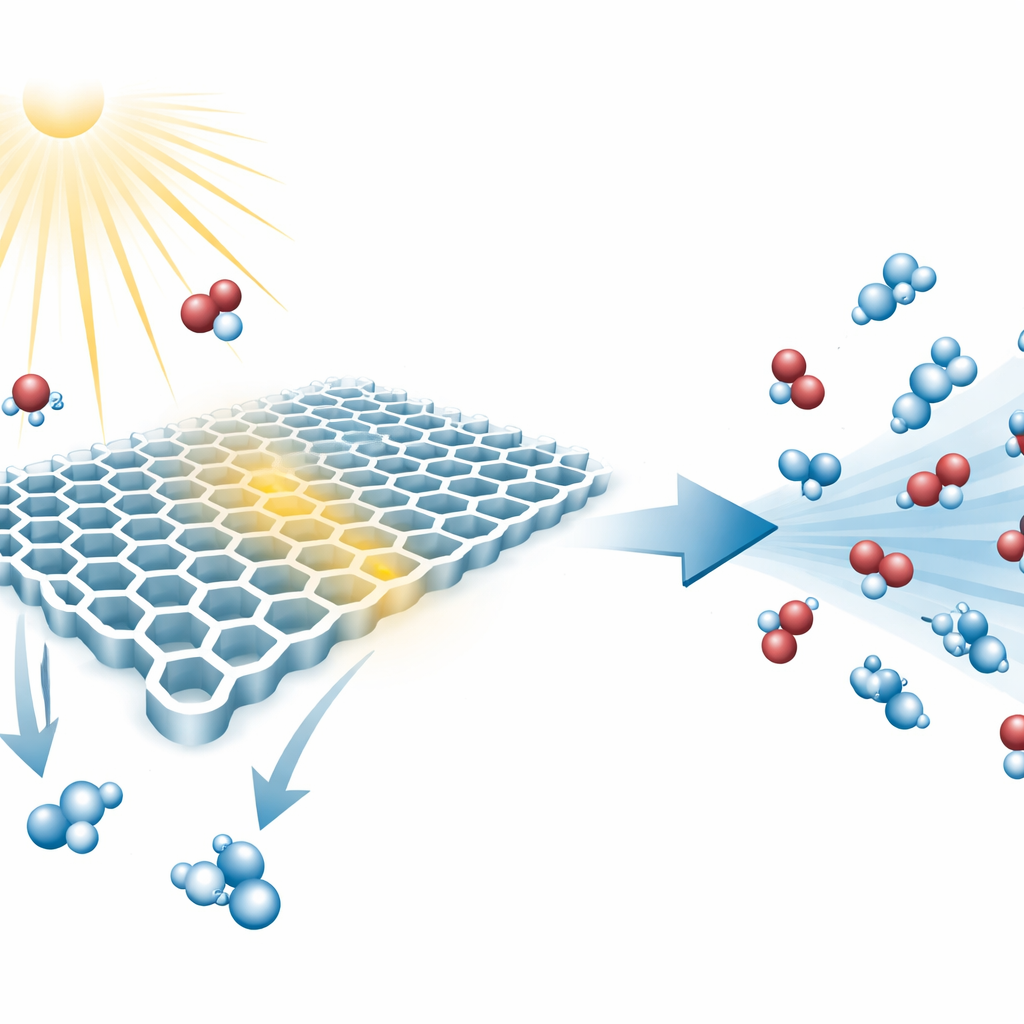
Hydrogen peroxide is best known as the fizzing liquid in brown bottles used to disinfect cuts, but it is also a workhorse chemical for bleaching, cleaning, and even emerging energy technologies. Today it is mostly made in giant factories using hydrogen and oxygen under risky conditions with expensive metal catalysts and organic solvents. This study explores a safer, greener route: using sunlight to turn water and oxygen from air directly into hydrogen peroxide, powered by a designer porous solid that quietly upgrades itself under light to work better over time.
Why a Better Hydrogen Peroxide Matters
Hydrogen peroxide is attractive because its only by-products are water and oxygen, making it far cleaner than many conventional chemicals. Yet the standard industrial method is energy-intensive, potentially explosive, and generates waste. A long-sought alternative is photocatalysis, in which light drives a solid material to combine oxygen and water into hydrogen peroxide. Many photocatalysts have been tested, but they often absorb sunlight poorly or waste the absorbed energy as heat instead of steering it toward the chemical reaction. The challenge is to design a solid that both harvests visible light efficiently and cleanly separates the positive and negative charges that light creates so they can do useful chemistry.
A Smart Porous Scaffold That Rebuilds Itself
The researchers start with a covalent organic framework (COF), a crystalline, sponge-like material built from organic molecules locked into a regular grid. Their initial framework, called OH-COF, is stitched together with so‑called imine linkages and forms a highly ordered, porous sheet. Tests show that OH-COF can absorb visible light and has electronic energy levels suitable for activating oxygen, meaning it can in principle kick-start the reaction that turns oxygen into hydrogen peroxide. However, when the team first shines light on OH-COF in pure water, hydrogen peroxide appears only slowly. Intriguingly, the production rate then rises sharply over the first three quarters of an hour and eventually levels off at a much higher, steady rate, hinting that the material is changing as it works.
Hidden Switch to a More Active Form
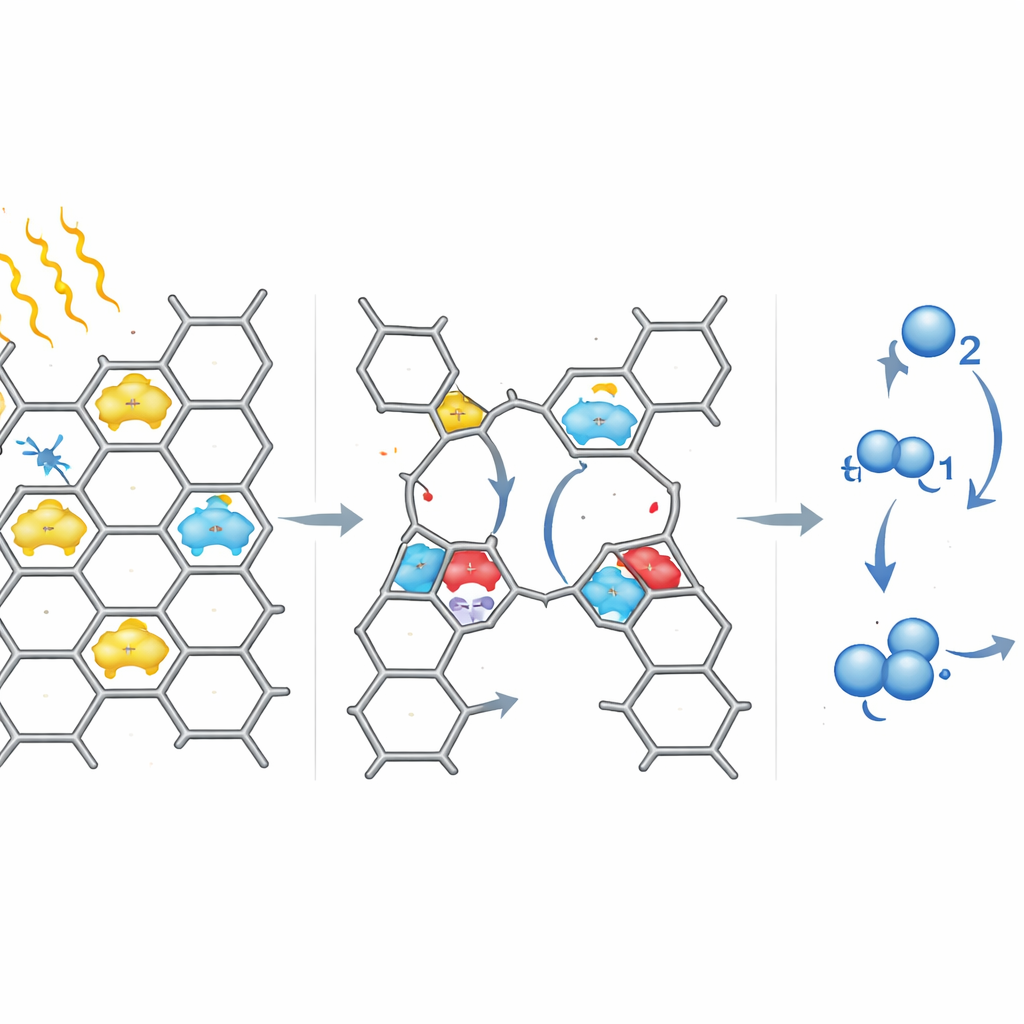
To understand this performance jump, the scientists probe the framework’s structure while it operates. Using infrared spectroscopy, solid-state NMR, and X‑ray photoelectron spectroscopy, they discover that a fraction of the original imine links are quietly transformed into benzisoxazole rings when the material is illuminated in water and exposed to oxygen. The overall scaffold and pore structure remain almost unchanged, but the new rings introduce electron-hungry spots within the framework. This creates a so‑called donor–acceptor arrangement: some units in the COF prefer to give up electrons when excited by light, while the new benzisoxazole units readily pull those electrons in. As a result, the light‑generated positive and negative charges separate more effectively instead of recombining uselessly, and the upgraded material, dubbed OH-COF-E, becomes a much more active photocatalyst.
How the Material Drives the Reaction
Advanced measurements of light emission and ultrafast spectroscopy reveal that in the evolved framework, excited states split into free charges more readily and these charges migrate quickly to the surface, where they can meet oxygen molecules. Calculations show that electrons concentrate on the benzisoxazole sites, which attract oxygen particularly strongly. There, oxygen is stepwise reduced: first to a highly reactive superoxide radical and then to hydrogen peroxide. Control experiments using additives that mop up specific intermediates confirm that this oxygen-reduction pathway is the dominant source of hydrogen peroxide, rather than routes that start by oxidizing water. Overall, OH-COF-E achieves a hydrogen peroxide production rate close to 2 millimoles per gram per hour in pure water and air, and maintains its performance over extended illumination.
What This Means for Everyday Technologies
By designing a porous organic framework that can rearrange some of its internal links under light, the authors demonstrate a catalyst that effectively upgrades itself into a more powerful, charge-separating engine for making hydrogen peroxide from just sunlight, water, and air. To a non-specialist, the key message is that careful molecular design can replace harsh industrial conditions with a quiet, sun-driven process in a beaker of water. While this work is still at the laboratory stage, it outlines a blueprint for safer, decentralized production of hydrogen peroxide, potentially enabling on-site generation for cleaning, environmental treatment, and sustainable energy applications without the need for massive, high-risk plants.
Citation: Zhang, P., Zeng, H., Zhang, Q. et al. In-situ formatting benzisoxazole-linked covalent organic framework for enhanced photocatalytic hydrogen peroxide generation. Nat Commun 17, 3365 (2026). https://doi.org/10.1038/s41467-026-70161-4
Keywords: photocatalytic hydrogen peroxide, covalent organic frameworks, solar-driven chemistry, donor-acceptor materials, green oxidant production