Clear Sky Science · en
Discovery and engineering of bacterial P450s for C-14 hydroxylation in ent-kaurane diterpenoids
Turning plant molecules into sharper cancer-fighting tools
Many modern medicines are inspired by plants, whose complex chemistry can attack disease in ways chemists still struggle to copy. One especially promising family of plant molecules, called ent-kaurane diterpenoids, shows strong anticancer and anti-inflammatory effects. Yet a small but crucial tweak at one specific position on these molecules—adding an oxygen atom as a “handle” at carbon 14—has been notoriously hard to achieve. This paper describes how researchers used a blend of computer modeling and bacterial engineering to solve that problem, opening a faster path to next-generation anticancer candidates.
Why a tiny molecular handle matters
Ent-kaurane molecules have a rigid four-ring backbone and a reactive “hot spot” that can latch onto proteins inside our cells. Earlier work showed that attaching extra groups at the C-14 position, near this hot spot, can make these molecules more water-soluble and more lethal to cancer cells. One such modified compound, called HAO472, has even reached early-stage clinical trials for leukemia. The obstacle is that installing this C-14 oxygen by traditional chemical synthesis takes a dozen or more painstaking steps, making it slow and expensive to explore many new variants.
Recruiting bacterial helpers to do precise chemistry
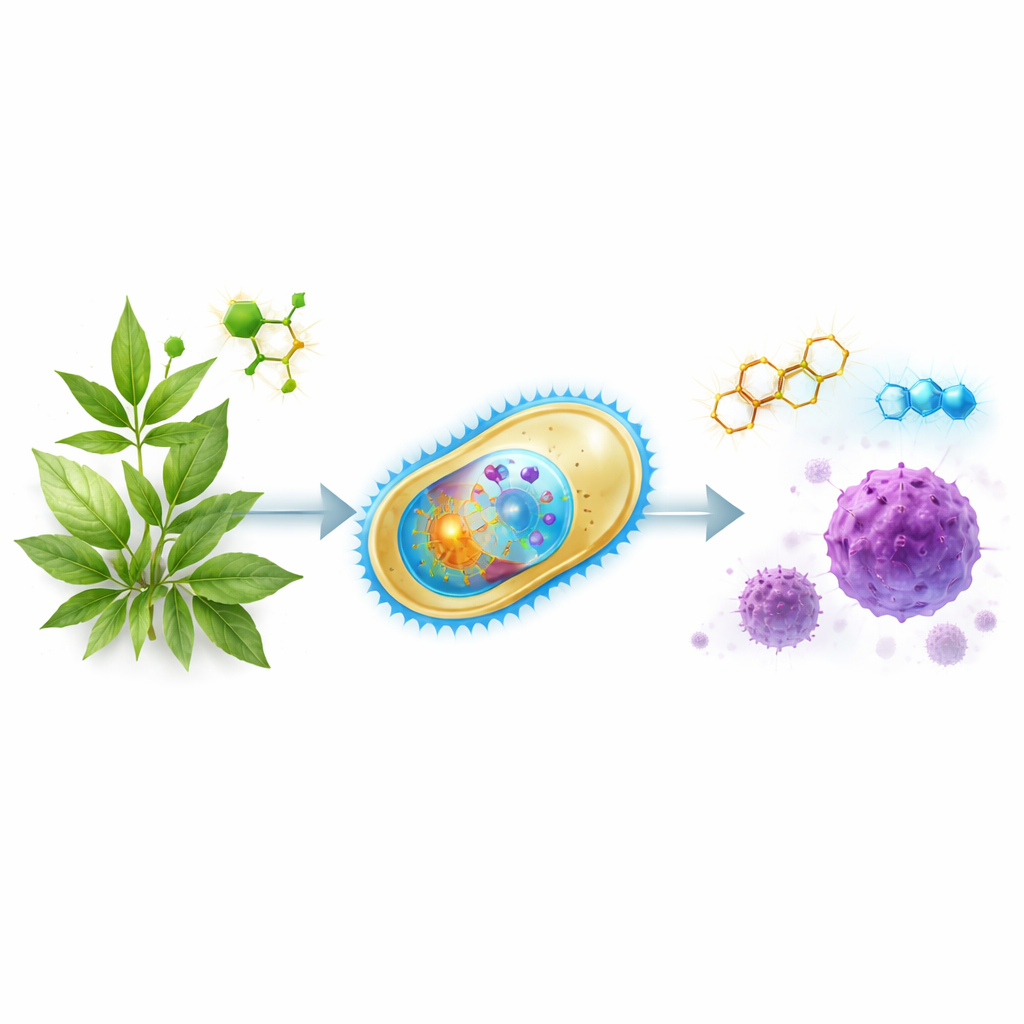
Nature already has specialist enzymes, known as P450s, that can insert oxygen into very specific spots of complex molecules. The challenge is finding the few P450s, among hundreds of thousands, that will hit exactly the C-14 position on ent-kaurane scaffolds. The team built a “computational heme-guided site-specific” strategy: they started from a large database of bacterial P450 structures, narrowed it to 44 enzymes likely to work on terpenes, and then used computer docking to see how an ent-kaurane-like molecule would sit above the enzyme’s iron-containing heme center. Only enzymes that positioned carbon 14 at the right distance and angle were shortlisted, then tested in living Escherichia coli, which were engineered to manufacture the ent-kaurane starting material inside the cell.
Designing a better oxygen-adding machine
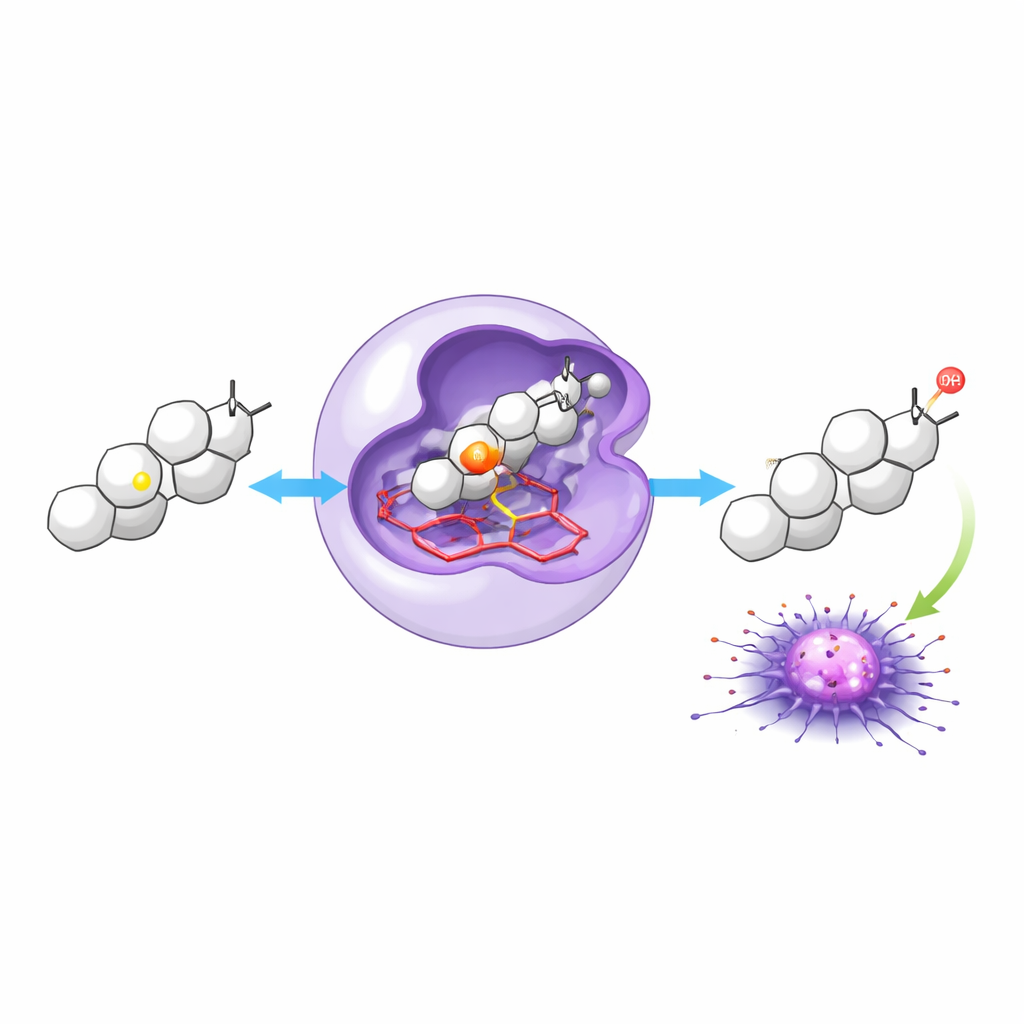
From this screen, three bacterial P450s emerged that could oxidize the difficult C-14 site, with one enzyme, CYP260A1, standing out. Initially, however, its output was modest. The researchers boosted performance in two main ways. First, they tried different “redox partners”—proteins that shuttle electrons into the P450 enzyme—discovering that a pair called CamA/CamB greatly improved oxygen-insertion efficiency. Second, they turned again to computation, running molecular dynamics simulations to watch how the ent-kaurane substrate moved in the enzyme’s pocket over time. By calculating which nearby amino acids destabilized binding, they virtually tested hundreds of mutations, then built the most promising variants in the lab. One subtle change, swapping a single leucine for valine (L162V), stabilized the substrate in the right orientation and raised the yield of a key product, ent-kauran-14,16-diol, to 84.2 mg per liter in E. coli—a 52-fold improvement over the starting system.
Exploring which shapes make stronger drugs
With this optimized enzyme in hand, the team asked which ent-kaurane variants it could accept, and how those structural tweaks affected anticancer activity. They prepared a panel of related molecules bearing different combinations of alcohol, ketone, and other groups around the rings, then let the engineered CYP260A1 L162V act on them. The enzyme accepted several substrates but was sensitive to bulky groups, revealing which positions could be changed without losing activity. Using a mix of biocatalysis and simple follow-up chemistry, the researchers built a standout compound, labeled 27, that combines the C-14 hydroxyl “handle” with a highly reactive pair of atoms at C-15 and C-16 known as a Michael acceptor. In cell tests, this compound killed colorectal cancer cells at much lower concentrations than the parent molecules—and was more potent than the chemotherapy drug cisplatin in the same assay.
From smarter enzymes to better medicines
Beyond delivering a single potent anticancer candidate, this work showcases a general playbook: use structure prediction, docking, and dynamics to mine vast enzyme databases, then refine promising hits with targeted mutations guided by physics-based calculations. For ent-kaurane compounds, the approach cracked a long-standing challenge in installing a key oxygen atom at C-14 and linked that modification to sharply improved cancer-cell killing when combined with a specific reactive feature nearby. For non-specialists, the broader message is that programmable microbes and computer-aided enzyme design can now act as flexible molecular factories, rapidly generating families of “upgraded” natural products that chemists alone would struggle to make, and speeding the search for safer, more effective drugs.
Citation: Lin, X., Xiao, Z., Xu, X. et al. Discovery and engineering of bacterial P450s for C-14 hydroxylation in ent-kaurane diterpenoids. Nat Commun 17, 3850 (2026). https://doi.org/10.1038/s41467-026-70157-0
Keywords: biocatalysis, enzyme engineering, natural product drug discovery, cytochrome P450, anticancer terpenoids