Clear Sky Science · en
Single-engineered-residue solvation perturbations regulate global protein architecture and function
When a Tiny Tweak Ripples Through a Whole Protein
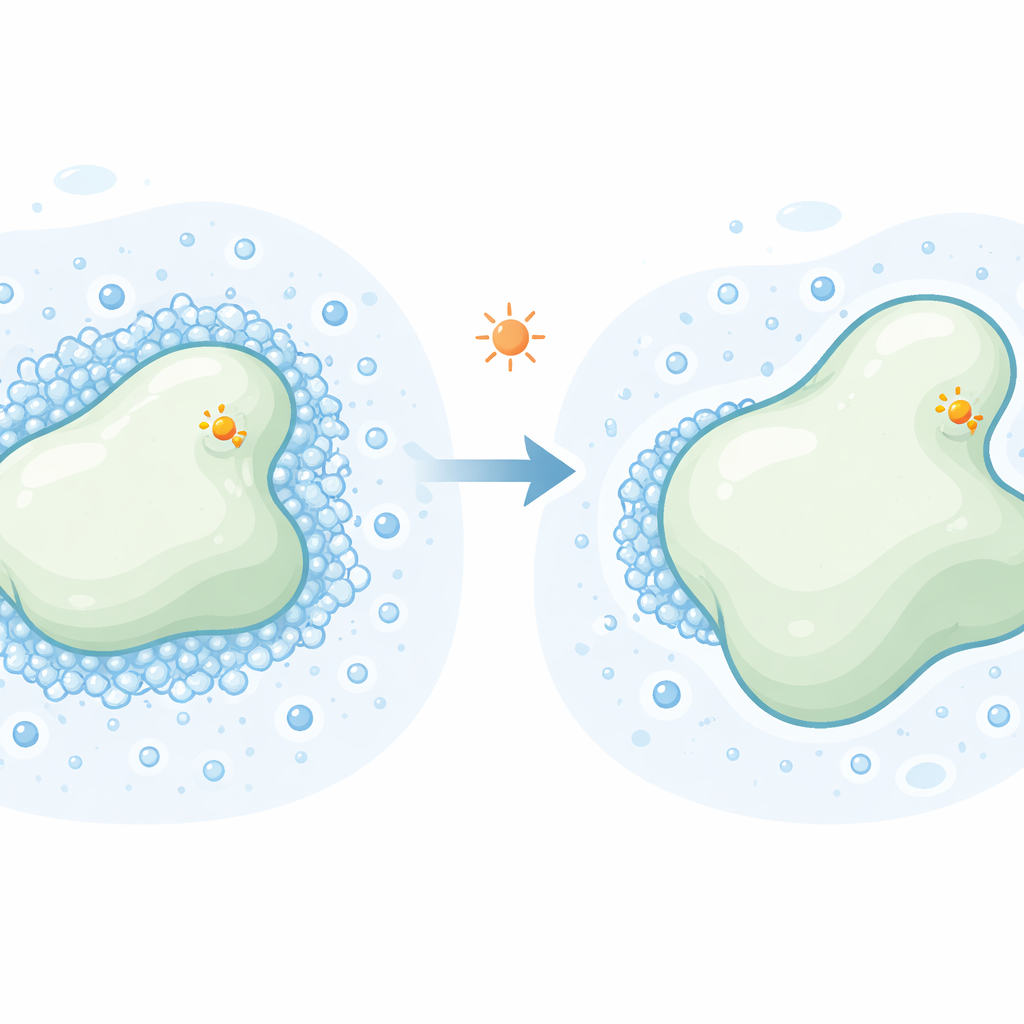
Proteins are the molecular machines that keep our cells alive, and they work in constant partnership with water. We usually think of protein function as being dictated by shape alone, but this study shows that changing the “wetness” of just one tiny spot on a protein’s surface can send a ripple of changes across the entire molecule. Using a light-switchable chemical tag, the authors reveal that local rearrangements of water can loosen or tighten a protein’s structure and tune how efficiently it carries out its job as an enzyme.
Water as an Invisible Partner
Water around a protein is not just a passive bath. It forms a delicate shell that links the protein’s surface to the surrounding liquid and helps guide motions needed for folding and function. Some regions of a protein attract water strongly, while others are more water-repelling, creating a patchwork landscape. Past experiments and simulations hinted that changing a single amino acid might only disturb water in its immediate neighborhood. Yet newer ultrafast measurements suggested that even tiny local tweaks might have much farther-reaching effects, possibly altering the whole protein’s motion. Resolving this disagreement required a way to create a very clear, controllable change in how “water-loving” or “water-fearing” one chosen site is.
Building a Light-Driven Surface Switch
The researchers turned to a special molecule called spiropyran, which can reversibly change its form when exposed to different colors of light. In one form it is more polar and water-attracting; in the other, it is more hydrophobic and water-repelling. They chemically attached this photoswitch to a specific pair of positions on a model enzyme, alkaline phosphatase, without disturbing the rest of the protein. Blue or visible light then acted as a remote control, toggling that single engineered residue between the two states and amplifying the local change in surface hydrophobicity far beyond what a natural amino acid swap would do. Fluorescence measurements confirmed that the local environment around the tag, including nearby water, indeed responded when the switch was flipped.
How a Local Water Jolt Spreads Across the Protein
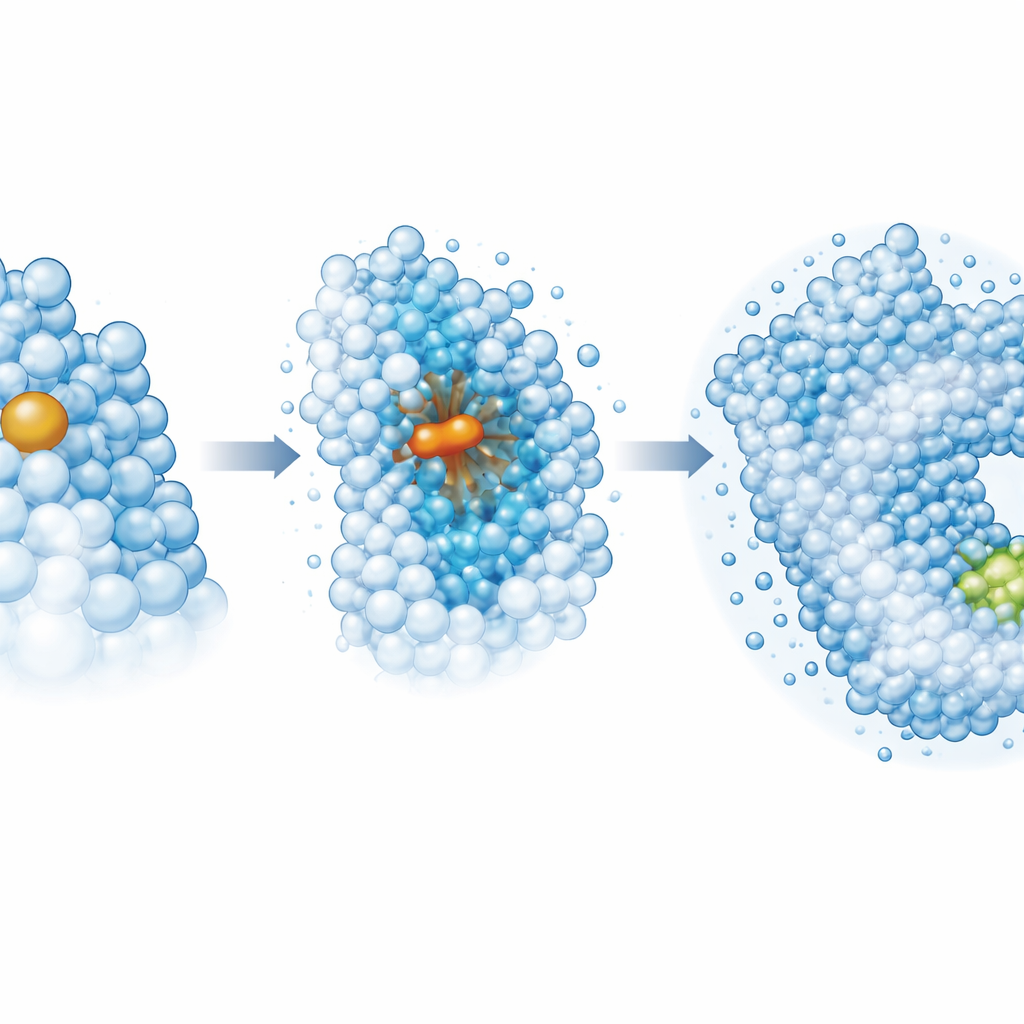
Using large-scale computer simulations combined with terahertz spectroscopy—a technique exquisitely sensitive to collective motions of water molecules—the team tracked how the hydration shell responded. When the tagged site became more hydrophobic, water was partially pushed away from that spot and reorganized into more rigid, cage-like structures around both the modified residue and distant parts of the enzyme, including the catalytic center. Hydrogen bonds between water molecules lived longer near the surface, and water mobility was reduced over multiple layers extending from the protein. These changes did not spread uniformly: residues with negative or positive charge were more strongly affected than nonpolar ones, showing that the chemical makeup of the surface steers how the disturbance travels along the water network.
From Reshaped Water to Reshaped Protein
These hydration shifts did not remain confined to the water alone. Structural analyses from simulations and small-angle X-ray scattering showed that, after the switch to the more hydrophobic state, some parts of the protein near the modification became more rigid, while the overall molecule subtly expanded and became more flexible. Distance maps between residues indicated that long-range contacts were loosened, and the enzyme’s melting temperature dropped, signaling a less tightly packed structure. In essence, altering how water is arranged at one engineered site nudged the entire protein into a different architectural “breathing” pattern, without directly changing most of its atoms.
Water-Tuned Enzyme Performance
Finally, the team asked whether these structural and hydration changes actually matter for function. They measured how efficiently the enzyme processed two different substrates: one that is strongly water-soluble and another that is more hydrophobic. When the photo-switch made the local site more hydrophobic and the hydration shell more rigid, the enzyme bound and converted the water-loving substrate less efficiently, as if a more ordered water layer were blocking its path into the active site. The hydrophobic substrate, by contrast, slipped in and reacted almost unaffected, since it could approach the active pocket without relying on an ordered water “conveyor belt”. Additional experiments using heavy water and conventional point mutations supported the idea that these effects arise from water-mediated communication across the surface, a kind of water-based allostery.
Why This Matters for Biology and Medicine
By showing that a single, engineered change in how one residue interacts with water can reorganize the entire hydration shell, reshape the protein, and alter enzymatic activity, this work argues that we should think in terms of a “structure–hydration–function” triad rather than a simple “structure–function” link. Interfacial water emerges as an active messenger that carries local perturbations over long distances on the protein surface. This insight opens new directions for designing drugs and engineered proteins that work not only by fitting into a static active site, but also by subtly steering the surrounding water networks that help determine how proteins move and perform.
Citation: Liu, Y., Zhai, J., Cao, S. et al. Single-engineered-residue solvation perturbations regulate global protein architecture and function. Nat Commun 17, 3754 (2026). https://doi.org/10.1038/s41467-026-70155-2
Keywords: protein hydration, enzyme dynamics, hydrophobicity switch, water-mediated allostery, protein engineering