Clear Sky Science · en
Sperm hyperactivation drives a circling-and-wandering swimming behavior
How tiny swimmers find their way
Fertilization starts with a remarkable journey: sperm must travel through the winding passages and sticky fluids of the female reproductive tract to reach the egg. This study asks a simple but crucial question for that journey: how does a change in the way sperm move help them search through such a complicated landscape? By watching bull sperm in carefully designed lab setups, the researchers show that a special form of motion, called hyperactivation, lets sperm switch between different ways of swimming that together can improve how they explore and navigate.
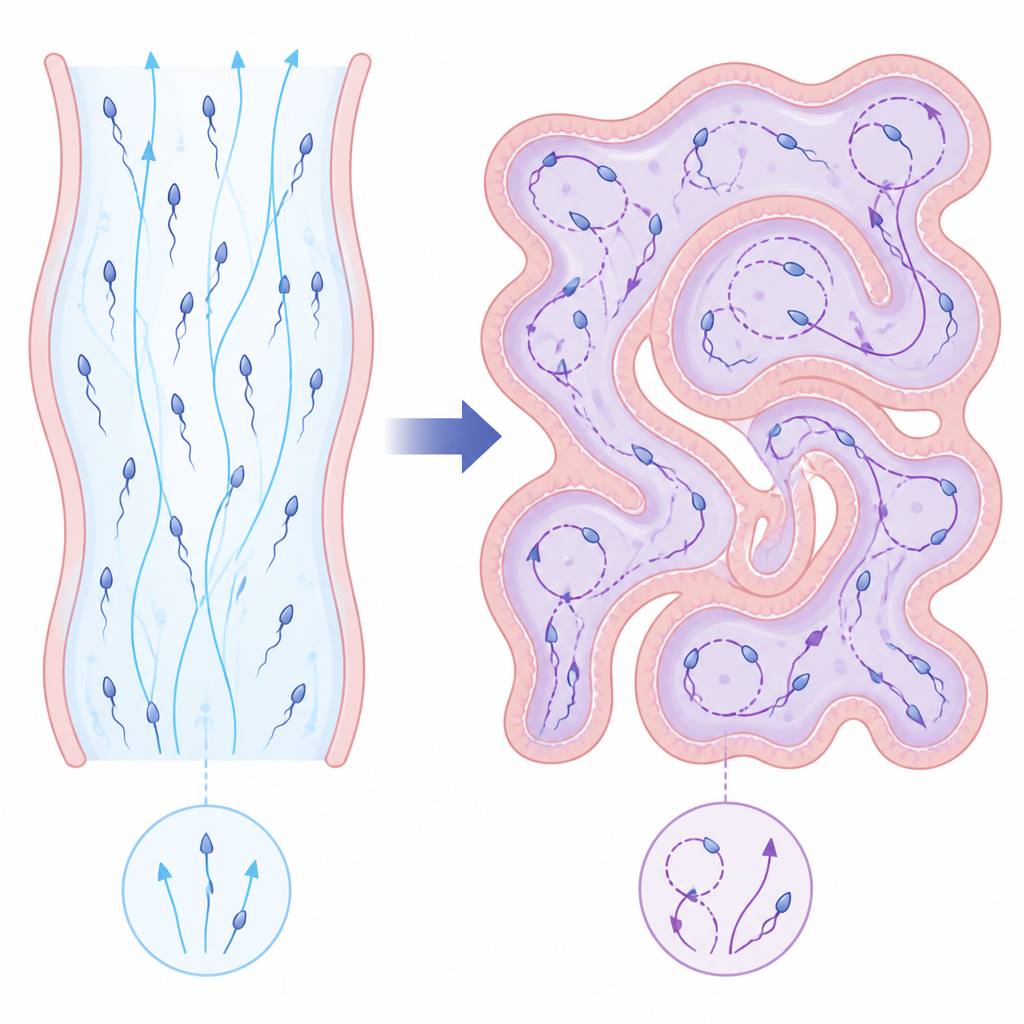
Three ways to swim
The team first placed sperm in a simple watery solution and in thicker, mucus-like fluids inside flat microfluidic chambers that mimic tight spaces in the body. They found three main swimming styles, or “gaits.” In simple fluid without strong stimulation, sperm moved mostly in straight, steady paths, a mode the authors call progressive. With a chemical trigger that induces hyperactivation, sperm in simple fluid began to wander: they still pushed forward but kept changing direction in a random fashion, tracing sprawling, irregular paths. In the thicker, mucus-like fluid, hyperactivated sperm instead tended to circle, following curved paths of various sizes near surfaces. A third mode emerged when some cells in the complex fluid randomly switched back and forth between circling and wandering over times of tens of seconds.
Spreading out versus staying focused
To understand what these gaits accomplish, the researchers analyzed thousands of tracked paths and calculated how far sperm spread over time. All three gaits eventually behaved like diffusion, similar to how a drop of dye spreads in water, but at very different rates. Wandering sperm covered space about ten times more efficiently than circling sperm, making them better at scouting large areas. Circling sperm, by contrast, stayed relatively confined, a behavior well suited for staying near a spot of interest. The mixed circling-and-wandering mode landed between the two in overall spread, suggesting it balances broad exploration with local focus.
Bouncing off walls and getting trapped
The team then tested how the different gaits interact with walls and obstacles that stand in for the folds and grooves of the reproductive tract. Progressive sperm tended to slide along curved walls and pillars once they touched them, effectively getting guided or trapped by boundaries. Hyperactivated wandering sperm behaved differently: they bumped into walls, dwelled briefly, then scattered away in new directions, preventing long-term trapping and helping them roam the interior. Circling sperm showed yet another behavior. In mucus-like fluid they could become permanently caught looping around small pillars, depending on how their curved path lined up with the obstacle. Tight circles around small pillars led to many cells orbiting in place, while larger circles often passed by without capture.
Why switching styles helps in a maze
To connect these observations to real-world environments, the researchers built computer models of sperm-like swimmers moving through a porous maze of round obstacles, similar to the crowded folds and pockets within the tract. They tuned the models to match the measured speeds and turning rates of progressive, wandering, circling, and mixed swimmers. In open, loosely packed mazes, straight progressive motion spread sperm the fastest, while circling lagged behind. As the maze grew tighter and more intricate, however, straight swimmers became easily stuck in corners and narrow channels. Under these conditions, hyperactivated strategies that included direction changes performed better, and the mixed circling-and-wandering pattern became the most effective at escaping traps and exploring the network of pores.
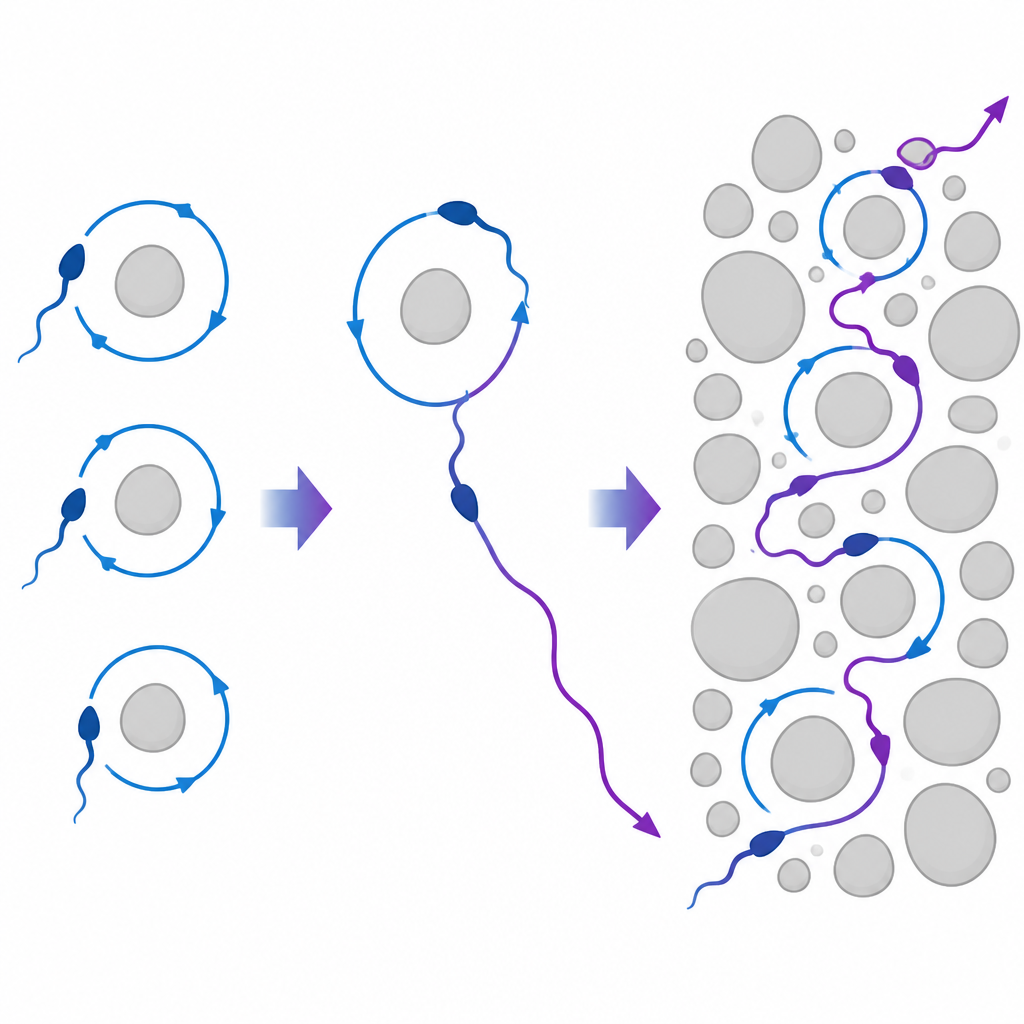
What this means for the journey to the egg
Taken together, the results suggest that hyperactivation is not just a boost in power but a way for sperm to switch between different search strategies. Wandering motion helps them scan wide regions, circling keeps them near promising locations, and intermittent transitions between the two can tune how they balance exploration and exploitation in complex environments. Although these experiments were done in simplified lab devices, they hint that similar circling-and-wandering behavior in the female reproductive tract could help sperm move through mucus-filled, folded regions more efficiently. Understanding these patterns may ultimately aid in designing assisted reproduction methods that better account for how real sperm navigate challenging terrain on their way to the egg.
Citation: Zaferani, M., Baouche, Y., Lago-Alvarez, Y. et al. Sperm hyperactivation drives a circling-and-wandering swimming behavior. Nat Commun 17, 4475 (2026). https://doi.org/10.1038/s41467-026-70143-6
Keywords: sperm motility, hyperactivation, female reproductive tract, microswimmers, porous media