Clear Sky Science · en
Engineering molecular rotor-stator ligand architectures on copper nanoclusters for efficient photothermal conversion
A New Way to Turn Light into Heat
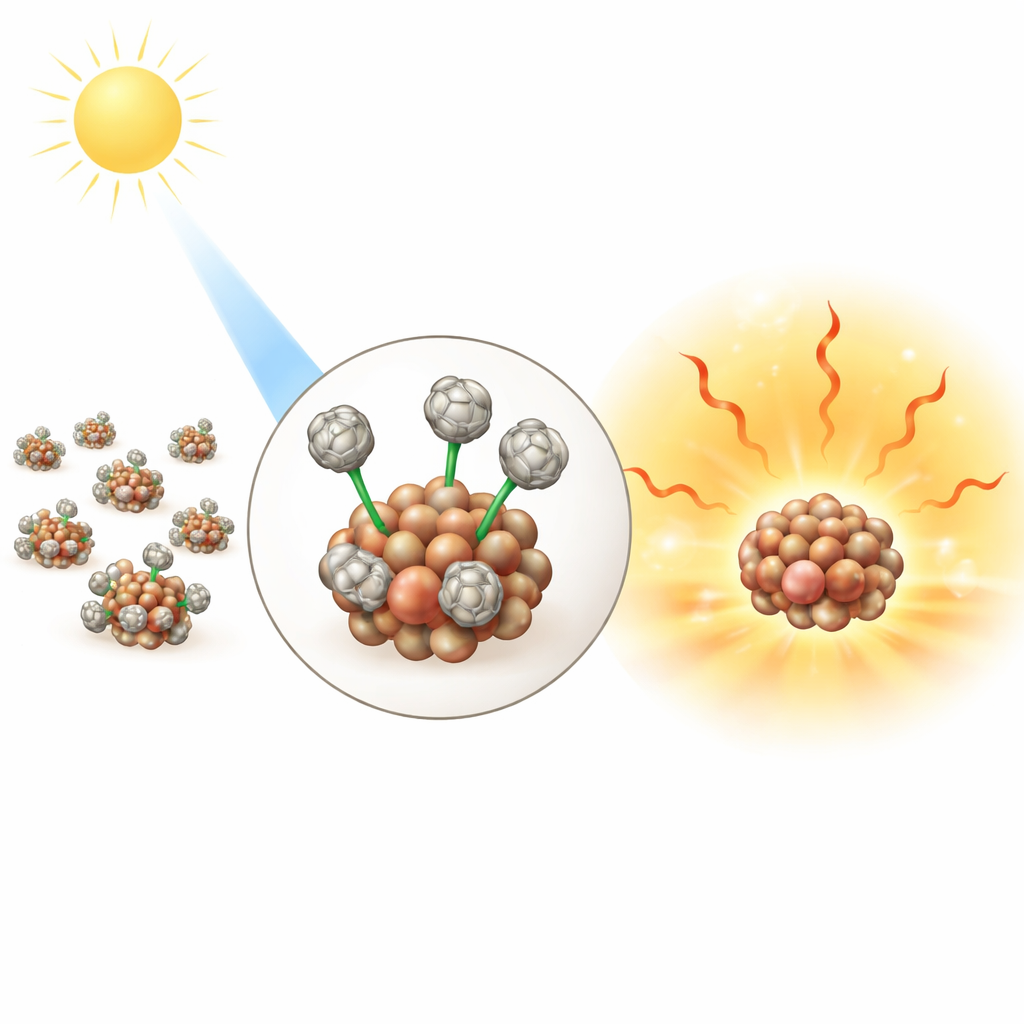
Turning light into heat might sound simple—think of how a dark car seat warms in the sun—but doing it efficiently and on demand, using tiny engineered particles, is a major challenge in modern materials science. This article describes a clever way to build copper-based nanomaterials that act like microscopic heat engines. By decorating their surfaces with moving molecular "rotors" held in place by rigid "stators," the researchers create particles that soak up light and rapidly convert it into heat with remarkably high efficiency.
Tiny Copper Clusters with Big Potential
The work centers on ultra-small copper nanoclusters, which contain only a few dozen copper atoms arranged in a precise, molecule-like structure. Copper is abundant and inexpensive, making it an attractive alternative to gold or silver in advanced technologies. These clusters are coated with organic molecules called ligands that shape their structure and tune how they interact with light. Until now, most efforts to improve their light-to-heat performance focused on changing how they absorb light or reshaping the metal core. Those approaches helped, but often ran into limits because they did not provide an efficient way for excited energy to be turned into heat rather than lost as light.
Borrowing Ideas from Molecular Machines
The authors take inspiration from earlier studies of organic materials where internal molecular motion—bonds twisting or groups spinning—was deliberately amplified to boost heat production under light. They reasoned that if such motion could be built directly into the surface of metal nanoclusters, the absorbed energy could be funneled into these internal movements and ultimately become heat. To do this, they designed a rotor-stator system: a rigid anchoring group (the stator) grips the metal surface, while a bulkier, more mobile group (the rotor) sticks out and can rotate freely.
Designing Free-Spinning Molecular Rotors
In their showcase material, the researchers use an adamantane unit—a cage-like, nearly spherical carbon framework—as the rotor. Adamantane is attached to the copper cluster by a carboxylate group that acts as the stator, clamping firmly onto the metal and defining a clear rotation axis. Detailed structural studies reveal a copper core of 36 atoms wrapped in a shell of sulfur, phosphorus, and carboxylate ligands. The adamantane groups sit far enough from the surface, and are surrounded loosely enough, that they can spin with very little hindrance. Nuclear magnetic resonance measurements and quantum-chemical calculations confirm that the energy barrier for this rotation is extremely low, meaning the rotors can move rapidly even at modest temperatures.
How Motion Becomes Heat
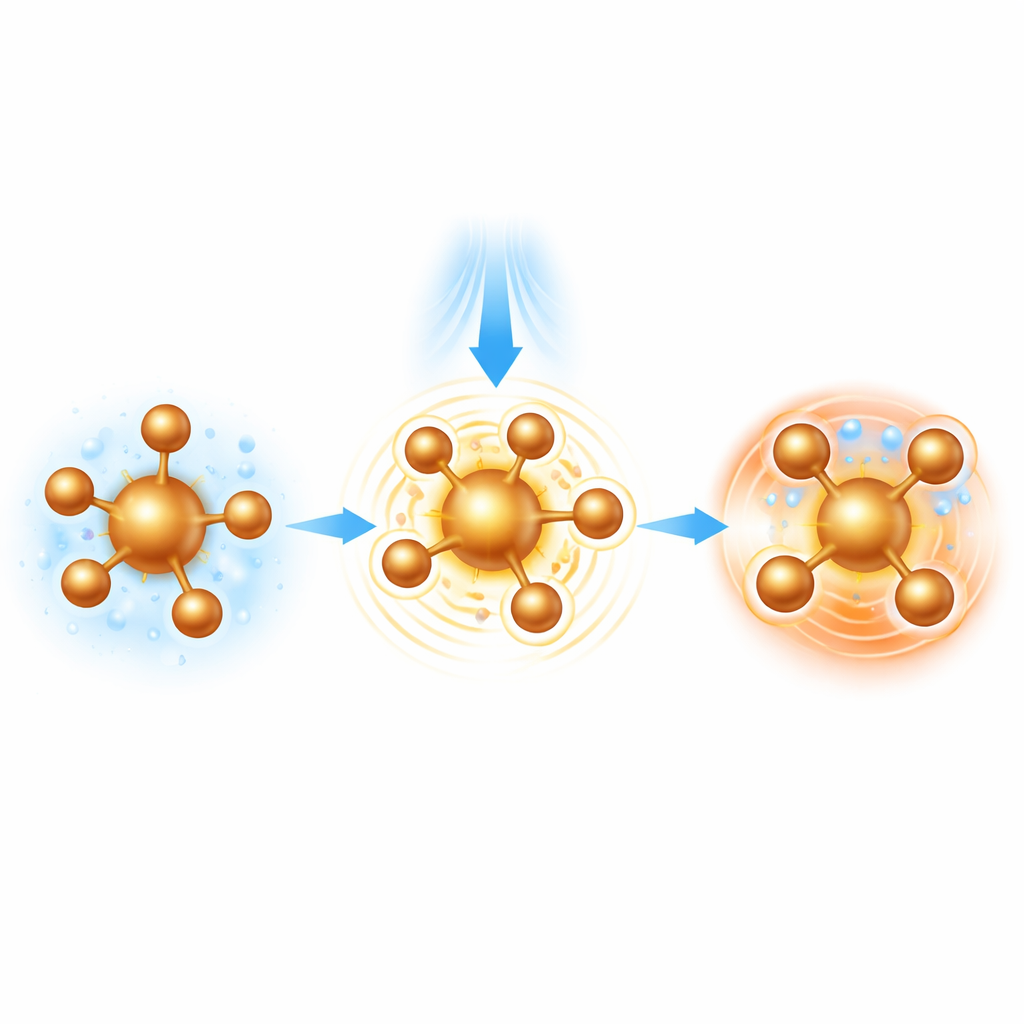
To understand how these moving parts affect heating, the team probed both the electronic structure and the ultrafast dynamics of the clusters. When the particles absorb blue light, electrons in the copper core are excited and then relax without emitting light, instead jostling the atoms in the core. Transient absorption experiments reveal a two-step process: a very fast relaxation in a few trillionths of a second within the core, followed by a slower process over hundreds of trillionths of a second linked to the motion of the rotors. In essence, the core hands off its energy to the spinning adamantane groups, which act as tiny mechanical paddles that dissipate the energy as heat into the surroundings.
Record-Level Heating and Practical Uses
Because of this engineered motion, the adamantane-decorated copper cluster reaches a photothermal conversion efficiency of about 75%, rivaling or surpassing many state-of-the-art systems. Under a blue laser, crystals of the material can heat almost instantly to around 200 °C at moderate power, and even higher under stronger illumination, while remaining structurally stable and reusable through many heating cycles. In solution, the clusters efficiently warm common solvents, and in practical tests they dramatically shorten the ignition time of matches when used as a coating. The team also shows that swapping in other rotor types—such as bicyclic cages or light-absorbing aromatic units—extends the approach across a family of copper nanoclusters with strong heating performance from visible to near‑infrared light.
Why This Matters for Future Technologies
To a non-specialist, the key message is that the authors have turned a subtle form of molecular motion into a powerful tool for managing energy at the nanoscale. By treating copper clusters as tiny machines with spinning parts instead of mere light absorbers, they unlock a highly efficient and tunable way to convert light into heat. This strategy could benefit technologies ranging from laser ignition and solar thermal storage to medical treatments that rely on precise heating inside the body, all while using earth-abundant copper and carefully designed organic components.
Citation: Yan, B., Samarasinghe, D.S.N.D., Sun, J. et al. Engineering molecular rotor-stator ligand architectures on copper nanoclusters for efficient photothermal conversion. Nat Commun 17, 3388 (2026). https://doi.org/10.1038/s41467-026-70141-8
Keywords: photothermal conversion, copper nanoclusters, molecular rotors, nanomaterials, solar thermal