Clear Sky Science · en
Stronger ENSO-induced global SST variability in a warming climate
Why this matters for our oceans and weather
El Niño is famous for reshaping weather patterns around the globe every few years, bringing floods to some regions and drought to others. This study asks a pressing question for our warming world: as the planet heats up, will El Niño’s grip on global sea surface temperatures, and thus regional climate and ecosystems, grow stronger? Using state-of-the-art climate models, the authors show that the answer is yes, and they explain why future El Niño events are likely to leave a bigger imprint on the oceans far beyond the tropical Pacific.
El Niño as a global climate heartbeat
El Niño is part of a see-saw pattern in the tropical Pacific Ocean that shifts warm water eastward and rearranges winds and rainfall in the atmosphere. Those shifts ripple outward through so-called atmospheric bridges, altering storms, heat waves, and rainfall on distant continents. Because the temperature of the sea surface helps steer storms and feed marine life, changes in how El Niño affects sea surface temperature have wide consequences, from coral bleaching and fisheries to coastal floods. The study focuses on how closely variations in global sea surface temperature track an El Niño index today, and how that link changes in a warmer future.
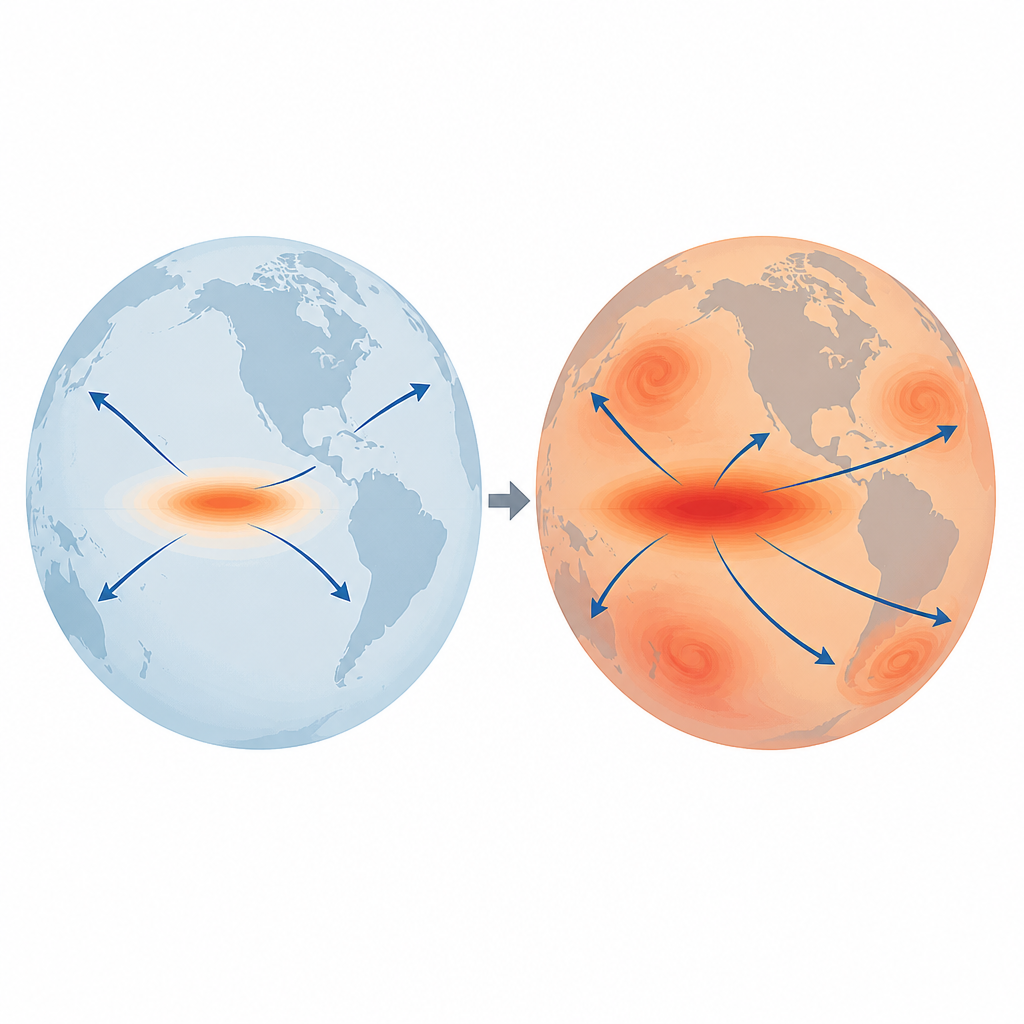
A stronger ocean response in a warmer world
The researchers analyzed a large number of simulations from one high-resolution climate model and 34 models from an international comparison project. Across nearly all of them, they find that the fraction of sea surface temperature ups and downs that can be explained by El Niño increases over most of the world’s oceans as greenhouse gases rise. This intensification shows up not only in the tropical Pacific itself, but also in the North and South Pacific, the Indian Ocean, and the Atlantic, including waters off the U.S. East Coast and around Australia. Even when the models disagree on how large future El Niño events will be, they still agree that the ocean’s sensitivity to El Niño, place by place, grows stronger.
How wind and moisture team up
To uncover the cause of this heightened sensitivity, the authors dissect how heat enters and leaves the upper ocean. They find that changes in surface heat exchange between the air and sea do most of the work; in contrast, changes in the thickness of the ocean’s mixed layer, which becomes slightly shallower in a warmer climate, play a smaller role. Two linked factors stand out. First, El Niño-related wind changes get stronger in a warmer atmosphere, stirring the ocean surface more vigorously and boosting evaporation in some regions while reducing it in others. Second, as the air and ocean warm, the sea surface can hold more moisture than the air just above it, increasing the typical humidity gap between them. This larger gap means that any given wind change caused by El Niño now triggers a bigger burst of evaporation and heat loss or gain, which then feeds back onto local sea surface temperatures.
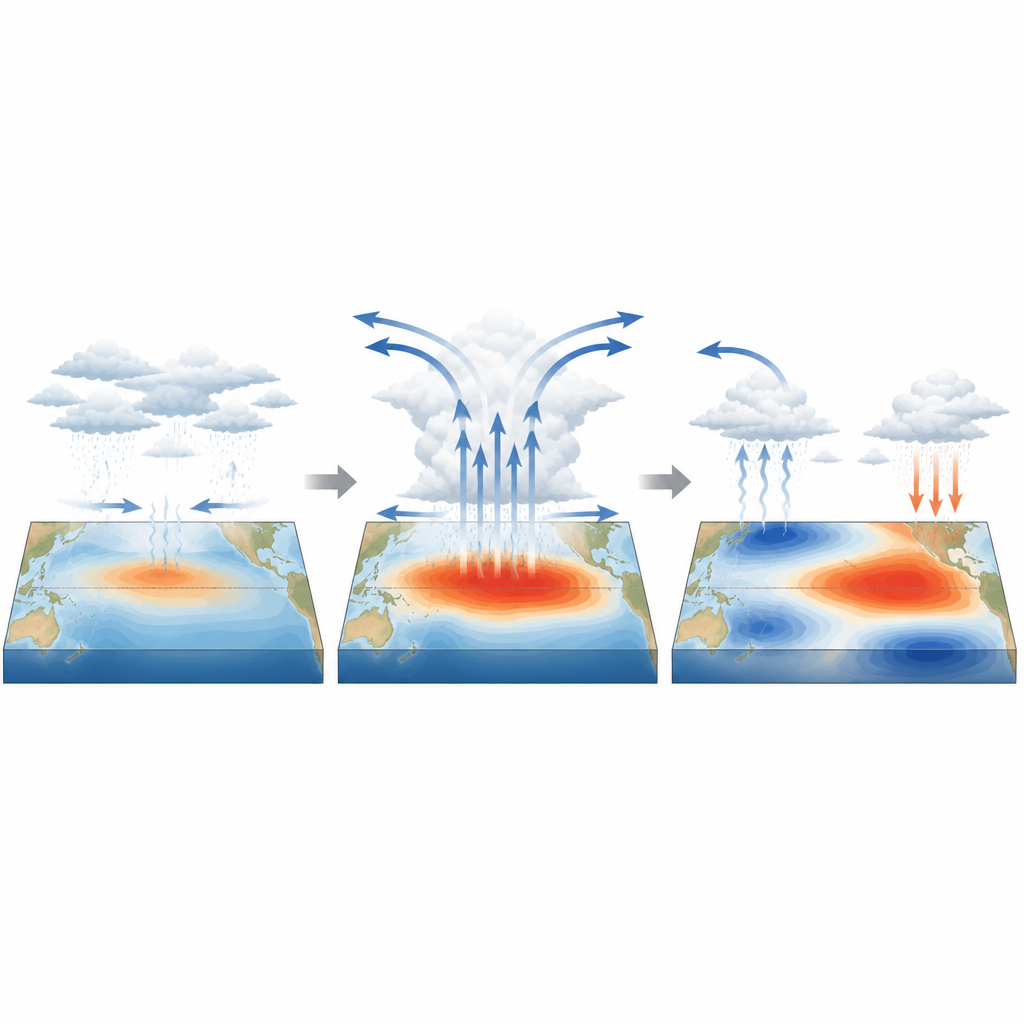
Regional hotspots of amplified change
The study zooms in on several key regions to show how these processes play out. In the East China Sea, stronger high-pressure systems linked to El Niño weaken the usual cool, dry winds, reducing evaporation and allowing the sea surface to warm more than it does today. Along the U.S. East Coast and in parts of the subtropical North Pacific, strengthened winds increase evaporation and lead to cooler-than-normal waters during El Niño years. In the South Indian Ocean, rising background humidity is the dominant player, tipping the balance toward warmer waters even without large changes in local wind patterns. While the details vary from place to place, the common story is that changes in wind and moisture work together to enlarge El Niño’s fingerprint on regional seas.
What this means for future climate risks
In plain terms, the study concludes that as the world warms, El Niño events will have a louder voice in shaping sea temperatures almost everywhere. This does not just affect weather patterns in the atmosphere; it also influences marine ecosystems, ocean carbon uptake, and the odds of extreme events tied to unusual sea surface temperatures. Even if future El Niño events do not always become bigger, the background conditions of warmer seas, moister air, and more responsive winds mean that their impacts on the world’s oceans, and the weather they help drive, are likely to intensify.
Citation: Hong, SJ., Kim, GI., Shin, Y. et al. Stronger ENSO-induced global SST variability in a warming climate. Nat Commun 17, 4231 (2026). https://doi.org/10.1038/s41467-026-70140-9
Keywords: El Niño, sea surface temperature, climate variability, global warming, air sea interaction