Clear Sky Science · en
Spatiotemporal photon distribution control on active sites enables bio-inspired methane-to-methanol conversion
Turning a Problem Gas into Useful Fuel
Methane is a powerful greenhouse gas, but it is also a rich source of energy and chemical building blocks. If we could turn methane directly into liquid methanol using sunlight, we could both reduce emissions and create a cleaner fuel. The challenge is that methane is so hard to activate that, once it finally reacts, it tends to burn all the way to carbon dioxide instead of stopping at methanol. This study shows a bio-inspired way to control where and when light-triggered charges appear on a catalyst surface so that methane can be gently converted to methanol with far fewer waste products.
Learning from Nature’s Playbook
In nature, certain microbes use an enzyme called methane monooxygenase to turn methane into methanol with remarkable precision. The enzyme does this in two clearly separated steps: first it activates oxygen to form very reactive oxygen species, and only afterward does it bring in methane and pull off a single hydrogen atom. Most artificial photocatalysts, however, mix these events together. Under light, the same surface spots often hold both oxygen and methane while also hosting the reactive charges that drive the chemistry. This overlap makes it easy for the reaction to run out of control, stripping multiple hydrogens and pushing carbon all the way to carbon dioxide.
Designing a Split-Task Catalyst
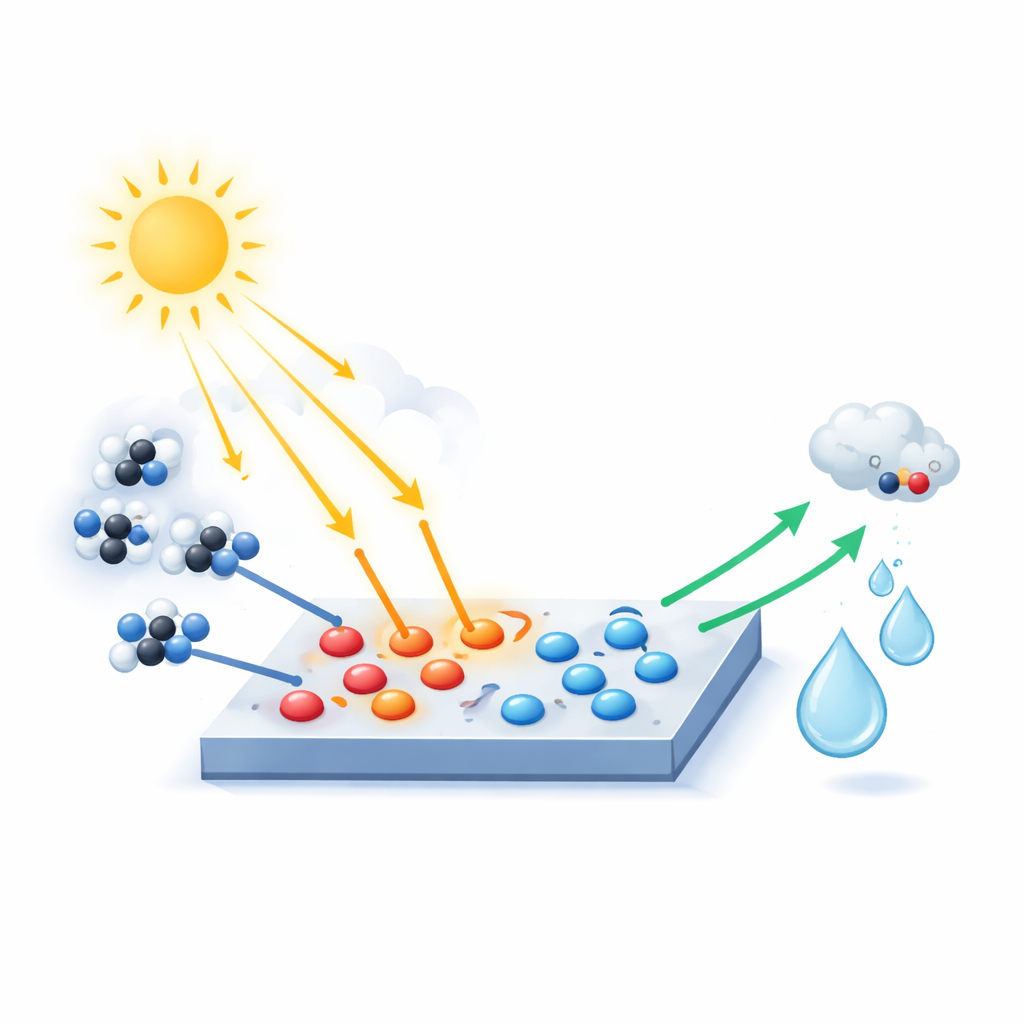
To mimic the enzyme’s ordered sequence, the researchers built a catalyst from cadmium sulfide particles decorated with individual platinum atoms. On the cadmium sulfide, they deliberately created “unsaturated” sulfur sites that naturally attract the positively charged holes produced by light. The platinum atoms, anchored to these sulfurs, become preferred landing spots for the negatively charged electrons. Ultrafast laser measurements showed that holes race to sulfur sites and electrons to platinum sites within just a few trillionths of a second, yet these separated charges remain localized long enough to drive reactions at the surface. Crucially, methane tends to bind at the hole-rich sulfur sites, while oxygen and water interact at the electron-rich platinum sites.
Steering the Reaction Step by Step
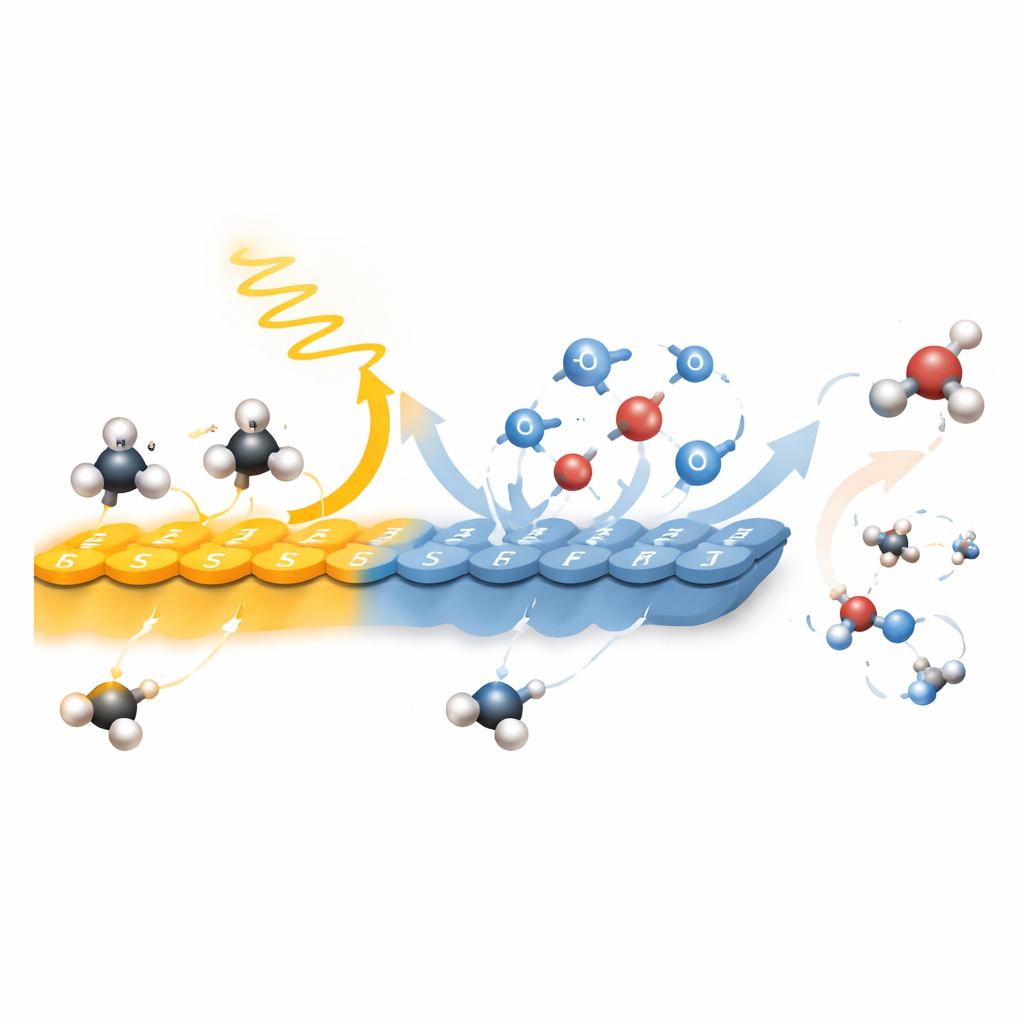
Because electrons and holes are confined to different neighborhoods on the same particle, the chemistry also becomes separated in space and time. At the platinum sites, electrons activate oxygen and water to form short-lived, aggressive oxygen species such as hydroxyl radicals. At nearby sulfur sites, holes help temporarily anchor methane molecules without immediately tearing them apart. The reactive oxygen species then diffuse over and snatch just one hydrogen atom from methane, forming a methyl fragment that quickly becomes methanol. By keeping the birth of radicals and the initial grip on methane at different sites, the system avoids repeatedly attacking the same carbon and thus limits overoxidation.
Proof in the Performance
The team compared plain cadmium sulfide with versions containing different amounts of platinum. With only sulfur sites active, methane could be activated but was heavily overoxidized, yielding more carbon dioxide and other byproducts than methanol. With too much platinum, overoxidation also increased, because electron-rich spots dominated and promoted deeper burning of methane. At an optimized loading of about one percent platinum, however, the balance was just right: charges separated cleanly, methane and oxygen were guided to different surface regions, and a two-step, enzyme-like pathway emerged. Under simulated sunlight and mild conditions, this catalyst converted methane to methanol with about 83.5 percent selectivity and maintained its structure and activity over repeated cycles.
A Gentle Route to Cleaner Carbon Use
In everyday terms, this work shows that by choreographing when and where light-induced charges appear on a catalyst, we can tell a stubborn molecule like methane to “stop” at methanol instead of racing to carbon dioxide. The catalyst does not simply make reactions faster; it organizes them, much like an assembly line that separates dangerous tasks so they do not interfere with one another. This bio-inspired strategy points to a broader design principle for solar-driven chemistry: finely tuning the spatiotemporal distribution of electrons and holes on a surface can unlock cleaner, more selective ways to upgrade simple molecules into useful fuels and chemicals.
Citation: Li, Y., Cao, Y., Han, C. et al. Spatiotemporal photon distribution control on active sites enables bio-inspired methane-to-methanol conversion. Nat Commun 17, 3357 (2026). https://doi.org/10.1038/s41467-026-70134-7
Keywords: methane to methanol, photocatalysis, bio-inspired catalysis, platinum cadmium sulfide catalyst, greenhouse gas conversion