Clear Sky Science · en
Phytochrome B integrates jasmonic acid and warm temperature signaling pathways to regulate cotyledon chloroplast development
Why tiny leaves and their green engines matter
When a seed sprouts, its first leaves—called cotyledons—must quickly build chloroplasts, the tiny green engines that capture light and power growth. But seedlings do this while facing shifting temperatures and attacks or stresses that trigger plant hormones. This study explores how a warming climate and a stress hormone work together to reshape chloroplasts in newborn leaves, revealing a built-in decision system that lets plants trade early growth for survival.
Warm days and stress signals team up
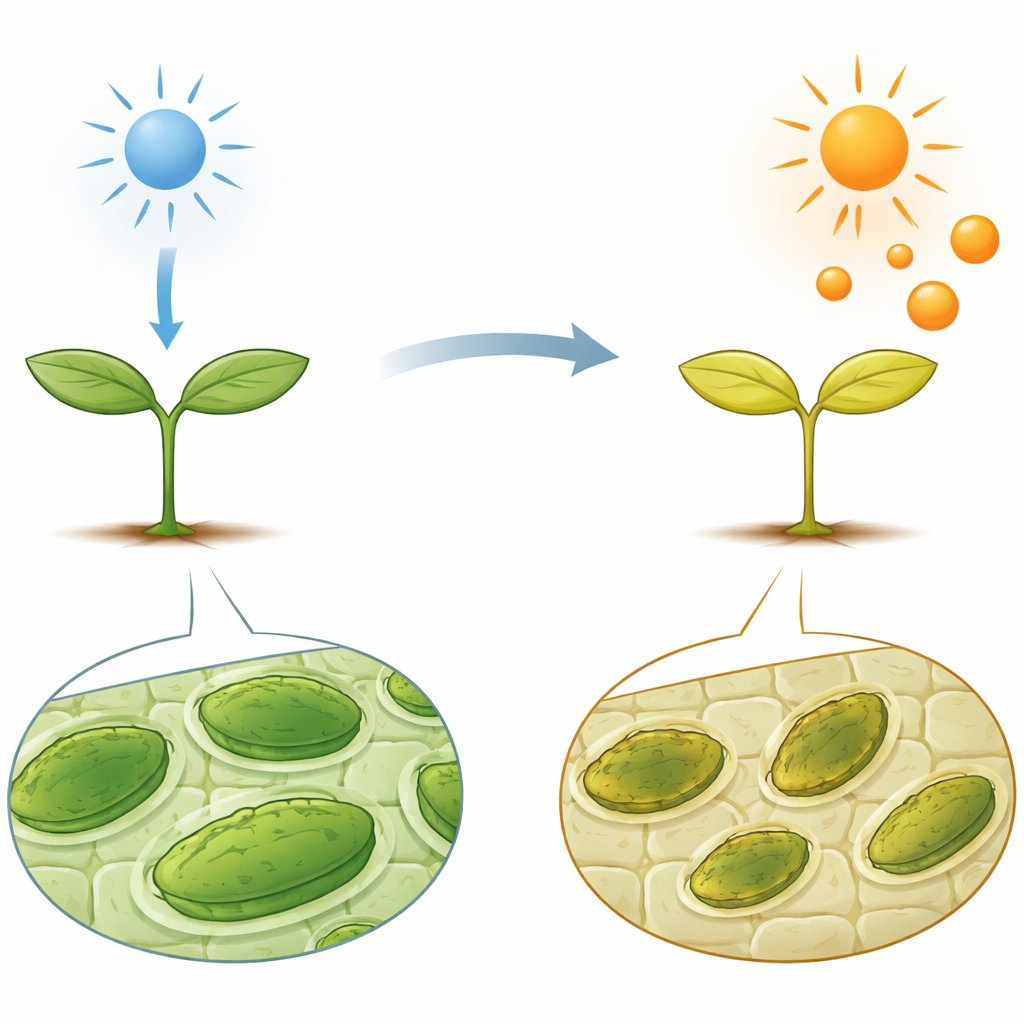
The researchers focused on Arabidopsis thaliana, a small mustard plant that serves as a workhorse for plant biology. They grew seedlings at normal temperature (22 °C) or a warmer but non-lethal temperature (28 °C), with or without methyl jasmonate, a chemical mimic of the stress hormone jasmonic acid. Either warmth or hormone alone made the cotyledons a bit paler and less efficient at photosynthesis. But together they had a strong additive effect: cotyledons turned yellow, their light-harvesting performance dropped, and the internal stacks of membranes in chloroplasts became smaller, fewer, and more disorganized, even though the number of chloroplasts per cell changed little. This showed that warm temperature and jasmonic acid act together to damage chloroplast quality rather than simply reducing their quantity.
A temperature sensor and a hormone receptor pull in opposite directions
The team then investigated two key proteins. One, phytochrome B, is best known as a red-light receptor but also serves as a temperature sensor. The other, COI1, is the main receptor for jasmonic acid. Seedlings lacking COI1 stayed greener and kept healthier chloroplasts under warm, hormone-rich conditions, while overactivating COI1 pushed development toward stronger yellowing. In contrast, seedlings lacking phytochrome B yellowed more, and plants with extra phytochrome B stayed greener. Microscopy confirmed that the “green” genotypes preserved chloroplast size and internal structure, whereas the “yellow” ones showed shrunken and degraded chloroplasts. These patterns revealed that phytochrome B protects chloroplast development, while COI1 promotes hormone-driven decline.
How the molecular brakes and accelerators interact
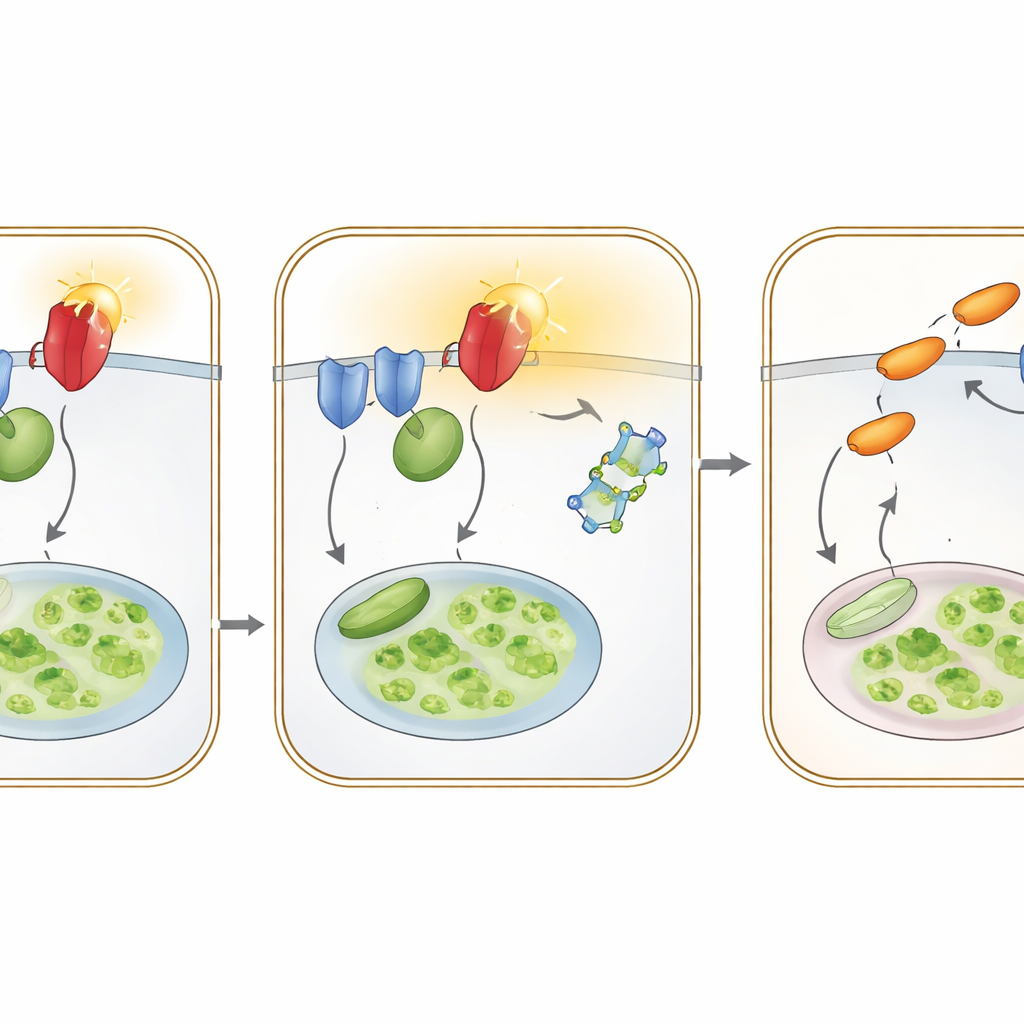
Inside cells, jasmonic acid normally works by tagging a family of repressor proteins, called JAZ, for destruction. When JAZ is removed, stress-responsive transcription factors such as MYC proteins become active. The authors discovered that phytochrome B physically binds two JAZ proteins, JAZ1 and JAZ3, and helps stabilize them, slowing their breakdown. Warm temperature weakens this interaction, allowing JAZ proteins to be more easily marked with molecular “ubiquitin” tags and destroyed. Under cooler, normal conditions, stable JAZ proteins keep MYC factors in check. Under warm, hormone-rich conditions, reduced phytochrome B activity and faster JAZ loss free MYCs to turn on stress and aging programs, pushing chloroplasts toward decline.
Balancing growth and stress through two master switches
To understand how these signals reach entire gene networks, the researchers examined two transcription-factor hubs: HY5, known to promote light-driven growth, and MYC2 (together with its close partners MYC3 and MYC4), known to drive jasmonic acid responses. When exposed to both warmth and hormone, seedlings lacking HY5 showed severe cotyledon yellowing and damaged chloroplasts, while those lacking MYC2/3/4 stayed greener with well-organized internal membranes. Large-scale RNA sequencing revealed that HY5 normally boosts genes for photosynthesis and chloroplast construction, while dampening some stress genes. MYC factors do the opposite: they activate genes for defense, dehydration, hormone signaling, and chlorophyll breakdown. Genome-wide DNA-binding assays showed that HY5 and MYC2 each latch onto many promoters, often at similar DNA motifs, but they tilt downstream programs in opposing directions—HY5 toward building and maintaining chloroplasts, MYC2 toward stress and senescence.
What this means for plants in a warming world
Taken together, the work outlines a molecular control panel that links temperature sensing and stress hormones to the very first leaves of a plant. At comfortable temperatures, active phytochrome B helps stabilize JAZ proteins, restrains MYC-driven stress responses, and feeds signals to HY5, which in turn promotes chloroplast development. Under warm conditions with heightened jasmonic acid, this balance shifts: phytochrome B activity falls, JAZ proteins are degraded, MYC factors rise, HY5 levels drop, and chloroplasts in cotyledons fail to fully mature. For crops facing climate warming and fluctuating stress, this integrated network may determine how well seedlings establish themselves, suggesting future strategies to breed or engineer plants that keep their green engines running even as the world heats up.
Citation: Qi, P., Huai, J., Gao, N. et al. Phytochrome B integrates jasmonic acid and warm temperature signaling pathways to regulate cotyledon chloroplast development. Nat Commun 17, 3711 (2026). https://doi.org/10.1038/s41467-026-70131-w
Keywords: chloroplast development, jasmonic acid, warm temperature, phytochrome B, Arabidopsis seedlings