Clear Sky Science · en
Persistent semiquinone radicals enable efficient near-infrared-driven H2O2 photosynthesis
Turning Sunlight into a Useful Cleaner
Hydrogen peroxide is a familiar ingredient in medicine cabinets and cleaning products, but making it on an industrial scale still relies on energy‑hungry, fossil‑fuel‑based processes. This study explores a way to manufacture hydrogen peroxide directly from water and oxygen using sunlight, including the near‑infrared portion of sunlight that most current solar materials waste. By tapping into this overlooked half of the solar spectrum, the authors move a step closer to cleaner, decentralized production of a key green oxidizing agent.
Why Near‑Infrared Light Matters
Sunlight that reaches Earth is dominated by near‑infrared light, the invisible warmth you feel on your skin. Yet most solar‑driven chemical systems only harvest the higher‑energy visible and ultraviolet parts of the spectrum. Existing materials that do respond to near‑infrared light typically funnel its energy into low‑lying “trap” states where electrons lack the push needed to drive demanding reactions, such as turning oxygen into hydrogen peroxide. As a result, their performance in this region is weak, and near‑infrared photons contribute little to overall chemical output. Unlocking this wasted energy is crucial for any future technology that hopes to rival or surpass natural photosynthesis in efficiency.
Building a Better Light‑Harvesting Pair
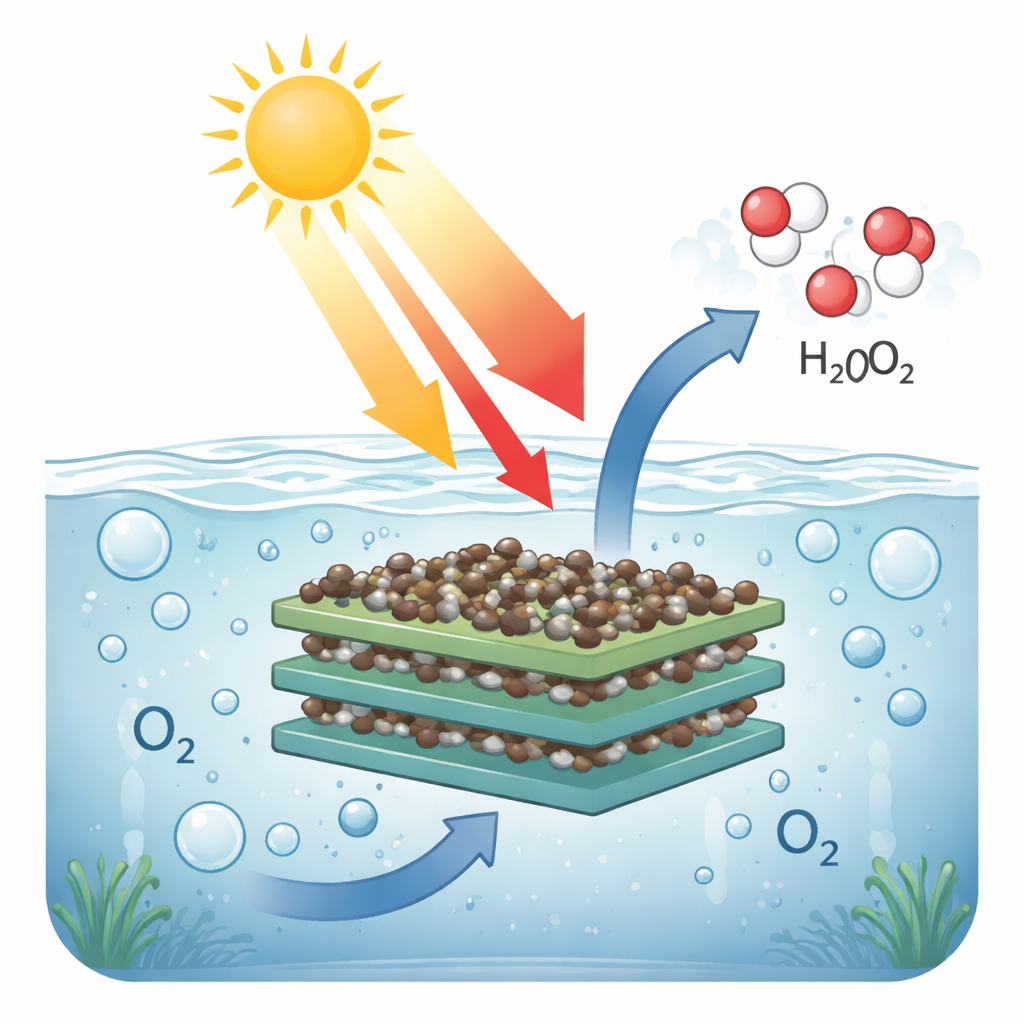
The researchers start from a porphyrin‑based material known as SA‑TCPP, which already absorbs light across a wide range and can make hydrogen peroxide through two routes: reducing oxygen and oxidizing water. They then coat these nanosheets with tiny particles of polydopamine, a dark, pigment‑like polymer inspired by the chemistry of mussel adhesive proteins and melanin. Polydopamine naturally hosts semiquinone radicals—highly reactive, but unusually long‑lived molecular fragments that can shuffle electrons very quickly. When the two components are brought together, hydrogen bonding helps lock the polydopamine particles onto the porphyrin sheets, creating intimate interfaces where light‑generated charges can move efficiently from one material to the other.
How Hidden Electrons Are Put to Work
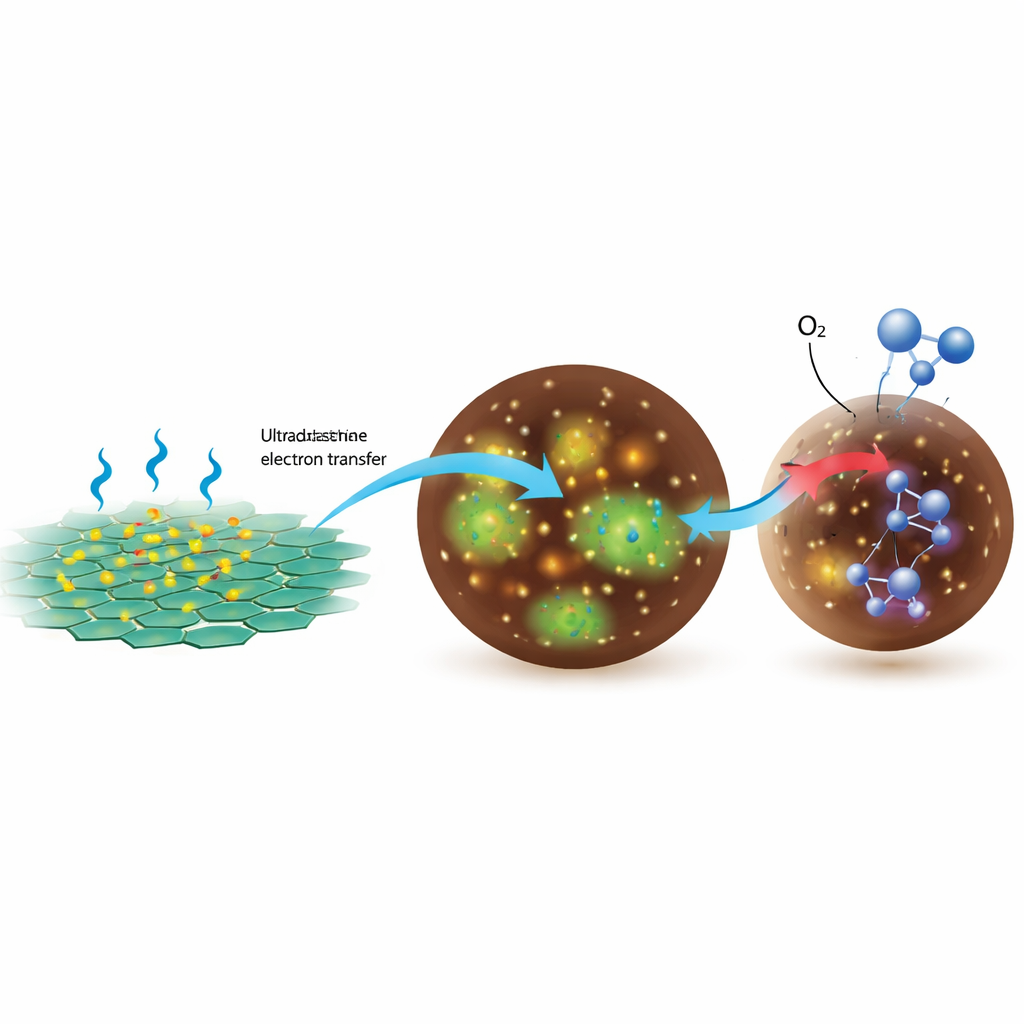
In the bare porphyrin material, electrons excited by near‑infrared light tend to settle into trap states that sit just shy of the energy needed to activate oxygen. They mostly recombine with positive charges instead of doing useful work. The addition of polydopamine changes this story. Detailed optical and electrical measurements show that, in the combined system, these trapped electrons are snatched away in tens of femtoseconds—quadrillionths of a second—by the semiquinone centers in polydopamine. Once there, they help form short‑lived oxygen‑containing radicals on the polydopamine surface. These radicals, in turn, are much more easily converted into hydrogen peroxide when additional electrons arrive, all without the intermediates leaking back into solution and undoing the progress.
From Microscopic Process to Macroscopic Output
This ultrafast hand‑off of energy‑poor electrons has clear macroscopic consequences. Under full‑spectrum simulated sunlight, the composite material produces hydrogen peroxide at 3.37 millimoles per hour with a solar‑to‑chemical efficiency of 2.2 percent, placing it among the best metal‑free systems reported so far. Strikingly, purely near‑infrared light—wavelengths above 800 nanometers—now accounts for almost 30 percent of the total activity, and the system still works out to 1020 nanometers, deep in the infrared. Long‑term tests under both artificial and natural sunlight show stable performance over many hours, and the authors demonstrate a small device in which the in‑situ generated hydrogen peroxide continuously degrades dye and pharmaceutical pollutants in water.
What This Means for Clean Chemistry
At its heart, the work shows that the right molecular “middlemen” can rescue low‑energy, easily wasted electrons and redirect them into useful chemistry. By harnessing persistent semiquinone radicals in polydopamine as ultrafast shuttles, the team turns near‑infrared light—more than half of the solar spectrum—into a productive driver for hydrogen peroxide formation from just water and oxygen. This approach not only points toward safer, more sustainable ways to make a widely used oxidizer, but also offers a general design idea for future solar materials: pair broad‑spectrum light absorbers with built‑in radical sites that can capture, store, and deliver even the weakest photoexcited charges where they are needed most.
Citation: Dou, S., Zhang, Y., Xu, J. et al. Persistent semiquinone radicals enable efficient near-infrared-driven H2O2 photosynthesis. Nat Commun 17, 3333 (2026). https://doi.org/10.1038/s41467-026-70130-x
Keywords: hydrogen peroxide photosynthesis, near infrared photocatalysis, polydopamine semiquinone radicals, porphyrin supramolecular catalysts, solar chemical conversion