Clear Sky Science · en
Strong optical anisotropy in one-dimensional phosphorus wavy tubes
Why this matters for future gadgets
Light is at the heart of technologies from smartphone cameras to high-speed internet, and many of these systems rely on controlling the direction and polarization of light with great precision. This article reports a long-sought phosphorus crystal that naturally bends and filters light very differently along different directions, far more strongly than most known materials. Such extreme, built‑in control over light could shrink polarizers, sensors and photonic circuits down to chip scale, making optical devices faster, smaller and more energy-efficient.
A new twist on a familiar element
Phosphorus is an everyday element—found in fertilizers and even DNA—but it can arrange itself into very different solid forms, or allotropes. For decades, theorists predicted an elusive version, known as Type-II red phosphorus, made of tiny tubular chains packed into a crystal. These tubes were thought to be slightly wavy and asymmetrical, a recipe for very strong directional behavior when light passes through. However, no one had managed to grow crystals large and orderly enough to confirm this structure or to test its optical powers. The authors solved this by developing a carefully tuned chemical vapor transport process that slowly converts ordinary amorphous red phosphorus into thin, orange‑red plates of a new material they call wavy‑tube phosphorus, or wtP.
Seeing the hidden wavy tubes
To verify what they had grown, the researchers combined single‑crystal X‑ray diffraction with advanced electron microscopy. These techniques revealed that wtP has a monoclinic lattice—a low‑symmetry arrangement—built from one‑dimensional tubes that snake through the crystal in a repeating V‑shaped pattern. Each tube is a polygonal ring of phosphorus atoms that bends periodically along its length, and many such tubes lie parallel to each other without being covalently tied together. This independence is crucial: unlike earlier phosphorus forms with straight, tightly coupled tubes, the wavy tubes in wtP maintain their own electronic personality, breaking rotational symmetry and setting the stage for very uneven light responses along different directions. 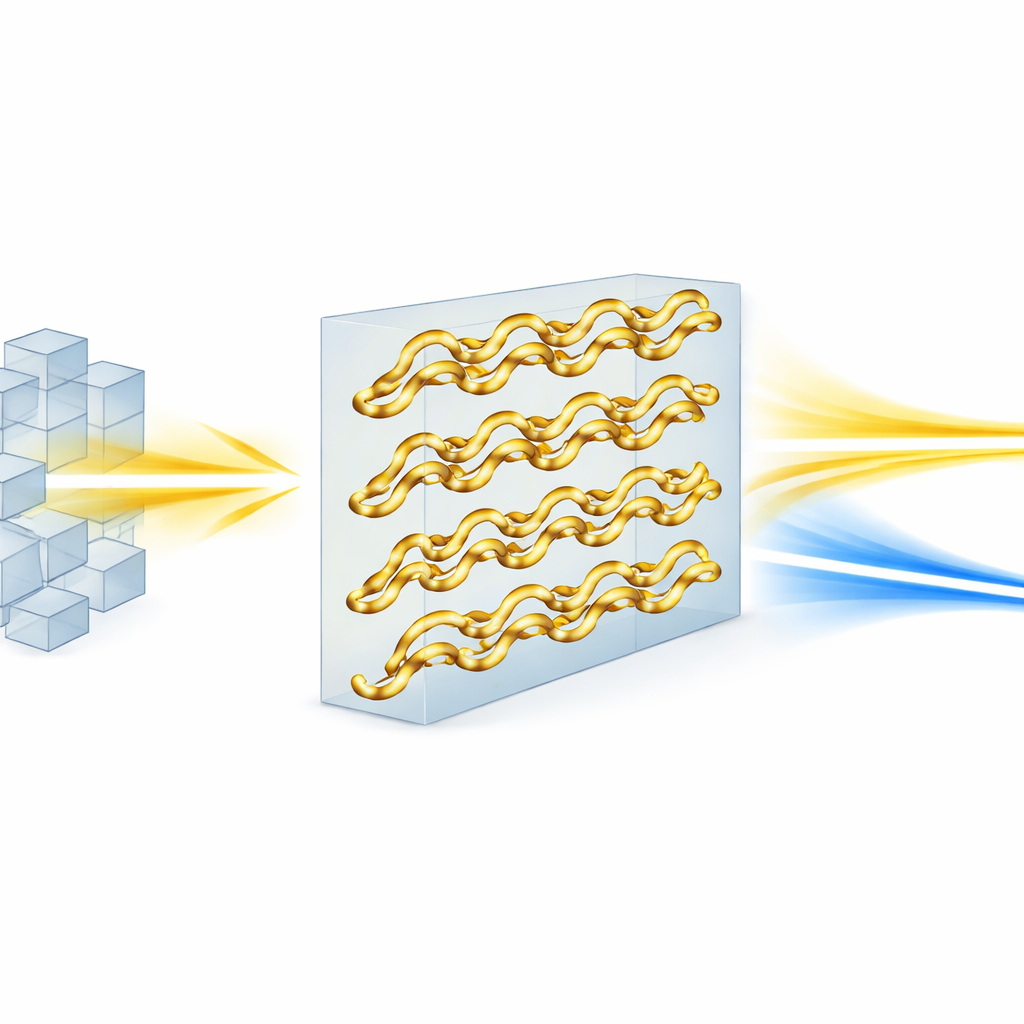
Light behaves differently along the tubes
With the structure in hand, the team turned to how wtP interacts with light. By measuring how the refractive index changes with wavelength and direction, they found that wtP shows “giant” birefringence in the visible and near‑infrared: light polarized along one in‑plane axis travels much more slowly than light polarized along the perpendicular axis. The difference in refractive index reaches nearly one at blue wavelengths—several times larger than classic crystals like calcite and even surpassing many recently engineered anisotropic materials. At the same time, the overall refractive index is very high, meaning wtP can confine light tightly in tiny volumes, a prized property for integrated photonics. 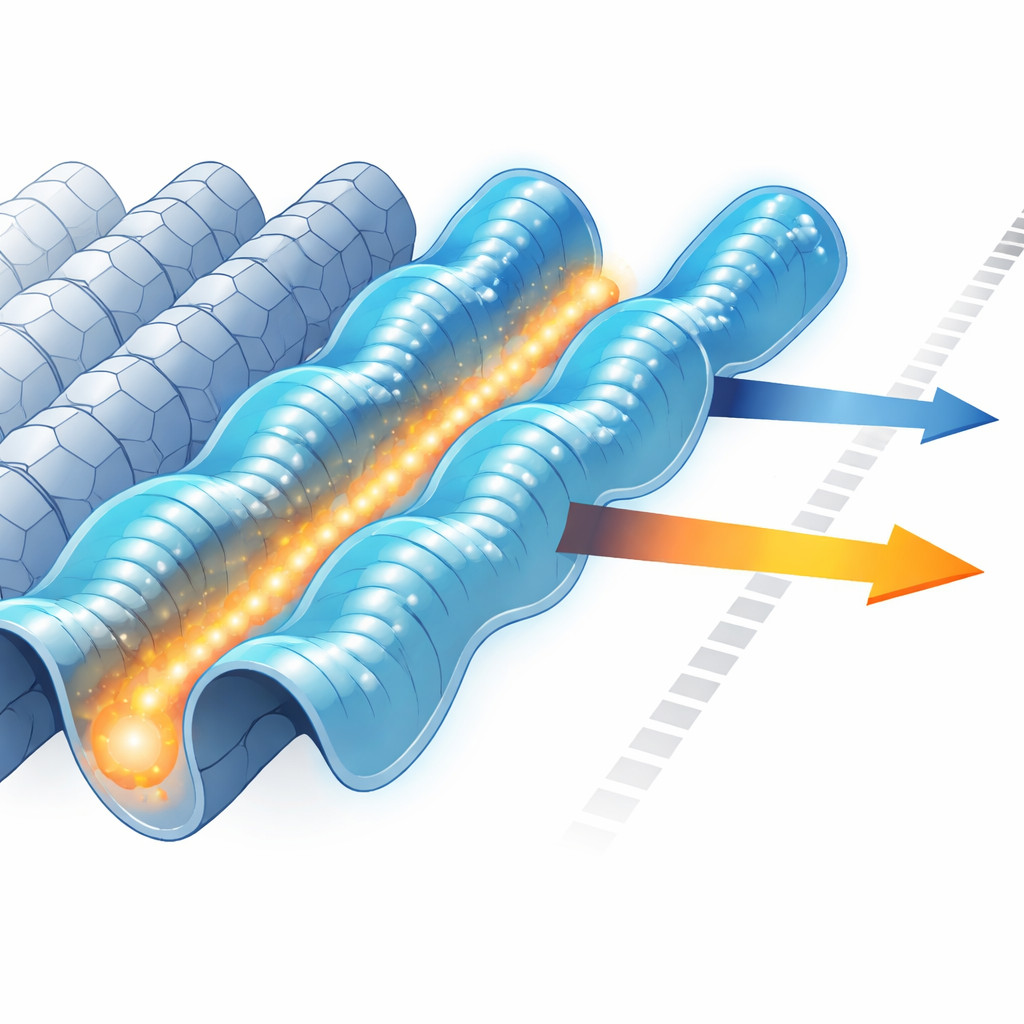
Electrons locked into one‑dimensional paths
The authors used quantum‑mechanical calculations to link this macroscopic behavior to the underlying electrons. They computed the electron localization function, which shows how charges prefer to sit in space, and found strongly localized regions wrapped around each wavy tube and aligned along its direction. The electronic states near the energy gap are dominated by phosphorus 3p orbitals that point along the tubes, creating a highly directional electronic landscape. Because light interacts most strongly with these orbitals, its response depends sharply on whether its electric field is aligned with or across the tubes. This one‑dimensional electronic confinement explains both the exceptionally large birefringence and the material’s classification as a “super‑Mossian” dielectric, one that bends light more strongly than simple rules would predict.
Rich directional signals from vibrations and glow
Beyond passive bending of light, wtP also shows striking direction‑dependent signals when illuminated. Raman scattering, which probes atomic vibrations, produces intensity patterns that swing as the polarization of incoming and outgoing light rotates, reflecting the tube‑based symmetry of the lattice. The crystal also generates strong second‑harmonic light—emission at twice the frequency of the incoming laser—and this nonlinear signal is highly sensitive to polarization. Likewise, the material’s own light emission, or photoluminescence, at red wavelengths varies dramatically with polarization, showing a linear dichroism higher than many two‑dimensional materials. Together, these effects mark wtP as an unusually versatile building block for devices that need to detect or manipulate the polarization state of light.
What this means going forward
By finally pinning down the long‑debated structure of Type‑II red phosphorus and demonstrating its extreme optical anisotropy, this study turns a theoretical curiosity into a practical platform. The wavy one‑dimensional tubes inside wtP amplify tiny electronic differences into giant, usable contrasts in how light travels, scatters and doubles in frequency. For non‑specialists, the takeaway is that a simple element, arranged in just the right tubular pattern, can outperform many complex compounds in steering polarized light. This opens a path toward compact on‑chip polarizers, polarization‑selective detectors, and nonlinear photonic circuits that rely on the geometry of atomic‑scale tubes rather than heavy chemical engineering.
Citation: Zhang, S., Liu, Z., Jiang, T. et al. Strong optical anisotropy in one-dimensional phosphorus wavy tubes. Nat Commun 17, 3286 (2026). https://doi.org/10.1038/s41467-026-70129-4
Keywords: optical anisotropy, phosphorus crystals, polarization photonics, birefringent materials, one-dimensional materials