Clear Sky Science · en
Lasing-like dynamics with virtual gain driven by complex-frequency excitations
Turning a Passive Device into a Light Amplifier
Lasers usually rely on special materials that actively boost light, much like a loudspeaker amplifies sound. This study shows that you can coax a completely passive optical device—one with no built‑in gain materials—into behaving a lot like a laser, simply by shaping the way you send light into it over time. This unconventional route to laser‑like behavior could help build more efficient sensors, communication links, and energy‑storage devices without the complexity of traditional laser gain media.
Shaping Light Instead of Adding Gain
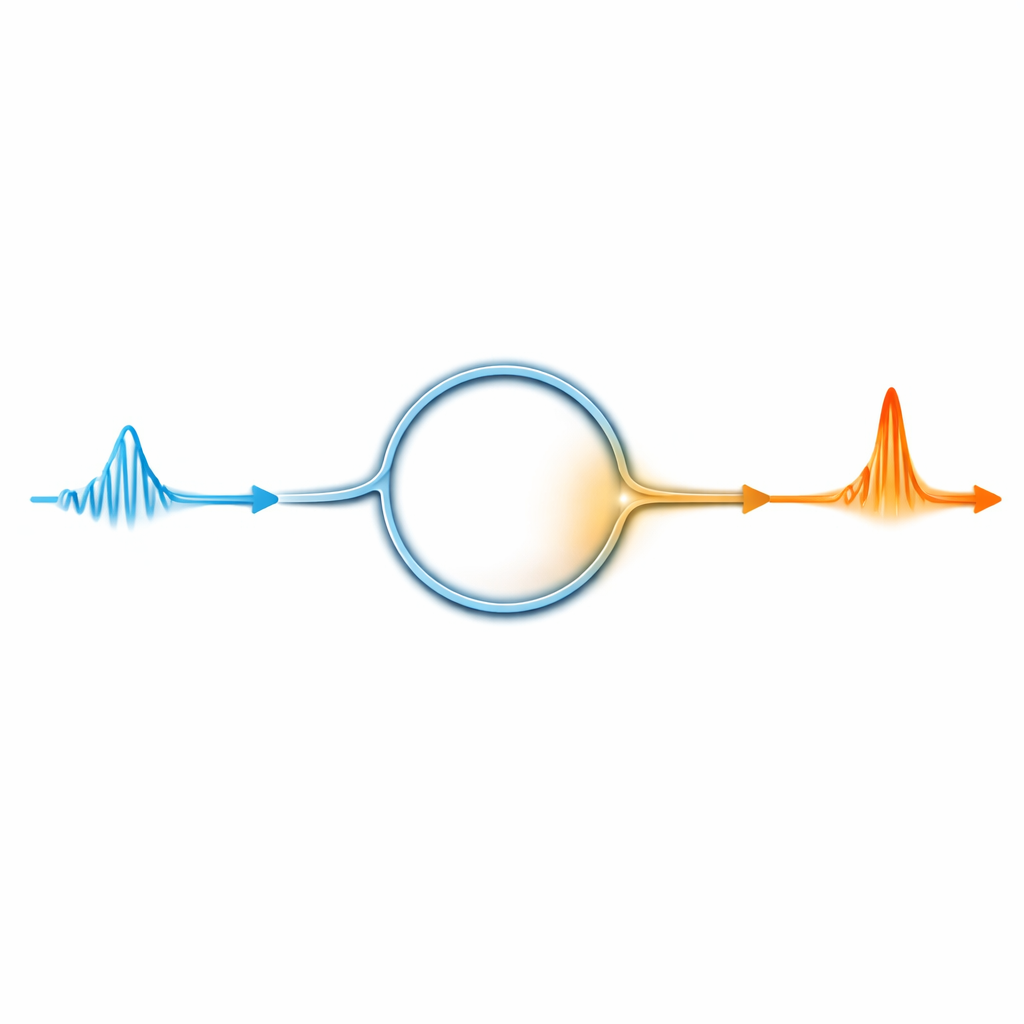
In a standard laser, atoms or molecules are “pumped” so they emit extra light and compensate for losses in the device. Here, instead of adding such a gain medium, the authors use what they call complex‑frequency excitations—carefully designed pulses whose intensity decays exponentially in time. These pulses effectively provide a “virtual gain”: by feeding energy into the system in just the right way while the pulse dies out, they can offset the natural leakage and absorption of light in a passive resonator and control how much light comes back out.
A Tiny Ring that Stores and Releases Light
The team works with a microscopic ring‑shaped device called a whispering‑gallery‑mode microcavity. Light circulates many times around its smooth rim, much like a whisper travels along the curved wall of a dome. The cavity is linked to thin optical fibers that guide light in and out. Because the cavity has an extremely high quality factor, it traps light for a long time before letting it leak away, making it an ideal testbed for subtle energy‑storage and release effects driven by the shaped pulses.

From Gentle Boost to Runaway Growth
By gradually changing how fast the input pulse decays, the researchers tune the strength of this virtual gain. They find three clear regimes in how the output grows during each pulse. With modest virtual gain, the output quickly increases and then settles into a steady amplified level: at each instant, more light comes out than goes in, yet the overall energy is conserved because the input itself is fading. At a critical setting, the output no longer settles; instead, it grows linearly in time, mimicking the exact behavior of a laser at its threshold. When the virtual gain is pushed further, the output grows exponentially during the pulse, in close analogy to a laser that has crossed its threshold and is building up intensity.
Laser‑Like Behavior Without Breaking Energy Rules
Although the instantaneous amplification can be huge, the total energy coming out never exceeds the total energy put in. The apparent “runaway” response arises because the cavity slowly releases energy it stored earlier, while the reference input signal used for comparison is decaying even faster. The authors confirm this with both theory and precise measurements, and even find a relation between linewidth narrowing and output strength that echoes a classic formula from laser physics, further cementing the laser analogy without invoking any true material gain.
Switching Between Perfect Absorption and Amplification
The same platform can also be tuned to do the opposite: nearly swallow the incoming light with almost no reflection or transmission, a regime known as coherent virtual absorption. By adjusting the virtual gain, the system moves smoothly from under‑coupled (mostly transmitting), to critically coupled (strong absorption), to over‑coupled and finally to the lasing‑like regime. This means a single passive microcavity can be reconfigured, purely through pulse shaping, to either hide light or strongly boost it on demand.
Why This Matters for Future Photonics
For non‑experts, the key takeaway is that clever timing can stand in for complicated materials. By engineering how light is sent into a passive structure, the authors unlock behaviors once thought to require active gain media, including laser‑like buildup and perfect absorption. This opens new avenues for compact, tunable devices that control light with great precision—useful for ultrasensitive sensors, information processing, and storing optical energy—without the cost and complexity of traditional lasers.
Citation: Xue, B., Zhang, R., Zhu, Y. et al. Lasing-like dynamics with virtual gain driven by complex-frequency excitations. Nat Commun 17, 3359 (2026). https://doi.org/10.1038/s41467-026-70123-w
Keywords: virtual gain, microcavity lasers, complex frequency excitation, coherent perfect absorption, non-Hermitian photonics