Clear Sky Science · en
Hyperparametric solitons in nondegenerate optical parametric oscillators
Light Pulses that Shape Themselves
Modern communications and sensing rely on light that is not just bright, but exquisitely well organized in color and timing. This paper reports a new way for light to organize itself into tiny, ultra-regular pulses inside a chip-scale device. These special pulses, called hyperparametric solitons, could help generate precise "frequency combs" of light at useful telecom and infrared colors using standard fiber-optic hardware.
Why Tiny Light Combs Matter
Over the last decade, miniature optical resonators on a chip have transformed how scientists generate frequency combs—sets of evenly spaced colors that act like rulers for light. When these resonators are pumped with a laser, they can produce solitons: short, stable flashes that circulate around the resonator and translate into ultra-clean combs in the frequency domain. Such devices promise compact tools for precision timing, distance measurement, spectroscopy, and high-capacity data links. However, most current soliton combs are locked to the pump color in the standard telecom C-band, making it harder to reach other important wavelength ranges without extra hardware.
Reaching New Colors on a Chip
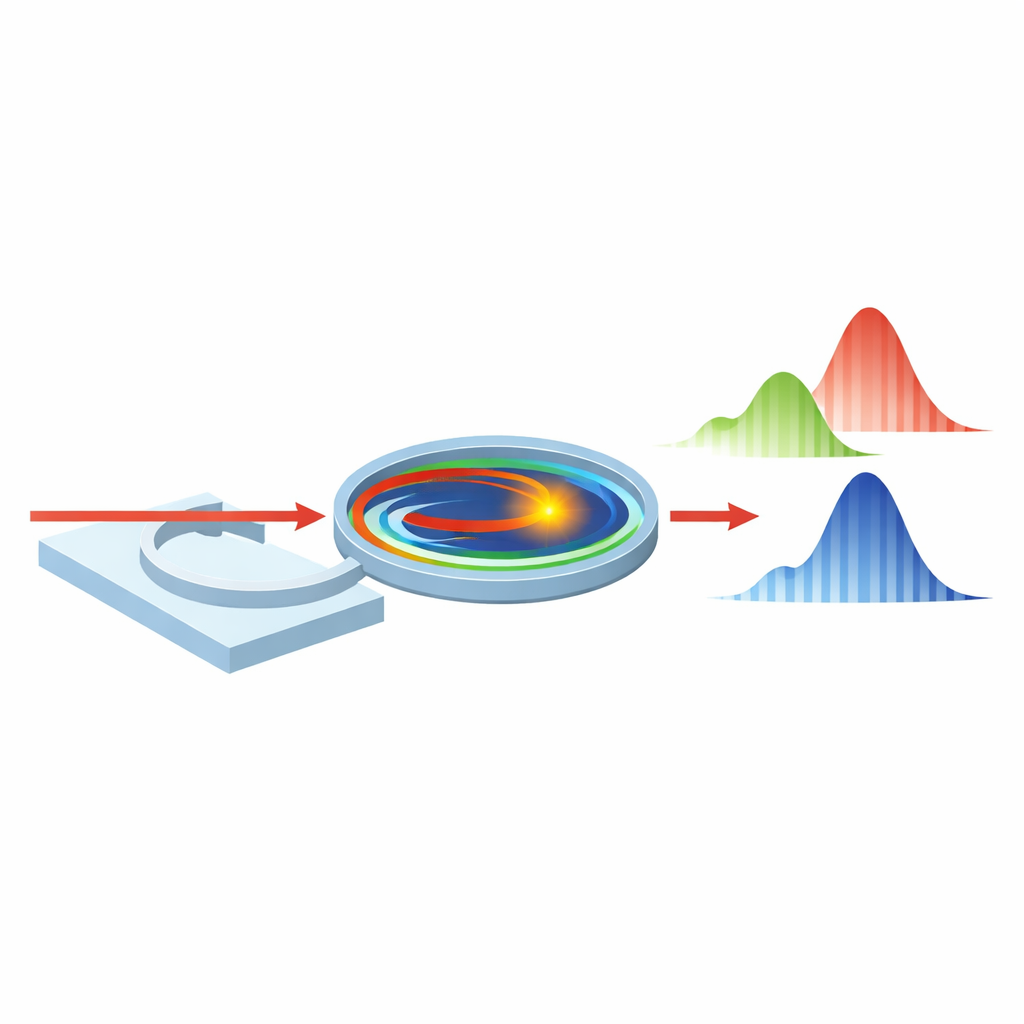
The authors tackle this limitation by using a process called optical parametric oscillation, where one color of light inside a resonator is converted into two new colors, known as signal and idler. Earlier work focused on "degenerate" devices where the new light sits at a fixed frequency determined by the pump, which limits tunability. In contrast, this study uses a "nondegenerate" design: by engineering the geometry and dispersion of a silicon nitride microring resonator, they arrange for the signal and idler to appear far from the pump frequency. Pumping the ring with a C-band laser around 1550 nm produces a signal in the O-band near 1.25 μm—very attractive for data-center links—and an idler beyond 2 μm in the infrared, all on the same chip.
A New Kind of Self-Shaped Pulse
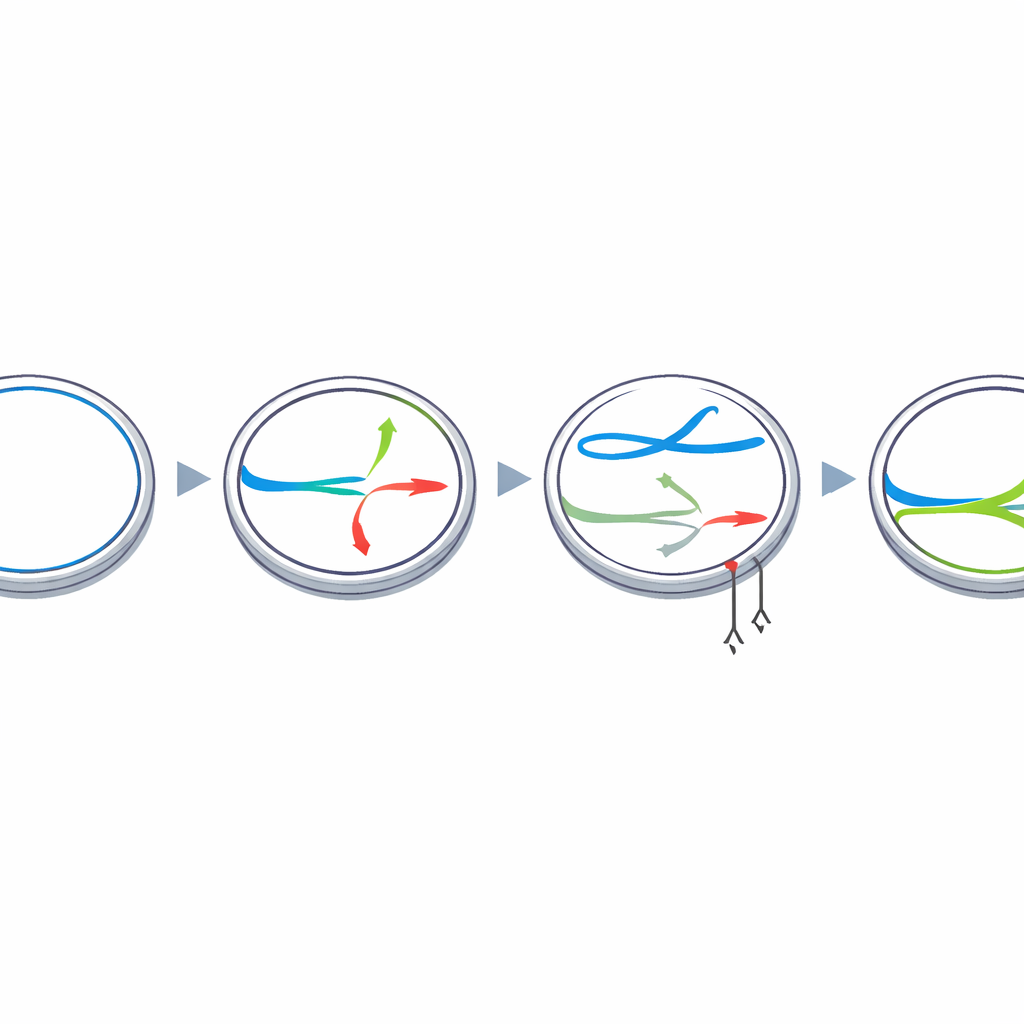
What sets these experiments apart is not just the color shift but the nature of the pulses that form. In earlier parametric soliton systems, the pulses sat on a dark background: away from the pulse, the parametric light essentially vanished. Here, the team observes solitons riding on top of a strong, continuous parametric background that never turns off. Careful design of coupling and loss in the resonator causes the parametric signal to deplete the pump so strongly that two different steady operating states can coexist—a phenomenon called bistability. Numerical modeling shows that one of these states is stable and provides a bright continuous wave, while the other is unstable and breaks up into pulses. The resulting hyperparametric soliton is a bright, short signal pulse sitting on a finite background, while the pump and idler components remain quasi-continuous waves.
Three Colors, One Rhythm
Experimentally, the authors generate three-color frequency combs in which the signal band clearly dominates in power. The repetition rate of the pulses—about 200 GHz—is set by the signal and locks the pump and idler combs to the same rhythm. By tuning either the resonator geometry or the pumped resonance, they shift the signal and idler frequencies over many terahertz, something that degenerate devices cannot easily do. At higher powers and slightly different conditions, the system produces multiple solitons that arrange themselves into regularly spaced "crystals" or more irregular "quasi-crystals," and even breathing states where pulse amplitudes oscillate in time, revealing rich internal dynamics of this new regime.
What This Means for Future Photonics
To a non-specialist, the key message is that the authors have uncovered a new way for light to self-organize inside a microscopic ring so that one color forms sharp, repeatable pulses while two others act as continuous companions. Because this mechanism operates in a flexible, nondegenerate parametric system, it offers a powerful route to generate clean, comb-like light sources at widely separated and tunable wavelengths—all while using standard C-band lasers. This hyperparametric soliton platform could underpin future on-chip light sources for data centers, precision measurements, and advanced experiments that study how many interacting light pulses behave like crystals or other exotic states of matter.
Citation: Weng, H., Ji, X., Ali, M. et al. Hyperparametric solitons in nondegenerate optical parametric oscillators. Nat Commun 17, 3329 (2026). https://doi.org/10.1038/s41467-026-70122-x
Keywords: optical frequency combs, microresonator solitons, nonlinear photonics, optical parametric oscillators, silicon nitride photonics